
A data governance framework is defined as a structured system of people, policies, processes, and technology that controls how an organisation manages, protects, and uses its data assets. The term "data governance framework" is the recognised industry standard; you may also encounter "enterprise data governance model" or "data governance architecture" used interchangeably in regulatory and technical literature. Understanding this structure is not optional for business leaders and data managers. Regulatory obligations under instruments such as Jamaica's Data Protection Act 2020, the GDPR, and HIPAA make a documented, enforceable framework a legal necessity, not a best practice aspiration.
A well-constructed framework comprises six core pillars: roles and accountability, metadata management, data quality, security and access controls, data lineage, and compliance reporting. Each pillar depends on the others. Weak access controls, for example, undermine data quality because unauthorised changes go undetected. Organisations that treat these pillars as independent workstreams consistently produce access silos and management failures.
What are the essential components of a data governance framework?
Governance differs from data management in a precise and consequential way. Data management covers the technical operations of storing, moving, and processing data. Governance provides the rules that determine whether those operations comply with security, quality, and legal requirements. Misalignment between the two produces the access silos and compliance gaps that regulators penalise.

Roles and accountability
Every governance framework assigns four primary roles.
- Data Owner: A senior business leader accountable for a specific data domain. The Data Owner approves access policies and accepts risk on behalf of the organisation.
- Data Steward: A domain expert responsible for day-to-day data quality monitoring, issue resolution, and metadata maintenance.
- Data Custodian: A technical specialist, typically in IT or engineering, who implements the physical controls the Data Owner and Steward define.
- Data Protection Officer (DPO): A legally designated role under instruments such as the GDPR and Jamaica's Data Protection Act 2020, responsible for regulatory compliance and breach notification.
Metadata management
Metadata management includes data catalogues, business glossaries, and data dictionaries. A data catalogue records what data exists, where it lives, and who owns it. A business glossary standardises definitions so that "revenue" means the same thing in finance, sales, and operations. Without these tools, data managers spend significant time resolving definitional disputes rather than generating insight.
Data quality, lineage, and compliance
Data quality standards define acceptable thresholds for accuracy, completeness, consistency, and timeliness. Automated monitoring tools flag records that breach these thresholds before they reach reporting pipelines.
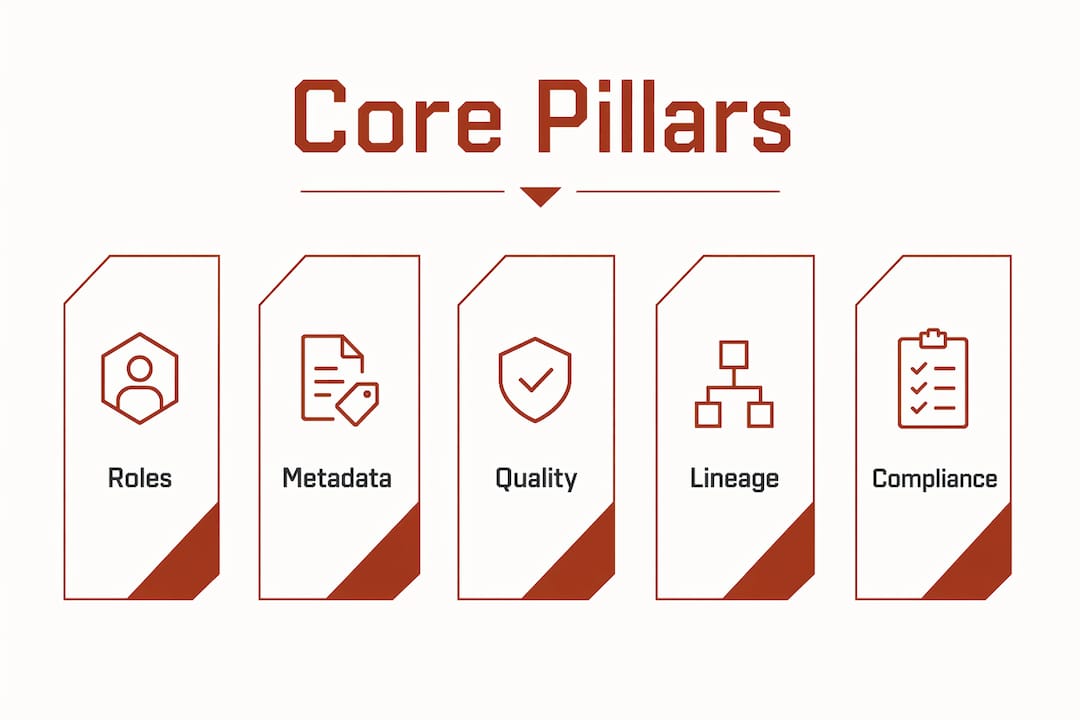
Data lineage traces the origin and transformation of every data element from source to consumption. This traceability is indispensable during regulatory audits, where data controllers must demonstrate exactly how personal data was collected, processed, and stored.
Compliance and regulatory reporting mechanisms translate governance policies into audit trails, consent records, and breach logs aligned to standards including GDPR, CCPA, and HIPAA. These mechanisms are the interface between your internal framework and external regulators.
| Pillar | Primary function | Key output |
|---|---|---|
| Roles and accountability | Assigns ownership and decision rights | RACI matrix, role definitions |
| Metadata management | Catalogues and defines data assets | Data catalogue, business glossary |
| Data quality | Monitors and enforces quality thresholds | Quality scorecards, issue logs |
| Security and access controls | Restricts data access by role and sensitivity | Role-based access control policies |
| Data lineage | Traces data origin and transformation | Lineage maps, audit trails |
| Compliance reporting | Produces regulatory evidence | Audit logs, consent records |
How do modern frameworks balance oversight and operational efficiency?
The most common failure mode in data governance is not insufficient control. It is excessive, undifferentiated control that slows every data request to the pace of a manual approval queue. Risk-based prioritisation resolves this by applying stricter controls where risk and business value are highest, and lighter controls elsewhere. A hospital's patient records warrant encryption, pseudonymisation, and role-based access control. The same hospital's publicly available appointment schedules do not.
Starting small to prove value
Governance programmes that fail to demonstrate measurable business outcomes often stall within 18 months. The remedy is to start with two or three priority data domains, deliver visible improvements in data quality or compliance posture, and then scale. A Jamaican financial services firm, for instance, might begin with its customer identity data domain, resolve duplicate records, and demonstrate a reduction in failed KYC checks before expanding to transaction data.
Automation and policy-as-code
Legacy governance that relies on manual approval workflows cannot scale to modern data volumes. The replacement is policy-as-code: governance rules written as executable logic and enforced automatically at the query and pipeline levels. Tools that implement Model Context Protocol (MCP) allow both AI systems and human analysts to operate under the same enforceable policy set in real time. This closes the gap between a policy document that sits in a shared drive and the actual behaviour of your data platform.
Pro Tip: Tie every governance metric to a business outcome. "Data quality score for customer records" is a governance metric. "Reduction in failed direct debit transactions due to incorrect account data" is a business outcome. Executives fund the latter.
Common pitfalls
Three failure patterns recur across organisations of every size.
- No executive sponsorship. Governance without a Chief Data Officer or equivalent executive champion stalls at the first cross-departmental conflict over data ownership.
- Treating governance as a technology project. Procuring a data catalogue tool before assigning Data Owners produces a well-documented system with no accountability.
- Over-documentation. Frameworks that generate policy documents faster than they enforce them create compliance theatre, not compliance.
What roles and organisational structures support data governance?
Governance success depends on accountability assigned to specific individuals, not to teams or departments in the abstract. The four core roles described above form the operational layer. Above them sits the executive layer.
- Chief Data Officer (CDO): Owns the enterprise data strategy and chairs the data governance council. The CDO translates governance requirements into board-level language and secures budget.
- Data Governance Council: A cross-functional body of Data Owners and senior business representatives that ratifies policies, resolves escalations, and reviews governance metrics quarterly.
- Executive Sponsor: A C-suite leader, often the CEO or CFO in organisations without a CDO, who provides political authority when governance decisions conflict with departmental interests.
Embedding governance responsibilities within business domains, rather than centralising them in a dedicated governance team, prevents the bottleneck problem. When the finance domain owns its data quality obligations, the governance team acts as a standard-setter and auditor rather than an operational gatekeeper.
Pro Tip: Do not wait for a perfect organisational structure before assigning Data Owners. Assign provisional ownership to the most senior person who uses the data daily. Refine the structure as governance matures.
AI agents now automate classification, lineage mapping, and access policy enforcement tasks that previously required manual stewardship hours. This does not eliminate the need for human Data Stewards. It redirects their effort from routine classification to exception handling, policy design, and stakeholder communication.
How to implement a data governance framework that delivers measurable value?
Clear data ownership must be established before any tool is procured or any quality initiative is launched. Organisations that reverse this sequence produce documentation without accountability. The Data Owner for each priority domain must be named, briefed on their obligations, and empowered to make access decisions before a single policy is written.
Implementation sequence
The sequence below reflects current best practice for organisations building a framework from the ground up.
- Define scope. Select two or three data domains with the highest regulatory risk or business impact.
- Assign ownership. Name a Data Owner, Data Steward, and Data Custodian for each domain.
- Audit current state. Map existing data flows, quality issues, and access patterns for each domain.
- Codify policies. Write governance rules as executable logic, not prose documents, and integrate them into your data platform.
- Monitor and report. Establish quality scorecards and compliance dashboards. Review them in governance council meetings.
- Scale. Expand to additional domains once the first cohort demonstrates measurable improvement.
Governance as a living system
Treating a data governance framework as a compliance checkbox is the surest way to render it obsolete within two years. Custom frameworks aligned with internal workflows and ownership structures consistently outperform off-the-shelf governance strategies. Business needs change, regulations evolve, and data volumes grow. Your framework must include a formal review cycle, typically quarterly for metrics and annually for policy architecture, to remain effective.
| Governance approach | Characteristic | Typical outcome |
|---|---|---|
| Documentation-only | Policies in documents, manual enforcement | Compliance theatre, audit failures |
| Tool-first | Platform procured before ownership assigned | Unused catalogue, no accountability |
| Policy-as-code | Rules enforced at pipeline and query level | Consistent enforcement, audit-ready |
| Domain-led, executive-sponsored | Ownership in business, CDO at board level | Sustained adoption, measurable ROI |
For organisations operating under Jamaica's Data Protection Act 2020, the legal gap between local obligations and the reach of foreign cloud law adds a further dimension. Understanding Jamaica's DPA versus US law is a prerequisite for any data controller designing cross-border data transfer policies within their governance framework.
Key takeaways
A data governance framework succeeds when it assigns clear ownership, enforces policies as executable code, and ties every governance metric directly to a measurable business outcome.
| Point | Details |
|---|---|
| Define ownership first | Assign Data Owners to priority domains before procuring tools or writing policies. |
| Apply risk-based controls | Apply stricter controls to high-risk, high-value data domains and lighter controls elsewhere. |
| Codify policies as executable rules | Enforce governance at the query and pipeline level, not through static documents. |
| Start with two or three domains | Demonstrate measurable outcomes in a limited scope before scaling enterprise-wide. |
| Secure executive sponsorship | A CDO or equivalent champion is the single most reliable predictor of governance adoption. |
Why governance is an accountability problem, not a technology problem
The most persistent misconception I encounter is that data governance is fundamentally a technology challenge. Organisations invest in data catalogues, lineage tools, and quality platforms, and then discover that adoption is poor and accountability is absent. The technology was never the constraint.
What actually determines whether a governance framework succeeds is whether specific individuals feel genuinely accountable for specific data assets. I have seen organisations with no dedicated governance tooling maintain excellent data quality because a senior Data Owner took personal ownership of the domain and enforced standards through direct management authority. I have also seen organisations with enterprise-grade platforms produce audit failures because no one could name the Data Owner for a critical dataset.
The second insight that practice confirms is that executive sponsorship is not a nice-to-have. Without a CDO or an equivalent C-suite champion, governance decisions that cross departmental boundaries stall indefinitely. The finance team will not accept data quality obligations defined by the IT team without someone at board level making the case.
Automation through policy-as-code genuinely changes the enforcement equation. When a governance rule is written as executable logic and enforced at the pipeline level, it does not depend on anyone remembering to check a document. That shift from aspiration to enforcement is where most mature governance programmes now focus their investment.
My practical advice is to start with the two data domains that cause the most operational pain or the greatest regulatory exposure. Deliver a visible improvement in those domains within 90 days. That result is your business case for the next phase of investment.
— Michael
Islandedgetech and sovereign data governance for Jamaican organisations
Jamaican organisations face a governance challenge that goes beyond internal policy design. Data stored on foreign cloud infrastructure may be subject to laws such as the US CLOUD Act, which can compel disclosure regardless of where the data physically resides. That legal exposure sits outside the scope of any internal governance framework.
Islandedgetech addresses this through its sovereign cloud infrastructure, which keeps data resident on Jamaican soil under Jamaican law. Products including EdgePod and Abeng are built to support compliant data operations under the Data Protection Act 2020, giving data controllers a technical foundation that aligns with their governance obligations rather than working against them. For organisations ready to operationalise their data governance framework on infrastructure they fully control, the Groundwork programme provides a structured starting point.
FAQ
What is a data governance framework?
A data governance framework is a structured system of people, policies, processes, and technology that defines how an organisation manages, protects, and uses its data. Its core pillars include roles and accountability, metadata management, data quality, access controls, data lineage, and compliance reporting.
How does data governance differ from data management?
Data governance provides the rules and policies that determine how data must be handled. Data management covers the technical operations of storing, moving, and processing data within those rules.
What roles are required in a data governance framework?
The four primary roles are Data Owner, Data Steward, Data Custodian, and Data Protection Officer. Larger organisations also appoint a Chief Data Officer to lead the governance council and represent data strategy at board level.
How long does it take to implement a data governance framework?
Implementation timelines vary by scope. Organisations that start with two or three priority data domains typically demonstrate measurable outcomes within 90 days. Enterprise-wide rollout commonly takes 12–24 months when governance is treated as a living system rather than a one-time project.
Why do data governance programmes fail?
The three most common causes are the absence of executive sponsorship, procuring technology before assigning data ownership, and treating governance as a documentation exercise rather than an accountability system.