
Digital sovereignty frameworks are defined as structured sets of governance, technology, and legal controls that organisations use to maintain full autonomy over their digital assets, data, and infrastructure. The recognised industry term is "digital sovereignty framework," and it sits at the intersection of data ownership frameworks, organisational policy, and cybersecurity governance. The European Commission's Cloud Sovereignty Framework assesses providers across 48 criteria in 8 categories, with Sovereignty Effectiveness Assurance Levels (SEAL) ranging from SEAL-2 to SEAL-4. Regulations including NIS-2, the AI Act, and the Data Act now require consolidated governance approaches that link risk management, transparency, and technical controllability. Organisations that treat sovereignty as a management discipline rather than a compliance checkbox gain measurable control over cross-border transfers, vendor concentration, and data residency.
1. What are the core components of digital sovereignty frameworks for organisations?
Effective digital sovereignty frameworks rest on four pillars: governance structures, technology controls, legal alignment, and operational sovereignty. Each pillar must reinforce the others. A framework that addresses technology without legal authority, or governance without operational monitoring, produces gaps that foreign regulations or vendor lock-in will exploit.

Governance structures form the foundation. A Digital Sovereignty Board, comprising the CTO, CISO, Data Protection Officer (DPO), and Head of Procurement, performs quarterly reviews on sovereignty posture and vendor concentration risk. Cross-functional integration prevents sovereignty from becoming an isolated IT concern.
Technology controls cover the practical mechanisms:
- Data location: All personal and sensitive data must reside within the jurisdiction specified by the applicable law, such as Jamaica's Data Protection Act 2020 or the EU's GDPR.
- Encryption: Customer-managed encryption keys ensure that the organisation, not the cloud provider, holds decryption authority.
- Vendor diversification: Reliance on a single provider creates a single point of legal and operational failure.
- Open standards: Interoperable formats prevent proprietary lock-in and preserve exit rights.
Legal alignment requires mapping each technology decision to the relevant regulatory instrument. European regulations like NIS-2, the AI Act, and the Data Act require unified governance that avoids duplication and strengthens control. Organisations outside the EU face analogous obligations under their own national frameworks.
Operational sovereignty covers the day-to-day enforcement of the framework through vendor risk monitoring, incident response, and exit planning.
Pro Tip: Map each technology control directly to a named regulation or policy. Controls without a legal anchor are unenforceable and will not survive an audit.
2. Which digital sovereignty maturity models help organisations assess their posture?
Maturity models give organisations a structured way to measure where they stand and where they need to go. The most widely referenced model measures digital sovereignty maturity from Level 1 ("Unaware") to Level 4 ("Sovereign"), covering data inventory, policy enforcement, and vendor diversification at each stage.
| Maturity level | Label | Key characteristics |
|---|---|---|
| Level 1 | Unaware | No data inventory; ad hoc vendor selection; no sovereignty policy |
| Level 2 | Aware | Basic data mapping; initial policy drafts; limited legal involvement |
| Level 3 | Managed | Enforced data residency; DPO engaged; vendor risk register active |
| Level 4 | Sovereign | Full data inventory; customer-managed keys; annual audit cycle; exit plans in place |
Annual evaluations guide organisations through these stages. The European Commission's SEAL scoring system applies a comparable logic to cloud providers, assessing them from SEAL-2 to SEAL-4 based on resilience and autonomy thresholds. Organisations can use SEAL criteria as a procurement filter, requiring providers to demonstrate a minimum SEAL tier before contract award.
Selecting the right target maturity level depends on risk tolerance. A healthcare organisation processing patient records requires Level 4. A small tourism operator may find Level 3 sufficient, provided it enforces data residency and maintains a vendor exit plan. The maturity model is not a pass-or-fail test. It is a roadmap for continuous improvement.
Pro Tip: Conduct your first maturity assessment before selecting any new cloud provider. The assessment output should define your procurement criteria, not the other way around.
3. How to establish governance bodies that maintain digital sovereignty compliance
Governance bodies are the institutional mechanism that keeps sovereignty frameworks active rather than dormant. Without a formal committee structure, sovereignty policies become documents that no one enforces.
The core governance body is the Digital Sovereignty Board. Its membership includes the CTO, CISO, DPO, and Head of Procurement. Each role brings a distinct perspective: the CTO assesses technical feasibility, the CISO evaluates security risk, the DPO monitors regulatory compliance, and the Head of Procurement controls vendor selection.
The Board's functions include:
- Quarterly sovereignty reviews: Assess the current posture against the maturity model, identify regressions, and assign remediation owners.
- Vendor concentration monitoring: Track the percentage of critical workloads held by any single provider and enforce concentration thresholds.
- Regulatory update integration: Translate new legislative developments, such as amendments to the Data Act or national data protection laws, into updated governance criteria.
- Incident escalation: Define the threshold at which a sovereignty breach triggers executive notification and regulatory disclosure.
A Technology Architecture Review (TAR) committee operates alongside the Board. TAR committees hold veto power over new technology procurement decisions that would breach sovereignty thresholds. This veto mechanism is the single most effective control against ad hoc platform adoption that creates foreign legal exposure.
Legal integration is non-negotiable. Legal departments must shift from late-stage compliance reviewers to early governance designers, embedding sovereignty criteria in procurement and project approvals from the outset.
Pro Tip: Give the TAR committee a written mandate that specifies which sovereignty criteria trigger a veto. Vague mandates produce inconsistent decisions and vendor disputes.
4. Which technology and operational strategies best support sovereignty goals?
Technology choices either reinforce or undermine the governance framework. The following practices translate governance policy into enforceable technical controls.
Onshore data residency is the most direct expression of data sovereignty. Organisations must specify, in contract, that all data at rest and in transit remains within the designated jurisdiction. Islandedgetech's EdgePod infrastructure keeps data on Jamaican soil, eliminating exposure to the US CLOUD Act, which can compel American providers to disclose data regardless of its physical location.
Customer-managed encryption keys (CMEK) ensure that the organisation retains decryption authority. If a provider is compelled by a foreign court order, encrypted data without the key is legally and practically inaccessible.
Multi-vendor and open-standards approaches prevent lock-in. Organisations that standardise on open formats can migrate workloads without rebuilding data pipelines, preserving exit rights and negotiating leverage.
Operational sovereignty measures include vendor risk monitoring, exit planning, and data residency enforcement. These are not one-time activities. They require scheduled reviews and documented procedures.
The table below compares technology control categories by sovereignty impact:
| Control category | Sovereignty impact | Implementation priority |
|---|---|---|
| Data residency enforcement | High: prevents foreign jurisdiction exposure | Immediate |
| Customer-managed encryption keys | High: retains decryption authority | Immediate |
| Vendor concentration limits | Medium: reduces single-point failure risk | Short-term |
| Open standards adoption | Medium: preserves exit rights | Short-term |
| Exit plan documentation | High: ensures operational continuity | Immediate |
Integrating technology controls with governance ensures enforceability. A data residency policy that the TAR committee cannot audit is a policy that will be violated.
5. What common pitfalls should organisations avoid when implementing sovereignty frameworks?
The most damaging mistakes in sovereignty implementation share a common root: treating the framework as a technical project rather than a governance obligation.
Organisations frequently err by selecting software or platforms before building the governance stack that includes legal authority and institutional mandates. Technology chosen without governance criteria becomes a sovereignty liability the moment a vendor changes its terms or a foreign court issues a disclosure order.
The most common pitfalls are:
- Treating sovereignty as a compliance checklist: Sovereignty in digital policies must function as a management tool that business units use daily, not an annual audit exercise.
- Delaying legal involvement: Legal teams brought in at the end of a procurement process cannot undo contractual commitments that violate sovereignty criteria. Early legal involvement influences procurement and project decisions from the start.
- Ignoring vendor concentration risk: Organisations that consolidate critical workloads with a single provider create a dependency that no governance policy can fully mitigate after the fact.
- Skipping exit planning: A sovereignty framework without documented exit procedures is incomplete. Exit plans must be tested, not merely written.
- Confusing data localisation with full sovereignty: Storing data locally satisfies residency requirements but does not address encryption authority, vendor legal exposure, or governance accountability.
Each of these errors is correctable before implementation begins. Correcting them after a sovereignty breach is significantly more costly, both financially and reputationally.
Key takeaways
Effective digital sovereignty frameworks require governance authority, legal integration, and technology controls to work together from the outset, not in sequence.
| Point | Details |
|---|---|
| Governance precedes technology | Build the Digital Sovereignty Board and TAR committee before selecting any platform. |
| Maturity models guide progression | Use the Level 1–4 model to set procurement criteria and annual improvement targets. |
| Legal teams belong at the start | Integrate DPO and legal counsel into procurement approvals, not end-stage reviews. |
| Technology controls must be auditable | Data residency, CMEK, and exit plans require scheduled reviews to remain enforceable. |
| Sovereignty is a management discipline | Treat digital governance structures as operational tools, not compliance documents. |
Why governance must come before the technology conversation
I have reviewed sovereignty frameworks across sectors, and the pattern of failure is almost always the same. An organisation selects a cloud platform, signs a multi-year contract, and then asks the legal team to "make it compliant." That sequence is backwards, and it is expensive to reverse.
The insight that changed how I think about this comes from the governance stack concept: legal mandates must precede technology to ensure that automated decisions are traceable and contestable. This is not an abstract principle. It means that before your organisation signs any cloud contract, the DPO must have reviewed the data processing agreement, the TAR committee must have assessed vendor concentration risk, and the Board must have confirmed the provider meets your target SEAL tier.
What I find most underappreciated is the role of maturity assessment as a procurement filter. Organisations that complete a maturity assessment first arrive at vendor conversations with specific, non-negotiable criteria. Those that skip it arrive with a budget and a vague preference for "local hosting," which vendors will satisfy on paper while retaining legal exposure in the fine print.
The organisations that get this right treat sovereignty as a governance stack problem, not a technology problem. They build the board, define the criteria, run the maturity assessment, and then select the technology. That sequence produces frameworks that hold under regulatory scrutiny. The reverse produces frameworks that look good in a slide deck and fail in an audit.
— Michael
How Islandedgetech supports sovereign cloud implementation
Organisations that have completed a maturity assessment and defined their governance criteria need infrastructure that meets those criteria without compromise.
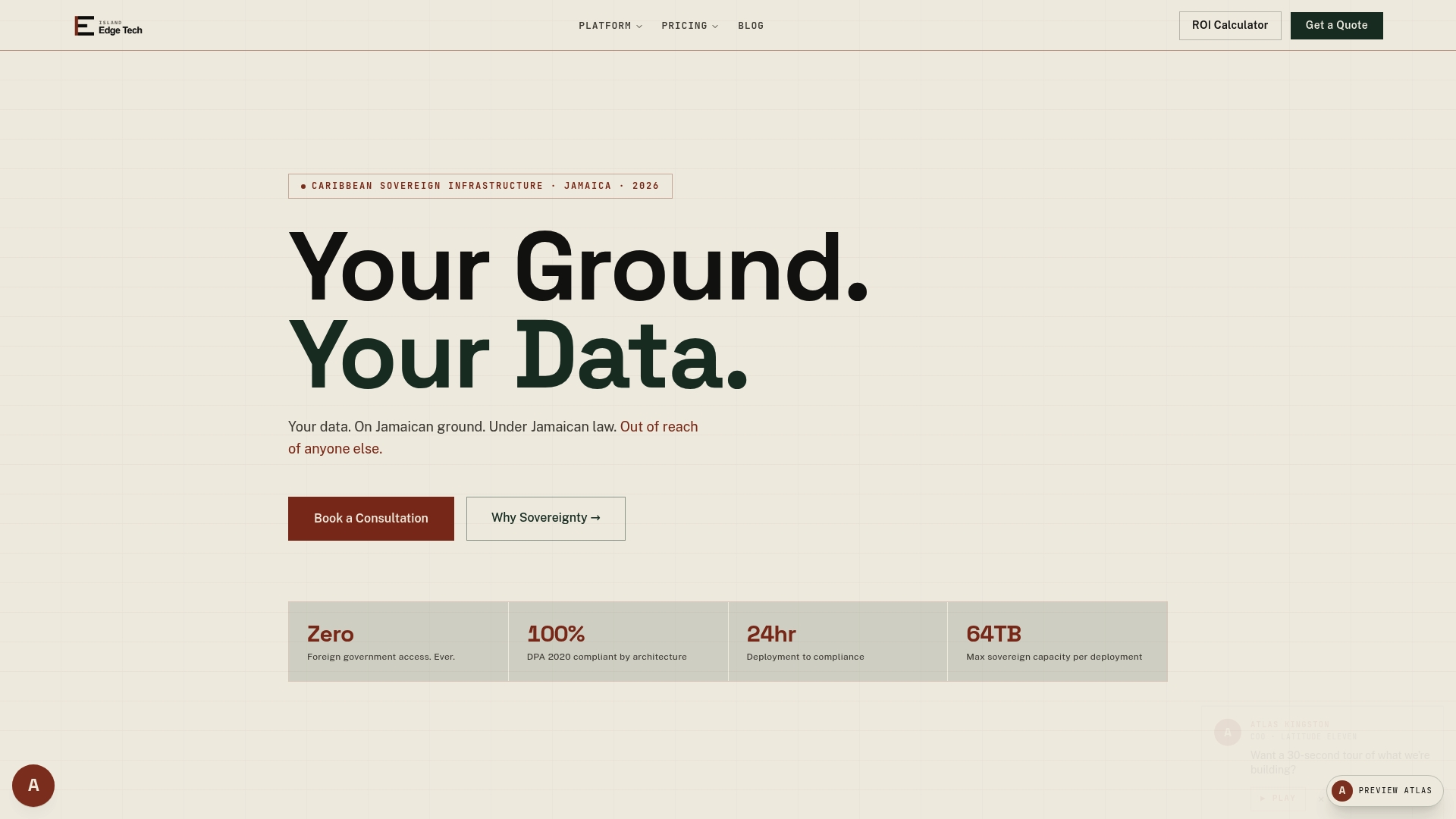
Islandedgetech provides sovereign cloud infrastructure built specifically for Jamaican organisations, with data residency on Jamaican soil under Jamaican law. The EdgePod product eliminates exposure to the US CLOUD Act and aligns directly with Jamaica's Data Protection Act 2020, covering the residency, encryption, and vendor independence criteria that a Level 3 or Level 4 maturity framework requires. Islandedgetech's industry-specific solutions serve healthcare, agriculture, and tourism organisations that carry the highest data sensitivity obligations. For organisations ready to move from governance design to technical deployment, Islandedgetech provides a clear path from compliance roadmap to operational sovereignty.
FAQ
What is a digital sovereignty framework?
A digital sovereignty framework is a structured set of governance, technology, and legal controls that enables an organisation to maintain full autonomy over its data, infrastructure, and digital decisions. It covers data residency, encryption authority, vendor governance, and regulatory alignment.
How does the SEAL scoring system work?
The European Commission's SEAL system rates cloud providers from SEAL-2 to SEAL-4 across 48 criteria in 8 categories. Higher SEAL tiers indicate greater resilience and autonomy, and organisations can use SEAL thresholds as minimum procurement requirements.
Why must legal teams be involved from the start?
Legal teams involved late in procurement cannot undo contractual commitments that create foreign legal exposure. Early integration ensures that sovereignty criteria appear in contract terms, data processing agreements, and vendor selection criteria before any commitment is made.
What is vendor concentration risk in sovereignty frameworks?
Vendor concentration risk is the degree to which an organisation's critical workloads depend on a single provider. High concentration creates a single point of legal and operational failure. Governance frameworks address this through concentration thresholds enforced by the TAR committee.
How does Jamaica's Data Protection Act 2020 relate to sovereignty frameworks?
Jamaica's Data Protection Act 2020 establishes data controller obligations, cross-border transfer restrictions, and residency requirements that form the legal foundation of any sovereignty framework for Jamaican organisations. Compliance with the Act is a baseline, not a ceiling, for organisational data sovereignty.