
Healthcare data compliance is the process of ensuring that healthcare organizations handle patient data securely and in accordance with applicable laws and standards to protect privacy and maintain institutional trust. In Jamaica, this obligation extends beyond good practice. It carries legal weight under the Data Protection Act 2020 (DPA 2020), and for organizations with international exposure, under frameworks like HIPAA and GDPR as well. Healthcare data compliance explained in practical terms means building governance structures, security controls, and operational policies that hold up under regulatory scrutiny. Administrators and clinical leaders who treat compliance as a governance discipline rather than a paperwork exercise are the ones who avoid costly breaches and enforcement actions.
What are the main regulations governing healthcare data compliance?
Healthcare compliance standards in Jamaica center on the Data Protection Act 2020, which governs how data controllers and data processors collect, store, and transfer personal data, including health information. The DPA 2020 establishes rights for data subjects, mandates lawful bases for processing, and restricts cross-border transfers of personal data to countries without adequate protection. Jamaican healthcare organizations that also serve patients in the United States or Europe must layer HIPAA and GDPR obligations on top of local requirements.

HIPAA (the Health Insurance Portability and Accountability Act) applies to covered entities and their business associates handling protected health information (PHI) in the United States. Its three main rules are the Privacy Rule, the Security Rule, and the Breach Notification Rule. The HIPAA Breach Notification Rule requires notifying affected individuals within 60 days and reporting incidents affecting 500 or more individuals to HHS and relevant media. That 60-day window is a hard deadline, not a guideline.
GDPR applies when Jamaican organizations process data belonging to European Union residents. It defines health data as a special category requiring explicit consent or another specific legal basis. GDPR also mandates data protection impact assessments (DPIAs) for high-risk processing activities, a requirement that overlaps with HIPAA's risk analysis obligations.
The table below maps the three frameworks across key compliance dimensions.
| Dimension | DPA 2020 (Jamaica) | HIPAA (United States) | GDPR (European Union) |
|---|---|---|---|
| Scope | All personal data, including health data | PHI held by covered entities and associates | Personal data of EU residents |
| Consent requirement | Lawful basis required | Authorization for certain disclosures | Explicit consent or specific legal basis |
| Breach notification | Notify Commissioner promptly | 60 days; 500+ triggers media notice | 72 hours to supervisory authority |
| Cross-border transfers | Restricted without adequate protection | N/A (domestic focus) | Restricted; adequacy decisions apply |
| Penalties | Fines and criminal liability | Civil and criminal penalties | Up to €20 million or 4% of global turnover |
Understanding where these frameworks overlap is not optional for Jamaican healthcare organizations with international patient populations. A breach affecting EU residents triggers GDPR's 72-hour notification clock simultaneously with DPA 2020 obligations. Administrators must map their data flows before a breach occurs, not after. Reviewing the legal gap between Jamaica's DPA and US law is a practical starting point for that mapping exercise.
What governance and security measures support effective healthcare data compliance?
Governance is the foundation of any credible compliance program. The Office of Inspector General (OIG) identifies seven core elements for an effective compliance program: written policies and procedures, designated compliance leadership, effective training and education, open lines of communication, internal monitoring and auditing, enforcement of standards, and prompt corrective action for identified problems. These seven elements define the structural minimum for healthcare organizations in Jamaica and internationally.
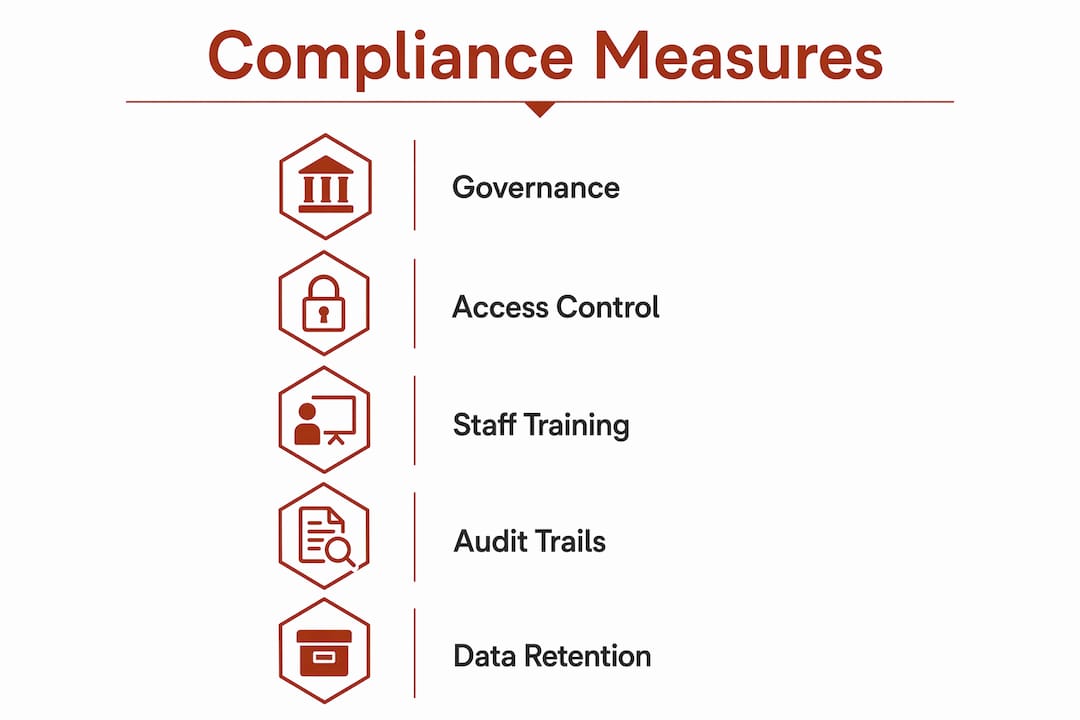
Data governance within healthcare requires assigning data stewardship roles to specific individuals accountable for data quality, access, and security. Without clear stewardship, compliance failures accumulate because no one owns the problem. A data steward in a hospital setting, for example, is responsible for approving access requests, reviewing audit logs, and escalating anomalies to the compliance officer.
Security controls must operate at multiple layers. The critical ones are:
- Encryption of PHI at rest and in transit, using current standards such as AES-256
- Role-based access control (RBAC), which maps data access to specific job functions and logs every interaction
- Risk assessments conducted at least quarterly or semi-annually to identify new vulnerabilities
- Incident response plans that define escalation paths, containment steps, and breach notification workflows
- Continuous monitoring of network activity and access logs to detect anomalies in real time
RBAC with comprehensive audit trails tied to job roles is the single most effective control for reducing unauthorized access. It limits exposure by ensuring that a billing clerk cannot access clinical notes, and that every access event is logged with a timestamp and user identity.
Staff training is not a one-time onboarding task. Healthcare organizations must schedule recurring training cycles, test comprehension, and document completion. When a staff member fails a phishing simulation or violates a data handling policy, the corrective action must be documented and tracked. Regulators look for evidence of enforcement, not just the existence of a policy.
Pro Tip: Maintain a data lifecycle policy that specifies retention periods for each data category, destruction methods, and the staff role responsible for each stage. Regulators frequently cite missing or inconsistent retention policies during audits.
How are emerging technologies reshaping healthcare data compliance risks?
Artificial intelligence introduces compliance risks that static policy frameworks were not designed to address. Medical AI models without verifiable risk mitigation such as differential privacy are vulnerable to membership inference attacks, where an adversary determines whether a specific patient's data was used to train the model. This is a direct privacy violation under HIPAA, GDPR, and the DPA 2020, even if the model never outputs identifiable data directly.
Re-identification is the compliance risk that most healthcare administrators underestimate. A dataset stripped of names and ID numbers is not automatically de-identified under HIPAA's Expert Determination method. If a secondary dataset, such as a public voter roll or insurance claims file, can be joined to re-identify individuals, the original data retains its legal status as PHI. Simple masking techniques are legally insufficient when re-identification remains technically feasible.
Healthcare privacy law is also increasingly fragmented, with new state-level consumer health laws in the United States expanding the definition of health data to include social determinants of health, inferred health conditions, and location data tied to medical facilities. Jamaican organizations that process data for US-based patients or partners must monitor these developments actively.
The practical implication is that compliance programs must move beyond annual checklists. Continuous risk analysis and regular updates are the standard, not the exception. Organizations that conduct only annual assessments leave months-long windows of unaddressed exposure between review cycles.
What practical steps can Jamaican healthcare organizations take to build compliance programs?
A compliance program is only as strong as the processes that sustain it day to day. Jamaican healthcare administrators can build a credible program by following a structured sequence.
- Map all data flows. Identify every system, vendor, and process that touches patient data. Document where data originates, where it is stored, how it moves, and who can access it. This map is the foundation for every subsequent compliance decision.
- Align policies with DPA 2020 and applicable international frameworks. Draft written policies covering data collection, processing, retention, destruction, and cross-border transfers. Policies must reference specific legal bases for each processing activity.
- Adopt a dual-framework approach where applicable. HITRUST CSF and SOC 2 Type II provide comprehensive assurance that satisfies both domestic and international requirements. Organizations handling US patient data should treat HIPAA as the baseline and layer HITRUST or SOC 2 on top.
- Assign data stewardship and custodial roles. Name specific individuals responsible for each data domain. Define their authority, their reporting lines, and the metrics they are accountable for.
- Implement continuous monitoring and scheduled audits. Set quarterly risk analysis cycles. Conduct internal audits of access logs, policy adherence, and vendor compliance at least semi-annually.
- Enforce the 60-day breach notification requirement. Build an incident response plan that triggers immediately upon breach discovery. Assign a notification coordinator and pre-draft template communications for regulators and affected individuals.
- Train staff on a recurring schedule. Document every training session, test result, and corrective action. Compliance officers should review training records before any regulatory inspection.
Pro Tip: When evaluating third-party vendors, require evidence of their own compliance certifications before granting access to patient data. A vendor's SOC 2 Type II report is the minimum acceptable standard for any system that processes or stores PHI.
Sovereign data infrastructure is a practical consideration for Jamaican healthcare organizations that want to eliminate cross-border data transfer risks entirely. Islandedgetech's sovereign cloud platform keeps data resident on Jamaican soil under Jamaican law, removing exposure to foreign legal instruments such as the US CLOUD Act. That structural choice simplifies DPA 2020 compliance significantly by eliminating the cross-border transfer question at the infrastructure level. Healthcare administrators can explore compliance-ready infrastructure options aligned to their operational scale and patient population.
Key Takeaways
Healthcare data compliance requires continuous governance, layered security controls, and clear accountability structures, not a single annual audit or a technology purchase.
| Point | Details |
|---|---|
| Regulatory layering is mandatory | Jamaican healthcare organizations must align with DPA 2020, and HIPAA or GDPR where international exposure exists. |
| OIG's seven elements define the structural minimum | Compliance programs must include policies, leadership, training, auditing, enforcement, risk assessment, and corrective action. |
| RBAC and audit trails reduce unauthorized access | Role-based access control tied to job functions and logged comprehensively is the most effective access governance control. |
| Re-identification risk makes anonymization unreliable | Simple data masking does not satisfy HIPAA's de-identification standard if re-identification via secondary datasets remains possible. |
| Continuous monitoring replaces annual checklists | Quarterly risk analysis cycles and semi-annual audits are the current standard for maintaining defensible compliance. |
Why compliance is a governance problem, not a technology problem
After years of working with healthcare organizations on data governance, the pattern is consistent. Organizations that experience serious compliance failures almost always have adequate technology in place. What they lack is clear accountability. No one owns the audit log review. No one is responsible for vendor contract compliance. The data stewardship role exists on an org chart but carries no real authority.
Technology controls like encryption and RBAC are necessary, but they do not make decisions. A well-configured access control system still fails if the administrator grants excessive permissions because a department head asked informally. The governance layer is what enforces the technology layer. Without documented processes, named accountable roles, and a culture of enforcement, even the best security stack becomes unreliable.
The other pattern worth naming is the false confidence that comes from completing an annual assessment. Organizations that conduct a risk analysis in january and then consider compliance "done" for the year are operating on a model that regulators have explicitly rejected. Compliance is a continuous lifecycle with ongoing risk management cycles and timely remediations. The threat environment changes monthly. Your compliance posture must keep pace.
The most practical advice for Jamaican healthcare administrators is to start with accountability before technology. Name your data stewards. Define their authority in writing. Build your audit trail before you need it for a regulator. The organizations that do this work in advance are the ones that handle incidents without catastrophic consequences.
— Michael
Islandedgetech supports healthcare data compliance in Jamaica
Healthcare organizations in Jamaica face a compliance challenge that is both local and international in scope. Islandedgetech addresses that challenge at the infrastructure level.
Islandedgetech's sovereign cloud infrastructure keeps patient data resident on Jamaican soil, under Jamaican law, and outside the reach of foreign legal instruments like the US CLOUD Act. Products including EdgePod and Abeng support compliance workflows, audit trail management, and data stewardship functions built for the Jamaican regulatory environment. For healthcare administrators who need to satisfy DPA 2020 requirements while managing international data exposure, Islandedgetech provides the infrastructure foundation that makes compliance structurally achievable. Contact the team at islandedgetech.com to assess your current compliance posture and identify the right infrastructure path forward.
FAQ
What is healthcare data compliance?
Healthcare data compliance is the practice of handling patient data according to applicable laws and industry standards, including HIPAA, GDPR, and Jamaica's Data Protection Act 2020, to protect privacy and maintain legal accountability.
What does HIPAA require for breach notification?
HIPAA requires notifying affected individuals within 60 days of a breach. Incidents affecting 500 or more individuals must also be reported to HHS and relevant media outlets.
How does Jamaica's Data Protection Act apply to healthcare organizations?
The DPA 2020 classifies health data as sensitive personal data requiring a lawful basis for processing. It restricts cross-border transfers and mandates prompt notification to the Data Protection Commissioner following a breach.
What is the difference between anonymization and pseudonymization?
Anonymization removes all identifiers so re-identification is impossible. Pseudonymization replaces identifiers with codes but retains a key that allows re-identification. Pseudonymized data remains legally protected health information under HIPAA and GDPR.
Why is a dual-framework approach recommended for healthcare compliance?
A dual-framework approach using HITRUST CSF and SOC 2 Type II provides assurance that satisfies both domestic and international requirements. HIPAA sets the baseline, while HITRUST and SOC 2 address broader security and operational controls that regulators and partners increasingly expect.