
Foreign cloud compliance risk is defined as the legal, regulatory, and operational exposure an organization faces when storing or processing data through cloud services governed by foreign law. For Jamaican business leaders and compliance officers, the stakes are concrete: Jamaica's Data Protection Act 2020 (DPA 2020) imposes binding obligations on cross-border data transfers, while laws like the US CLOUD Act extend foreign government reach into data regardless of where it physically sits. To assess foreign cloud compliance risks accurately, organizations must look beyond server location and examine corporate jurisdiction, regulatory overlap, and the adequacy of technical and contractual safeguards.
How does legal jurisdiction affect foreign cloud compliance risk?
The most consequential misconception in cloud compliance is that storing data in a local data center equals legal protection. Legal jurisdiction follows the vendor's parent company, not the physical location of the server. A Jamaican hospital using a US-incorporated SaaS platform stores patient records in a Jamaican data center but remains fully subject to US law because the vendor's corporate nationality determines legal exposure.
The US CLOUD Act is the clearest example of this principle in practice. It compels US-incorporated companies to produce data held anywhere in the world when served with a valid US court order. This means a Jamaican tourism operator's guest records, or a clinic's patient files, can be accessed by US authorities without the Jamaican organization's knowledge or consent. The DPA 2020 versus US law gap creates a direct conflict that no data center location agreement can resolve.
Two additional risks compound the jurisdictional problem:
- Follow-the-sun support models: Global cloud vendors routinely route support tickets to engineers in the US, India, or Europe. Unless contracts explicitly restrict support access to regional staff, foreign personnel can access locally stored data during routine maintenance.
- Encryption limitations: Encryption protects data content but not metadata. Technical assistance compelled under foreign law can bypass encryption entirely through unreviewable software updates pushed by the vendor.
- Subprocessor chains: Most SaaS platforms rely on third-party subprocessors, each with their own corporate nationality and legal exposure.
- AI service integrations: Cloud platforms increasingly embed AI services from separate legal entities, routing data through jurisdictions not covered by the primary service agreement.
Pro Tip: When evaluating a foreign cloud vendor, request the full corporate ownership structure and the list of subprocessors before reviewing any data center documentation. Jurisdiction follows the parent company, not the building.
What regulatory frameworks must Jamaican businesses consider?
Jamaican organizations operating in sectors like healthcare, hospitality, and finance face a layered regulatory environment when using foreign cloud services. Understanding which frameworks apply, and where they conflict, is the foundation of any foreign cloud risk assessment.
-
Jamaica's Data Protection Act 2020. The DPA 2020 requires that cross-border transfers of personal data occur only to jurisdictions with adequate protections or under approved transfer mechanisms. Data controllers must document the legal basis for every transfer and demonstrate that the recipient country or organization provides equivalent protection.
-
GDPR and UK GDPR. Jamaican businesses that process data belonging to EU or UK residents are subject to GDPR or UK GDPR obligations, regardless of where the business is incorporated. Regulatory penalties can reach €20 million or 4% of annual global turnover for severe violations. The 2023 Meta Ireland fine of €1.2 billion illustrates that enforcement is active and cross-border.
-
Standard Contractual Clauses (SCCs). The EU's SCCs remain the primary contractual mechanism for authorizing data transfers to third countries. Jamaican organizations transferring EU resident data to foreign cloud providers must execute SCCs and conduct a Transfer Impact Assessment (TIA) to validate that the receiving jurisdiction's laws do not undermine the contractual protections.
-
Data Privacy Framework (DPF). US vendors certified under the EU-US Data Privacy Framework provide a recognized transfer mechanism for EU data. Compliance officers must verify active DPF certification status before relying on it, as certification can lapse.
-
China's Data Security Law and PIPL. Jamaican businesses with operations or partners in China face additional restrictions on cross-border data flows under China's Personal Information Protection Law. These regulations can conflict directly with GDPR obligations, creating compliance gaps that require legal analysis.
Annual reassessment of all transfer mechanisms is not optional. Legal landscapes shift, vendor certifications expire, and ownership structures change. A compliance program that was valid in 2024 may be inadequate in 2026 without a formal review cycle.
How to conduct a Transfer Impact Assessment for foreign cloud services
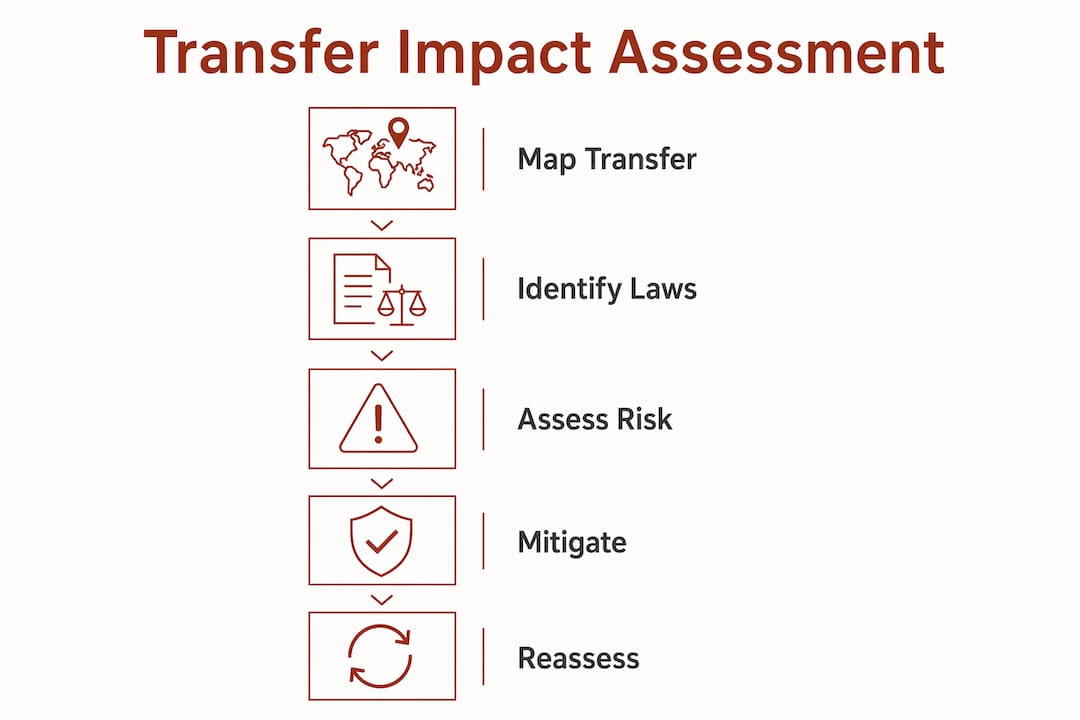
A Transfer Impact Assessment (TIA) is the formal process for evaluating whether a cross-border data transfer exposes personal data to legal risks that contractual safeguards cannot adequately address. The EDPB's six-step TIA methodology is the accepted standard for this evaluation.
- Map the transfer. Document every data flow: what data is transferred, to which country, under which legal basis, and through which vendor and subprocessors.
- Identify the applicable law. For US vendors, assess FISA 702, Executive Order 12333, and the CLOUD Act. For other jurisdictions, identify equivalent surveillance and data access laws.
- Evaluate the legal framework. Determine whether the destination country's laws provide protections essentially equivalent to the originating jurisdiction's standards.
- Assess practical effectiveness. Examine whether the transfer mechanism (SCCs, DPF, binding corporate rules) can realistically protect data given the identified legal risks.
- Implement supplementary measures. Where gaps exist, apply technical controls. End-to-end encryption with exporter-held keys is the most effective technical safeguard, because it prevents the vendor from producing readable data even under legal compulsion.
- Document and reassess. Record all findings, decisions, and safeguards. Reassess whenever the legal landscape changes, the vendor updates its subprocessor list, or a new data category is introduced.
| TIA Step | Key Question |
|---|---|
| Map the transfer | What data goes where, and through whom? |
| Identify applicable law | Which foreign surveillance laws apply to this vendor? |
| Evaluate legal framework | Does the destination provide equivalent protection? |
| Assess practical effectiveness | Can the transfer mechanism withstand legal compulsion? |
| Implement supplementary measures | Are technical controls like encryption with exporter-held keys in place? |
| Document and reassess | Are records current and triggers for reassessment defined? |
Pro Tip: Require vendors to provide machine-readable subprocessor manifests and configure automated alerts for subprocessor changes. Manual tracking of subprocessor updates across a large SaaS portfolio is not reliable.
How to map cloud data flows and evaluate third-party subprocessors
Mapping cloud data flows is the operational core of any cloud compliance audit. Most organizations underestimate the complexity of their SaaS portfolio. A single productivity platform may rely on dozens of subprocessors spanning multiple jurisdictions, each representing an independent compliance risk.

The mapping process starts with a full inventory of every SaaS tool in use, including shadow IT. For each tool, compliance officers must identify the vendor's parent company, country of incorporation, data center locations, subprocessor list, and support access model. This inventory is the foundation of the foreign cloud risk assessment.
Data flows through third-party AI services present a specific and growing risk in hospitality and healthcare. A hotel property management system may integrate with an AI-powered revenue management tool operated by a separate legal entity in a different jurisdiction. Patient data in a healthcare platform may flow through an AI diagnostic service incorporated in the US, exposing it to CLOUD Act jurisdiction even if the primary platform is hosted locally. These integrations are often disclosed only in dense subprocessor annexes that compliance teams rarely review.
A thorough data mapping audit covering all subprocessors and external APIs is critical to uncovering hidden risks. In hospitality and healthcare, the most significant compliance exposures frequently originate not from the primary cloud vendor but from the third-party services embedded within it.
Key risks to document during the mapping process include:
- Ownership changes: Cloud vendors are acquired regularly. A vendor incorporated in Jamaica or the UK today may be US-owned within 12 months, changing its legal exposure entirely.
- Support access geography: Confirm in writing which countries can access your data during support operations and under what conditions.
- API integrations: Every external API call is a potential data transfer. Map API destinations and their corporate nationality.
- AI service routing: Identify whether the platform's AI features are operated by the primary vendor or a third party, and assess the third party's jurisdiction independently.
What ongoing compliance practices are essential after risk assessment?
A completed risk assessment is a point-in-time finding. The legal and vendor environment changes continuously, so compliance programs must include structured ongoing review cycles.
Quarterly security reviews and yearly audits of transfer mechanisms and subprocessors are the minimum standard for organizations handling sensitive personal data. Quarterly reviews should verify that active certifications like DPF remain valid for US vendors and that no material changes have occurred in the vendor's ownership or subprocessor list. Annual audits should revalidate all TIAs, SCCs, and data processing agreements against the current legal landscape.
Key ongoing compliance practices include:
- Automated compliance triggers: Configure monitoring systems to alert compliance teams when a vendor announces a subprocessor change, a legal framework is amended, or a certification lapses.
- Hybrid cloud architecture: US hyperscalers control over 70% of the European cloud market, and digital sovereignty trends favor hybrid models that route sensitive workloads through locally managed sovereign layers. Jamaican organizations can adopt this approach by separating sensitive data categories onto locally controlled infrastructure while retaining foreign cloud services for lower-risk workloads.
- Customer-managed encryption keys: Where full data sovereignty is not achievable, customer-managed encryption keys reduce vendor access to data content. This control has real limits, as metadata remains accessible and software updates can introduce compelled technical assistance.
- Contractual enforcement: Data processing agreements must explicitly restrict support access geography, prohibit unauthorized subprocessor additions, and require notification of legal demands within defined timeframes.
Pro Tip: Quantify compliance risk in financial terms before selecting mitigation measures. A probability-weighted scenario comparing the cost of a DPA 2020 enforcement action against the cost of sovereign infrastructure investment gives leadership a defensible basis for budget decisions.
True sovereignty requires architectural, operational, and human-managed local controls. Contractual protections alone are insufficient when the vendor's legal obligations under foreign law override the contract's terms.
Key Takeaways
Assessing foreign cloud compliance risks requires Jamaican organizations to evaluate vendor corporate jurisdiction, conduct formal Transfer Impact Assessments, and maintain continuous audit cycles rather than treating compliance as a one-time exercise.
| Point | Details |
|---|---|
| Jurisdiction follows the parent company | A local data center does not protect data if the vendor is incorporated under US or other foreign law. |
| TIAs are legally required | Organizations relying on SCCs must complete a six-step EDPB TIA and reassess it annually or after legal changes. |
| Subprocessors multiply risk | Every third-party API and AI integration is an independent compliance exposure requiring its own jurisdiction assessment. |
| Encryption has limits | Encryption protects data content but not metadata, and foreign law can compel technical assistance that bypasses it. |
| Ongoing audits are mandatory | Quarterly certification checks and annual transfer mechanism audits are the minimum standard for continuous compliance. |
What I have learned about foreign cloud compliance in Jamaica
Working through cloud compliance assessments with Jamaican organizations across healthcare, hospitality, and financial services, the pattern I see most often is not ignorance of the law. It is overconfidence in contracts. Compliance officers sign a data processing agreement with a US cloud vendor, note the Jamaican data center option, and consider the matter closed. The CLOUD Act does not care about that agreement.
The second most common pitfall is treating the SaaS inventory as a static document. Vendors update their subprocessor lists quarterly. AI integrations appear in product updates without prominent disclosure. An inventory that was accurate in january may be materially wrong by june. The organizations that manage this well build automated monitoring into their compliance programs from the start, not as an afterthought.
The approach that works is a hybrid sovereignty model: use foreign cloud services where they provide genuine operational value, but route sensitive personal data categories through locally controlled infrastructure with verifiable architectural controls. This is not an all-or-nothing choice. It is a risk-calibrated architecture that matches data sensitivity to the level of legal control the organization can actually verify and enforce.
The economic case for local data sovereignty in Jamaica is stronger than most leaders realize when they factor in regulatory penalty exposure, reputational risk in healthcare and tourism, and the operational continuity benefits of infrastructure that cannot be disrupted by foreign legal proceedings.
— Michael
How Islandedgetech supports Jamaican cloud compliance
Jamaican organizations that have completed a foreign cloud risk assessment frequently identify a gap between what their current vendors can contractually guarantee and what the DPA 2020 and international frameworks actually require.
Islandedgetech addresses that gap directly. The Groundwork sovereign cloud platform provides data residency on Jamaican soil under Jamaican law, with verifiable architectural controls that foreign cloud vendors cannot match contractually. The EdgePod infrastructure delivers the operational and human-managed controls that compliance frameworks require for true sovereignty. The Abeng Work Suite provides productivity tools that keep sensitive workflows within a compliant, locally governed environment. Compliance officers and business leaders managing foreign cloud exposure can contact Islandedgetech to evaluate which sovereign infrastructure components fit their specific risk profile and regulatory obligations.
FAQ
What is a Transfer Impact Assessment and when is it required?
A Transfer Impact Assessment (TIA) is a formal evaluation of whether a cross-border data transfer exposes personal data to legal risks that contractual safeguards cannot adequately address. Organizations relying on Standard Contractual Clauses for data transfers to third countries must complete a TIA using the EDPB's six-step methodology and reassess it annually or whenever the legal landscape changes.
Does storing data in a Jamaican data center protect it from foreign law?
No. Legal jurisdiction is determined by the cloud vendor's parent company incorporation, not the physical location of the data center. A US-incorporated vendor storing data in Jamaica remains subject to the US CLOUD Act, which can compel data disclosure regardless of where the data physically resides.
What are the risks of foreign cloud services for medical records and patient data?
Foreign cloud services expose patient data to the surveillance laws of the vendor's home jurisdiction, including FISA 702 and the CLOUD Act for US vendors. AI service integrations embedded in healthcare platforms can route patient data to additional foreign jurisdictions not covered by the primary service agreement, compounding the compliance exposure.
How often should Jamaican organizations audit their foreign cloud compliance?
Quarterly security reviews and annual audits of transfer mechanisms and subprocessors are the minimum standard. Compliance teams should also configure automated alerts for subprocessor changes, vendor ownership changes, and certification lapses to trigger reassessment outside the regular audit cycle.
What is the difference between data residency and data sovereignty?
Data residency refers to the physical location where data is stored. Data sovereignty refers to the legal jurisdiction that governs access to and control over that data. An organization can achieve data residency in Jamaica while remaining subject to foreign law if the cloud vendor is incorporated in a foreign jurisdiction.
Recommended
- Island Edge Tech | Sovereign Cloud, DPA 2020 Ready
- Data Sovereignty Series | Insights | EdgeTech Jamaica
- Jamaica's Data Protection Act vs US Law: The Legal Gap That Puts Your Data at Risk | EdgeTech Jamaica
- The Economic Case for Caribbean Data Sovereignty: Why Keeping Data in Jamaica Matters | EdgeTech Jamaica