
Student data privacy is the right and practice of protecting personally identifiable information (PII) about students collected within educational settings, governed by laws such as FERPA and supported by technical and organisational safeguards. What is student data privacy in practical terms? It is the legal, technical, and institutional framework that determines who can access student records, under what conditions, and for what purposes. As digital learning platforms, AI tools, and third-party ed-tech vendors become standard in schools, the volume and sensitivity of student data has grown considerably. Educators, parents, and students all carry legal rights and responsibilities in this space, and understanding them is the first step towards genuine protection.
What legal frameworks govern student data privacy?
FERPA (the Family Educational Rights and Privacy Act) is the primary federal law protecting student educational records in the United States. Enacted in 1974, FERPA applies federal standards around PII from education records and requires parental or eligible student consent for most disclosures. Schools that receive federal funding must comply or risk losing that funding entirely.
FERPA includes a critical provision known as the 'school official' exception, which permits access to student data by third-party vendors when those vendors are under the direct control of the school and have a legitimate educational interest. However, without clear, public criteria defining what constitutes legitimate educational interest, enforcement gaps are common. This ambiguity creates real risk for students whose data may be accessed by vendors operating in grey areas.

Complementary laws add further layers of protection. The Protection of Pupil Rights Amendment (PPRA) governs surveys and data collection activities involving students. The Children's Online Privacy Protection Act (COPPA) restricts the collection of personal data from children under 13 by online services. Globally, 144 countries now have comprehensive data protection laws, many aligned with the EU's General Data Protection Regulation (GDPR), which sets a high bar for consent, data minimisation, and individual rights.
The challenge is that legacy laws like FERPA were written before cloud computing, AI, and biometric technology existed. State laws in the U.S. are increasingly filling these gaps, broadening definitions of student data to include metadata and behavioural data generated by ed-tech tools. This patchwork of federal, state, and international rules creates compliance complexity for schools operating across jurisdictions.
Pro Tip: Review your school's data sharing agreements annually against both FERPA requirements and any applicable state laws. A contract that was compliant three years ago may not reflect current legal standards.
What are the common risks to student data privacy?
The risks to student information security are not theoretical. They arise from everyday decisions about which platforms schools adopt and how those platforms handle data.
-
Third-party vendor access. Most ed-tech tools operate under the school official exception, but schools legally remain liable even when parents sign up directly for platforms. A school cannot transfer its legal responsibility to a vendor simply by pointing parents to a terms of service agreement.
-
Terms of service circumvention. FERPA prohibits schools from using Terms of Service agreements to bypass federal privacy protections. Privacy rights cannot be waived as a condition of enrolment or service participation. Schools that allow this practice expose themselves and their students to significant legal and reputational risk.
-
Re-identification of anonymised data. De-identification is not a reliable final safeguard. Datasets can potentially be re-identified through cross-referencing with other large datasets, meaning that anonymised student records are not always as private as they appear.
-
Biometric and AI-generated data. Emerging technologies such as AI and biometric systems generate new categories of student data, including behavioural metadata and biometric identifiers, that current legal frameworks were not designed to address.
-
Parental misconceptions. Parents often believe that once data leaves the school environment, it is fully protected. The legal reality is that the school remains the data controller and retains responsibility for vendor compliance.
The cumulative effect of these risks is significant. A single poorly negotiated vendor contract can expose thousands of student records to misuse, profiling, or unauthorised disclosure.
How do schools protect student data effectively?
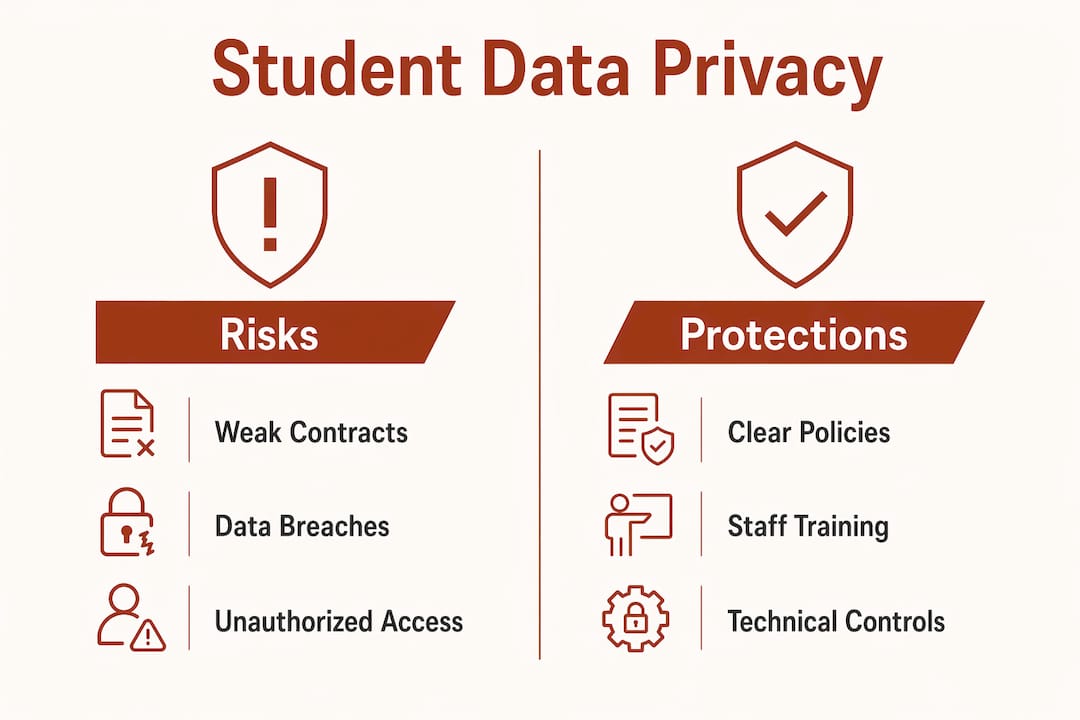
Effective data privacy protection in schools requires a combination of governance, technical controls, and cultural change. No single measure is sufficient on its own.
Governance and vendor management
Schools must establish clear data governance policies that define what data is collected, why it is collected, and who may access it. Every third-party vendor agreement should specify the vendor's obligations as a data processor, including restrictions on secondary use of student data for advertising or profiling. Schools must clearly define and publicly communicate who qualifies as a school official with legitimate access to student records.
Technical safeguards
Technical measures form the operational backbone of student information security. Schools should implement:
- Encryption for data in transit and at rest, preventing unauthorised interception.
- Access controls based on the principle of least privilege, ensuring staff access only the data their role requires.
- Secure data storage on compliant infrastructure, preferably with documented data residency guarantees.
- Audit logs that record who accessed student records and when, enabling accountability.
Data minimisation and retention
Schools should collect only the data they genuinely need. Strict data retention and destruction policies are critical because re-identification risks increase as datasets accumulate over time. Records that are no longer needed should be securely destroyed according to a documented schedule.
Pro Tip: Appoint a designated data protection lead within your school or district. This person should review all new technology procurement decisions before contracts are signed, not after.
Staff training and transparency
Regular staff training on privacy obligations reduces the risk of accidental disclosure. Transparency with parents and students about data collection practices builds trust and supports compliance. Schools that publish clear, plain-language privacy notices demonstrate accountability and reduce the likelihood of disputes.
| Safeguard | Purpose |
|---|---|
| Encryption | Protects data from interception during transfer or storage |
| Access controls | Limits data exposure to authorised personnel only |
| Vendor agreements | Defines legal obligations and restricts secondary data use |
| Data retention schedules | Reduces re-identification risk by limiting data accumulation |
| Staff training | Prevents accidental disclosure and builds a privacy-aware culture |
What rights do students and parents have over educational data?
Students and parents hold defined rights to access, correct, and control educational data under frameworks including FERPA and the GDPR. These rights are not passive entitlements. They require active assertion to be effective.
The core rights include:
- Right of access. Parents and eligible students may request to inspect and review educational records held by the school. Schools must respond within 45 days under FERPA.
- Right to correction. If a record contains inaccurate or misleading information, parents and students may request an amendment. If the school refuses, they have the right to a formal hearing.
- Right to be informed. Schools must notify parents annually of their FERPA rights and explain how data is collected and used. This includes disclosure of which third-party vendors have access to student records.
- Right to opt out. Parents may opt out of certain disclosures, including the release of directory information to third parties.
- Right to erasure. Under frameworks like the GDPR, individuals have an increasing right to request deletion of their data. This right is gaining recognition in education data contexts globally.
Parental awareness and proactive engagement in their child's data rights is critical, as privacy frameworks increasingly require active assertion rather than passive acceptance. Schools have an obligation to make these rights accessible, not buried in policy documents.
How is emerging technology reshaping student data privacy?
Artificial intelligence, biometric identification, and online learning platforms are generating categories of student data that did not exist when FERPA was enacted. This creates a structural mismatch between current legal protections and the realities of modern education.
AI tools used in classrooms collect behavioural metadata, including reading speed, response patterns, and engagement metrics. This data can reveal sensitive information about a student's cognitive profile, learning difficulties, or emotional state. Current privacy laws do not consistently classify this type of data as protected PII, leaving students exposed.
Biometric technologies, including facial recognition used for attendance or exam proctoring, collect identifiers that are permanent and cannot be changed if compromised. These technologies raise privacy concerns and expose gaps in current legal protections that were designed for paper records and simple digital files.
The expansion of online learning has broadened the attack surface for data misuse. Students interacting with multiple platforms simultaneously generate data trails that, when aggregated, can reveal far more than any single data point. State-level laws are increasingly addressing these modern privacy gaps, but federal law has not kept pace.
Schools and policymakers face a clear choice. They can wait for legislation to catch up, or they can adopt privacy-by-design principles now, building data protection into technology procurement decisions from the outset. The latter approach is both more protective and more legally defensible. For context on how Jamaican data law compares to U.S. frameworks, the gap in sovereign data protections is instructive for any institution evaluating its compliance posture.
Key takeaways
Student data privacy requires active legal compliance, technical safeguards, and ongoing stakeholder engagement to protect personally identifiable information from misuse, unauthorised access, and emerging technological threats.
| Point | Details |
|---|---|
| FERPA is the legal foundation | Schools must obtain consent for most disclosures and cannot transfer liability to vendors. |
| Third-party risk is underestimated | Schools remain legally responsible for vendor compliance even when parents sign up directly for platforms. |
| De-identification is not sufficient | Anonymised data can be re-identified; strict retention and destruction policies are necessary. |
| Emerging tech creates new exposure | AI and biometric tools generate data categories not covered by existing legal frameworks. |
| Rights require active assertion | Parents and students must proactively engage with schools to access, correct, and control educational records. |
Why the "set and forget" approach to student privacy fails
Most schools treat data privacy as a compliance exercise completed once a year during a policy review. That approach is structurally inadequate, and I say that having reviewed how institutions across multiple sectors handle data governance.
The core problem is that privacy risk in education is dynamic. Vendors update their terms of service. New tools get adopted mid-year without formal procurement review. Staff change roles and retain access they no longer need. Each of these events creates a gap, and gaps accumulate quietly until a breach or a regulatory inquiry makes them visible.
The overreliance on de-identification is a particular concern. Institutions treat anonymisation as a final safeguard, when the evidence is clear that re-identification is achievable with sufficient cross-referencing. Schools that store large historical datasets without destruction schedules are carrying risk they have not quantified.
What actually works is treating privacy as an operational discipline rather than a compliance checkbox. That means vendor reviews tied to contract renewals, access audits conducted quarterly, and staff training that addresses real scenarios rather than abstract principles. It also means giving parents genuine, usable information about their rights, not a 12-page legal notice written for a solicitor.
The institutions that get this right are the ones that appoint someone with actual authority to say no to a technology procurement decision. Without that, privacy governance is advisory at best.
— Michael
Sovereign data infrastructure for educational compliance
Schools and educational organisations handling sensitive student records face a compliance challenge that generic cloud services cannot reliably solve. Foreign-hosted platforms may be subject to laws like the U.S. CLOUD Act, which can compel data disclosure regardless of where data is physically stored.
Islandedgetech provides sovereign cloud infrastructure designed to keep data on local soil, under local law, and outside the reach of foreign legal compulsion. For Jamaican educational institutions, this means compliance with Jamaica's Data Protection Act 2020 and full data residency guarantees. Products including EdgePod and Abeng are built with data sovereignty at their core. Contact Islandedgetech to discuss how sovereign infrastructure can support your institution's data privacy obligations.
FAQ
What is student data privacy?
Student data privacy is the legal and technical framework protecting personally identifiable information (PII) collected about students in educational settings, governing who may access that data and under what conditions.
What does FERPA protect?
FERPA protects educational records by requiring parental or eligible student consent before schools disclose PII, with limited exceptions including school officials with legitimate educational interest.
Can schools share student data with third-party vendors?
Schools may share student data with vendors under the school official exception, but schools remain legally liable for vendor compliance and cannot transfer that responsibility through terms of service agreements.
How can parents protect their child's school data?
Parents should request annual FERPA notices from their school, review which vendors have access to student records, and actively exercise their rights to access, correct, and opt out of certain data disclosures.
Is anonymised student data fully protected?
No. De-identified datasets can be re-identified through cross-referencing with other data sources, so anonymisation alone is not a sufficient safeguard without accompanying data retention and destruction policies.
Recommended
- Jamaica's Data Protection Act vs US Law: The Legal Gap That Puts Your Data at Risk | EdgeTech Jamaica
- Data Sovereignty Series | Insights | EdgeTech Jamaica
- Where Is Jamaican Data Actually Being Stored? | EdgeTech Jamaica
- The Economic Case for Caribbean Data Sovereignty: Why Keeping Data in Jamaica Matters | EdgeTech Jamaica