
Data sovereignty is defined as the legal principle that data is subject to the laws and governance of the country in which it is collected and stored. For Jamaican resort operators, this principle carries direct and immediate consequences. The data sovereignty advantages Jamaican resorts gain from keeping guest data on local soil include stronger legal protection, reduced breach exposure, and full compliance with Jamaica's Data Protection Act 2020. With full enforcement of the DPA 2020 expected from june 2026 onwards, the window for preparation is closing. Resorts that rely on foreign-hosted platforms face a multi-jurisdictional compliance burden that local data control resolves directly.
1. What are the security advantages of data sovereignty for Jamaican resorts?
Local data control gives resort operators direct authority over who accesses guest information and under what conditions. Jamaican resorts collect some of the most sensitive categories of personal data: passport numbers, payment card details, biometric identifiers used in check-in systems, and behavioural profiles built from loyalty programmes. When that data sits on a foreign server, the resort loses the ability to apply tailored security protocols aligned with Jamaican law.

Data sovereignty allows Jamaican resorts to fully control sensitive guest data, shielding it from foreign government surveillance and reducing breach risk. The Jamaican government is also exploring a data embassy model to strengthen national digital asset protection. That signals a regulatory direction that resort operators should anticipate now, not after enforcement begins.
Key security benefits of local data residency include:
- Jurisdiction clarity: Jamaican law governs access requests, not foreign statutes such as the US CLOUD Act, which can compel American companies to release data regardless of where it is physically stored.
- Tailored access controls: Operators can implement access policies that meet DPA 2020 requirements for data controllers without negotiating with a foreign vendor's compliance team.
- Breach containment: Local infrastructure allows faster incident response because the resort's own technical team holds administrative authority over the environment.
- AI vendor oversight: When AI tools process guest data, local sovereignty keeps that processing within Jamaican jurisdiction, preventing inadvertent cross-border transfers.
Pro Tip: Before signing any AI vendor contract, require a data processing agreement that explicitly restricts processing to Jamaican territory. If the vendor cannot comply, treat that as a disqualifying condition.
2. How data sovereignty simplifies compliance and reduces legal risk
Jamaican resorts face a layered compliance environment that most operators underestimate. A resort serving British, American, and European guests simultaneously must satisfy Jamaica's DPA 2020, the UK GDPR, the EU GDPR, and potentially US state privacy laws such as the California Consumer Privacy Act. Jamaican hotels using foreign-hosted platforms face multi-jurisdictional compliance with all of these frameworks at once. Non-compliance risks include legal action, reputational damage, and loss of international contracts.
The DPA 2020 imposes specific obligations on data controllers, a category that includes every resort that determines the purpose and means of processing guest data. These obligations are not optional and do not transfer to a cloud vendor simply because the vendor hosts the data.
The four compliance obligations every resort data controller must address are:
- Data access control: Documented policies governing who within the organisation can view, edit, or export personal data.
- Retention schedules: Clear rules on how long guest records are kept and when they are securely deleted.
- Breach notification: A tested procedure for notifying the Office of the Information Commissioner and affected guests within the statutory timeframe.
- Cross-border transfer safeguards: Written assessments confirming that any transfer of guest data outside Jamaica meets the adequacy or contractual standards required by the DPA 2020.
The Jamaican Data Protection Act requires treating personal data as a regulated business asset with full accountability and documentation. This is not an administrative formality. Failure to maintain documented governance exposes a resort to enforcement action by the Office of the Information Commissioner, whose budget and staffing were approved in full by the Jamaican government in 2026.
"Many Caribbean hotels wrongly assume foreign cloud vendors manage regulatory risk. Terms-of-service disclaimers routinely shift legal accountability back to the resort. The liability for a data breach sits with the data controller, not the hosting provider."
Establishing a data governance policy in Jamaica is therefore not a matter of best practice. It is a legal requirement with enforceable consequences.
3. What operational and business continuity benefits does local data control deliver?
Operational resilience is one of the most underappreciated data protection benefits for resorts. A foreign cloud outage during peak season can disable property management systems, payment processing, and guest communication simultaneously. Data sovereignty directly supports business continuity by reducing dependency on foreign data infrastructure that is vulnerable to outages or geopolitical disruptions.
Sovereign or federated cloud approaches enable local operations to continue functioning even when international connectivity is degraded. For a Jamaican resort, that means check-in systems, restaurant point-of-sale terminals, and concierge platforms remain operational regardless of what happens to a data centre in Virginia or Frankfurt.
Beyond resilience, demonstrable data governance improves commercial relationships:
- Banking and insurance: Financial institutions and insurers increasingly require evidence of data compliance before extending credit facilities or coverage to hospitality businesses.
- International travel aggregators: Platforms that distribute room inventory to global markets conduct vendor due diligence that includes data protection assessments. Weak compliance leads to delays or outright rejection by these partners.
- Corporate travel accounts: Large corporate clients with their own data protection obligations will not contract with resorts that cannot demonstrate adequate safeguards for employee travel data.
Pro Tip: Prepare a one-page data governance summary that your sales team can share during contract negotiations with travel aggregators and corporate accounts. It signals maturity and accelerates due diligence.
4. Which implementation approaches best suit Jamaican resorts?
The practical path to data sovereignty varies by resort size and existing infrastructure, but the core principle is consistent: guest data must reside on infrastructure governed by Jamaican law. Understanding where Jamaican data is actually stored is the necessary first step before any migration or governance programme begins.
Sovereign cloud versus foreign-hosted platforms
A Jamaica-based sovereign cloud provider keeps data physically on Jamaican soil and contractually subject to Jamaican law. Foreign-hosted platforms, regardless of their compliance certifications, remain subject to the laws of their home jurisdiction. The foreign cloud compliance risks for Jamaican resorts include exposure to the US CLOUD Act, UK Investigatory Powers Act, and equivalent statutes in other jurisdictions where major cloud providers operate.
| Approach | Data residency | Jurisdictional control | DPA 2020 alignment |
|---|---|---|---|
| Jamaica-based sovereign cloud | On Jamaican soil | Full | Direct |
| Regional federated Caribbean cloud | Within Caribbean region | Partial | Requires assessment |
| Foreign-hosted platform | Outside Jamaica | None | Requires contractual safeguards |
Federated Caribbean cloud initiatives
Regional collaboration across Caribbean jurisdictions offers a middle path for resorts that require capacity beyond what a single-island provider can deliver. Small island economies must pivot quickly to regional federated or local cloud models to reduce reliance on conflicting foreign jurisdictions. A federated model distributes data across participating Caribbean nations under agreed governance frameworks, preserving regional control while increasing resilience.
Data-flow mapping as a governance foundation
Before selecting any infrastructure approach, resort operators must map every data flow within their operations. This means identifying where guest data enters the system, which internal departments access it, which third-party vendors receive it, and where it ultimately resides. Implementing GDPR-friendly data practices within a Jamaican legal framework requires this mapping as a prerequisite. Without it, compliance assessments are guesswork and audit responses become reactive rather than prepared.
The DPA 2020 compliance roadmap for a resort should include documented data-flow maps, a data register, assigned data controller responsibilities, and a breach response plan. These are not one-time exercises. They require annual review as vendor relationships and technology stacks change.
Key takeaways
Data sovereignty gives Jamaican resorts legal control over guest data, direct compliance with the DPA 2020, and operational resilience that foreign-hosted platforms cannot guarantee.
| Point | Details |
|---|---|
| DPA 2020 enforcement is imminent | Full enforcement from june 2026 means resorts must have documented governance in place now. |
| Liability stays with the resort | Foreign cloud vendors disclaim responsibility in contracts, leaving the resort as the accountable data controller. |
| Local hosting protects operations | Jamaica-based sovereign cloud eliminates exposure to foreign surveillance laws and vendor outages. |
| Governance improves commercial standing | Documented compliance accelerates due diligence with banks, insurers, and travel aggregators. |
| Data-flow mapping is the starting point | Resorts cannot demonstrate compliance without first knowing where every piece of guest data resides. |
The case for treating data as a regulated asset, not an IT concern
Working with Jamaican organisations across the tourism sector, the pattern I see most consistently is this: data governance is treated as an IT department problem rather than a board-level obligation. That framing is the root cause of most compliance failures.
Hotel executives should transition from viewing data as mere information to treating it as a fully regulated business asset with assigned accountability roles. That shift in mindset changes everything. It moves data protection out of the server room and into the boardroom, where decisions about vendor contracts, AI adoption, and infrastructure investment are actually made.
The resorts I have seen handle this well share one characteristic: they appointed a named data controller before they needed one, not after an enforcement notice arrived. They also piloted local sovereign cloud infrastructure for a single department before committing to a full migration. That phased approach reduces risk and builds internal confidence.
Viewing AI infrastructure as core to operations rather than a software trend is equally important. Every AI tool that processes guest data is a potential cross-border transfer. Local sovereignty is what keeps that processing within Jamaican jurisdiction and within the law. Resorts that get this right will hold a genuine competitive advantage as enforcement tightens and international partners raise their compliance expectations.
— Michael
How Islandedgetech supports Jamaican resorts on the path to data sovereignty
Islandedgetech builds sovereign data infrastructure specifically for Jamaican organisations, with products designed to keep guest data on Jamaican soil and fully compliant with the DPA 2020. The EdgePod infrastructure provides local hosting that eliminates exposure to the US CLOUD Act and equivalent foreign statutes. The Abeng Work Suite delivers productivity tools within a sovereign cloud environment, so resort teams can operate without routing sensitive data through foreign servers.
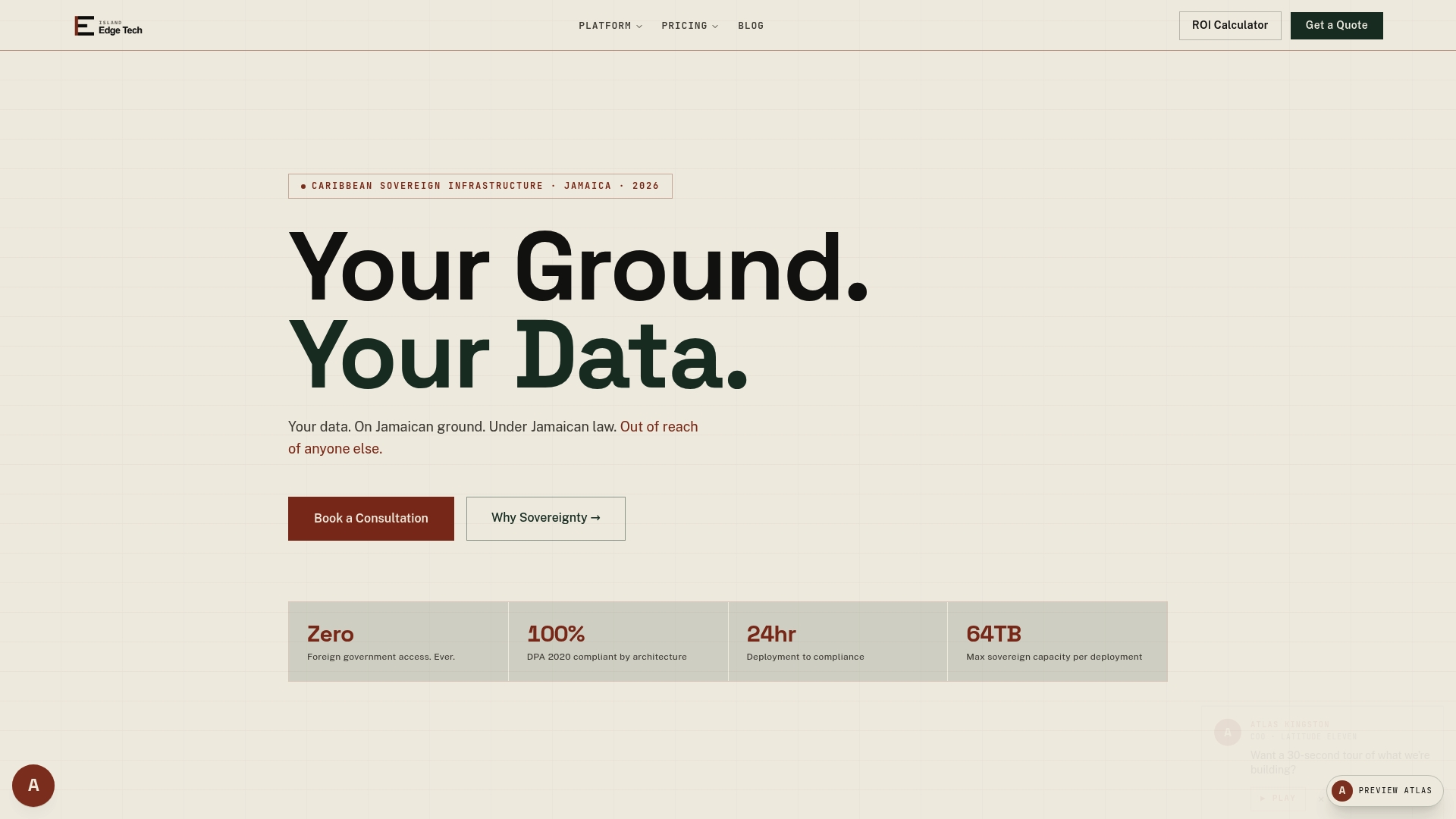
For resort operators ready to assess their current exposure and build a compliance roadmap, Islandedgetech's sovereign cloud solutions are purpose-built for the Jamaican regulatory environment. The platform is DPA 2020 ready and designed to support the full range of data controller obligations, from access control and retention policies to breach notification and cross-border transfer assessments.
FAQ
What is data sovereignty and why does it matter for Jamaican resorts?
Data sovereignty means that data is governed by the laws of the country where it is stored. For Jamaican resorts, it determines whether guest data is protected by Jamaican law or exposed to foreign statutes such as the US CLOUD Act.
When does full enforcement of Jamaica's Data Protection Act 2020 begin?
Full enforcement provisions of the DPA 2020 are expected from june 2026, following the Office of the Information Commissioner's restructuring and budget approval. Resorts that have not established documented data governance by that point face direct enforcement risk.
Are foreign cloud vendors responsible for a resort's DPA 2020 compliance?
No. Foreign cloud vendors routinely disclaim liability in their terms of service, leaving the resort as the legally accountable data controller. The resort bears full responsibility for compliance and breach consequences regardless of where the data is hosted.
What does a basic data governance policy for a Jamaican resort include?
A compliant data governance policy covers data access controls, retention schedules, breach notification procedures, and written safeguards for any cross-border data transfers. These elements are required under the DPA 2020 for all data controllers.
How does data sovereignty affect a resort's relationships with travel aggregators and banks?
Strong data governance accelerates due diligence with international travel aggregators, banks, and insurers. Weak or undocumented compliance leads to delays or rejection during partner onboarding, directly affecting revenue and financing opportunities.