
A data privacy policy in the educational context is defined as a formal, documented framework that governs how a school collects, stores, processes, and shares personal data relating to pupils, staff, and parents. Schools that fail to implement data privacy policy measures face regulatory action from the Information Commissioner's Office (ICO), reputational damage, and, under UK GDPR and the Data (Use and Access) Act 2025, potential financial penalties. The good news is that a structured, phased approach makes full compliance achievable. School districts can establish a functioning data privacy programme within 90 days using a roadmap focused on visibility, data minimisation, and formalised application approvals. That timeline is realistic for most schools when leadership commits to the process from the outset.
What must schools do before implementing a data privacy policy?
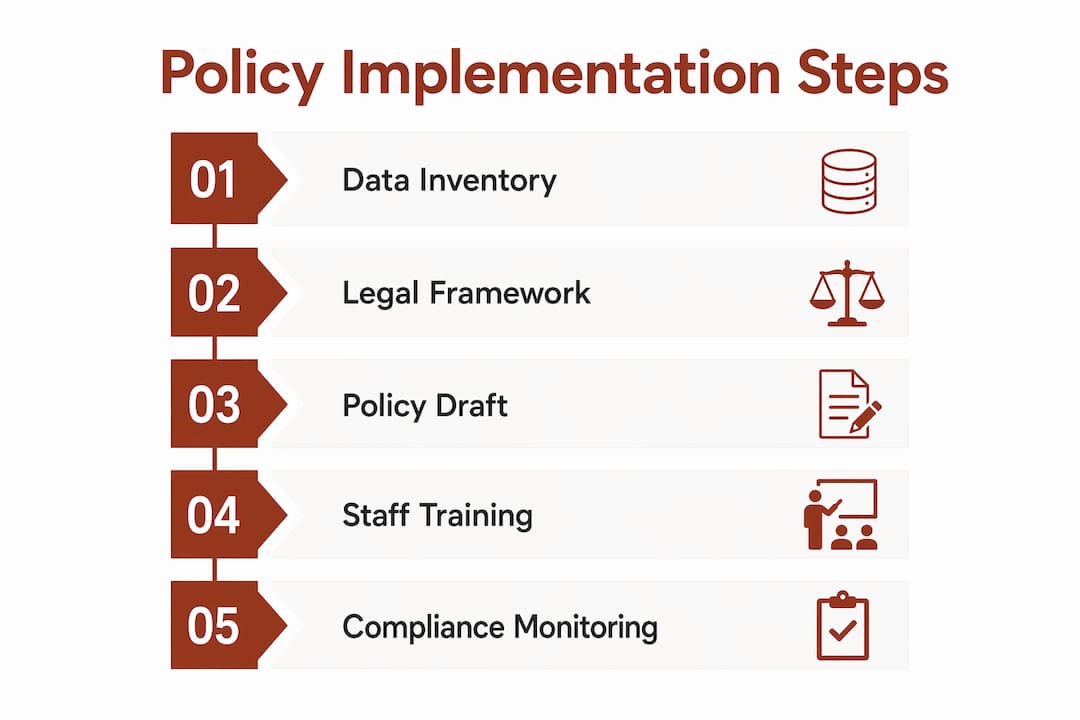
Effective student information privacy measures begin with a clear picture of what data the school already holds. Before drafting a single policy clause, administrators must conduct a full data inventory: catalogue every dataset, identify where it is stored, and map how it flows between systems, staff, and third parties. Without this baseline, any policy will contain gaps that regulators and auditors will find.

Governance structure comes next. Schools operating under UK GDPR are classified as data controllers, which carries specific legal obligations. Appointing a Data Protection Officer (DPO) or a designated privacy lead is not optional for most state schools; it is a statutory requirement. The DPO serves as the internal authority on compliance, advises on Data Protection Impact Assessments (DPIAs), and acts as the primary contact for the ICO.
Stakeholder identification is equally critical at this stage. The relevant parties extend well beyond the IT team and include:
- Senior leadership and governors
- Teaching and support staff who process pupil data daily
- Third-party vendors supplying edtech platforms, catering systems, or HR software
- Parents and guardians, whose consent may be required for specific processing activities
Documentation must be assembled before policy drafting begins. This includes existing privacy notices, third-party contracts, any prior DPIAs, and records of consent. Key foundations for data protection include clear privacy notices, DPIAs for high-risk processing, and standardised Data Processing Agreements. Assembling these documents early prevents duplication of effort and reveals where gaps exist.
Pro Tip: Map your data flows visually using a simple spreadsheet: columns for data type, source, storage location, access rights, and retention period. This single document will underpin your DPIA, your privacy notice, and your vendor contracts.
How to create and formalise your school's data privacy policy
Drafting a school data protection policy is a legal exercise, not merely an administrative one. Every clause must align with UK GDPR principles and, from june 2026, the requirements of the Data (Use and Access) Act 2025. The following steps provide a structured path from blank page to board-approved policy.
-
Define lawful bases for each processing activity. UK GDPR requires schools to identify a lawful basis, such as legal obligation, legitimate interests, or consent, for every category of data they process. Pupil attendance records typically rely on legal obligation; marketing photographs of pupils require explicit consent.
-
Embed Privacy by Design. The principle of Privacy by Design requires that privacy protections are built into systems and processes from the start, not added afterwards. When procuring a new edtech platform, the DPIA must be completed before the contract is signed, not after the tool is already in use.
-
Apply data minimisation. Schools should collect only the data strictly necessary for a defined purpose. Collecting a pupil's home address for a school trip is proportionate; collecting it for a newsletter mailing list is not.
-
Establish vendor assessment protocols. Third-party vendors accessing student data require written contracts that prohibit unauthorised redisclosure without parental consent and limit use to defined educational purposes. Every supplier agreement must include a Data Processing Agreement (DPA) that specifies retention periods, security standards, and breach notification obligations.
-
Define Subject Access Request (SAR) and complaint handling processes. The Data (Use and Access) Act 2025 mandates that schools facilitate and respond promptly to data protection complaints and introduces a 'stop the clock' provision on SAR response deadlines until necessary information is received from the requestor. Schools must document these processes explicitly in the policy.
The table below summarises the core policy components and their legal basis.
| Policy component | Legal basis or standard |
|---|---|
| Lawful basis register | UK GDPR Article 6 |
| Privacy notices for pupils and parents | UK GDPR Article 13 |
| Data Processing Agreements with vendors | UK GDPR Article 28 |
| DPIA for high-risk processing | UK GDPR Article 35 |
| SAR and complaint handling procedure | Data (Use and Access) Act 2025 |
| Breach notification protocol | UK GDPR Article 33 (72-hour rule) |
Pro Tip: Use a data governance framework as the structural backbone for your policy. A governance framework defines ownership, accountability, and review cycles, which transforms a static document into a living compliance tool.
What practical measures ensure ongoing compliance in schools?
A written policy achieves nothing without operational controls to enforce it. Educational institution data security depends on consistent monitoring, regular training, and a tested breach response plan.
Monitoring systems must track who accesses what data and when. Access logs for pupil management systems, HR platforms, and cloud storage should be reviewed at least monthly. Anomalous access, such as a staff member downloading large volumes of pupil records outside normal hours, must trigger an immediate investigation. Recurring security reviews of all third-party integrations are crucial because vendor terms can change and expose schools to data privacy risks without warning.
Staff training is the single most underinvested element of most school privacy programmes. Training must cover:
- How to identify a personal data breach and who to report it to
- The school's lawful bases for processing and what they mean in practice
- How to handle a SAR from a parent or a pupil aged 13 or over
- The risks of using unapproved applications or cloud storage services
- Correct procedures for sharing data with external agencies such as local authorities
Breach response planning requires documented timelines. Under UK GDPR, schools must report a qualifying breach to the ICO within 72 hours of becoming aware of it. That clock starts the moment any staff member recognises a breach, not when it reaches the DPO. The breach response plan must therefore be known to all staff, not just senior leaders.
Governance meetings should be scheduled quarterly at minimum. These meetings review the policy, assess any changes in processing activities, evaluate new vendor contracts, and record decisions formally. Regulators expect comprehensive documentation and rapid, documented action on data breaches and complaints. Minutes from governance meetings serve as evidence of that documented action.
What challenges do schools face when implementing data privacy policies?
Even well-resourced schools encounter predictable obstacles when embedding school data protection guidelines into daily practice. Recognising these challenges in advance allows administrators to address them before they become compliance failures.
-
Shadow IT. Staff and pupils routinely use unapproved applications, from messaging apps to AI writing tools, that process personal data outside any formal agreement. Successful data privacy implementation requires cultural buy-in across all school roles, not just the IT department, to prevent unsanctioned app use and data exposure. The solution is a formal application approval process that is fast enough not to frustrate staff, combined with clear acceptable use policies.
-
Parental consent management. Written parental consent must be documented centrally for all third-party data collection; informal practices create legal risks. Schools that rely on verbal consent or paper forms filed in individual classrooms cannot demonstrate compliance during an audit.
-
Keeping pace with legal change. The Data (Use and Access) Act 2025 introduced new obligations that took effect from june 2026. Schools that treat their policy as a one-time document will fall out of compliance as legislation evolves. Scheduling an annual policy review tied to the academic calendar prevents this drift.
-
Balancing educational innovation with privacy risk. Some of the most pedagogically effective tools carry the highest privacy risk. Schools often restrict use of popular educational tools on school networks when formal data privacy agreements are absent, while allowing parents to use those tools at home to limit institutional liability. This approach protects the school without denying pupils access to beneficial resources entirely.
"Transparent communication with parents and staff is the foundation of a sustainable privacy culture within schools. Open dialogue builds trust and compliance buy-in, even when it requires limiting the use of popular but non-compliant educational applications. Schools that communicate clearly about why certain tools are restricted consistently report stronger stakeholder support for their privacy programme overall."
Key takeaways
Implementing a data privacy policy in schools requires governance structures, legal alignment, and whole-school cultural commitment working together, not in sequence.
| Point | Details |
|---|---|
| Start with a data inventory | Map all data flows and storage locations before drafting any policy clause. |
| Appoint a DPO early | A designated privacy lead is a statutory requirement for most state schools under UK GDPR. |
| Align with 2026 legislation | Update SAR and complaint handling procedures to reflect the Data (Use and Access) Act 2025. |
| Train all staff, not just IT | Shadow IT and accidental breaches originate from staff who lack practical privacy training. |
| Treat compliance as ongoing | Schedule quarterly governance reviews and annual policy updates to stay aligned with legal change. |
Why data privacy in schools is a leadership issue, not an IT issue
Most administrators I encounter still frame data privacy as a technical problem. They assign it to the IT coordinator, purchase a filtering tool, and consider the matter resolved. That framing is the single most common reason school privacy programmes fail.
The evidence is clear. Cultural buy-in across all school roles is what prevents the shadow IT behaviour that creates real exposure. When a classroom teacher uses a free AI tool to generate pupil feedback reports without realising it processes personal data, that is not an IT failure. It is a governance failure rooted in inadequate training and absent leadership communication.
The schools that build genuinely effective privacy cultures share one characteristic: the headteacher or principal treats privacy as a professional value, not a compliance burden. They discuss it at staff meetings. They ask about it when approving new tools. They model the behaviour they expect from others. That leadership signal travels through the organisation faster than any policy document.
My practical advice is to involve your school governors directly in the annual policy review. Governors who understand the school's data obligations ask better questions, approve appropriate budgets, and provide the institutional authority that a DPO alone cannot generate. Privacy governance without board-level engagement is fragile. With it, the programme becomes self-sustaining.
— Michael
How Islandedgetech supports schools with data privacy compliance
Schools managing sensitive pupil and staff data need infrastructure that keeps that data under institutional control. Islandedgetech provides sovereign cloud solutions designed to give educational institutions full data residency and control, removing the compliance risks associated with foreign cloud services subject to laws such as the US CLOUD Act.
The Islandedgetech platform supports schools in managing Data Processing Agreements, documenting compliance workflows, and maintaining audit-ready records. The Abeng Work Suite provides secure, sovereignty-respecting productivity tools that align with data minimisation principles. For school administrators ready to move from policy intention to verified compliance, Islandedgetech offers a tailored data privacy readiness assessment. Contact the team at islandedgetech.com to begin.
FAQ
What is a data privacy policy in a school context?
A data privacy policy in a school is a formal document that defines how the school collects, stores, uses, and shares personal data relating to pupils, staff, and parents, in compliance with UK GDPR and applicable legislation.
Who is responsible for data protection in a school?
The school is the data controller under UK GDPR and must appoint a Data Protection Officer or designated privacy lead. Responsibility for day-to-day compliance sits with all staff, not solely the IT department.
How quickly can a school implement a data privacy programme?
A functioning data privacy programme can be established within 90 days using a phased roadmap covering governance definition, application approval, and operational monitoring.
What does the Data (Use and Access) Act 2025 require from schools?
From june 2026, schools must update their policies to reflect new complaint handling obligations and a 'stop the clock' provision on SAR deadlines until the requestor provides necessary information.
How should schools handle a personal data breach?
Schools must report qualifying breaches to the ICO within 72 hours of becoming aware of them. The breach response plan must be known to all staff, and all decisions must be formally documented.