
Health data residency is defined as the legal obligation to store, process, and audit sensitive health information within a specified geographic jurisdiction, in accordance with applicable national and international law. For Jamaican businesses, the primary framework is Jamaica's Data Protection Act 2020 (DPA 2020), which classifies health data as a special category of personal information requiring heightened protection. Organisations that manage health data residency requirements incorrectly face regulatory penalties, reputational damage, and potential exposure to foreign legal instruments such as the US CLOUD Act. Getting this right demands a structured compliance roadmap that covers data classification, technical controls, documentation, and ongoing audit.
What are the key data residency regulations affecting health data in Jamaica?
Jamaica's DPA 2020 is the governing statute for health data compliance in the country. It designates health information as sensitive personal data and imposes strict obligations on data controllers and data processors alike. Organisations must obtain explicit consent before collecting health data, limit processing to stated purposes, and implement appropriate technical and organisational safeguards.
Cross-border data transfers are permitted only under specific legal mechanisms. These include adequacy decisions, standard contractual clauses, or binding corporate rules. Jamaican businesses that transfer health data to foreign jurisdictions must document the legal basis for each transfer and assess whether the receiving country offers equivalent protections.

International frameworks add further complexity. HIPAA applies to any Jamaican organisation handling health data belonging to US citizens or working with US-covered entities. HIPAA breach notification requires affected individuals to be notified within 60 days of discovery. That 60-day window is a firm legal deadline, not a guideline, and many jurisdictions are tightening it further. The GDPR applies when Jamaican organisations process data belonging to EU residents, adding consent and data minimisation obligations on top of local requirements.
Key regulatory obligations for Jamaican health data controllers include:
- Registering as a data controller with the Office of the Information Commissioner (OIC)
- Maintaining a lawful basis for all health data processing activities
- Implementing breach notification procedures aligned with DPA 2020 timelines
- Restricting cross-border transfers to jurisdictions with adequate legal protections
- Conducting Data Protection Impact Assessments (DPIAs) for high-risk processing activities
- Retaining health data only for as long as operationally and legally necessary
By 2026, 42 countries have enacted laws mandating data storage within national borders. That figure reflects a global tightening of data sovereignty rules that Jamaican regulators are actively tracking.
What technical and organisational controls are needed?
Effective health data management requires layered technical controls that address data at every stage of its lifecycle. Storage location alone does not constitute compliance. True compliance covers the full data lifecycle, including data in use and data in transit, not just where data sits at rest.
The following controls form the foundation of a compliant technical architecture:
- Encryption at rest and in transit. All health data must be encrypted using current standards. Encryption keys should remain under the control of the Jamaican organisation, not a foreign cloud provider.
- Access management and zero-trust architecture. Implement role-based access controls (RBAC) so that only authorised personnel access specific data categories. A zero-trust model treats every access request as unverified until authenticated, regardless of network location.
- Data classification schemes. Classify health data by sensitivity level and residency requirement. This classification drives decisions about storage location, encryption strength, and permissible processing environments.
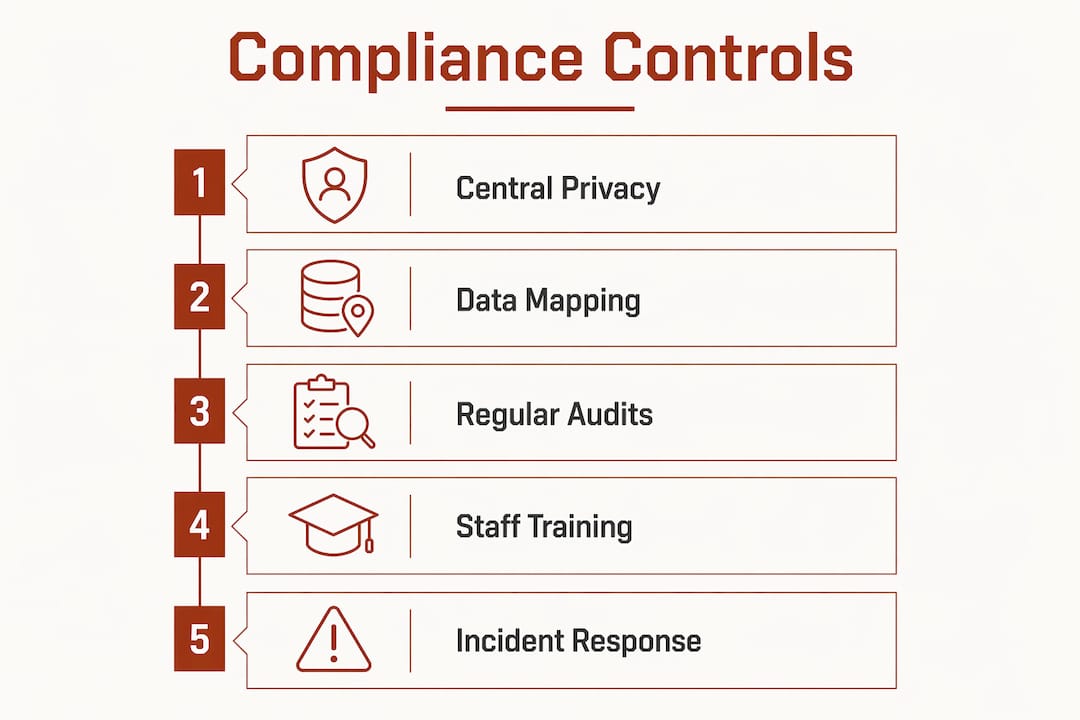
- Audit logging and real-time monitoring. Automated tools must log every access, modification, and transfer event. Layered audits combining automated monitoring, monthly storage reviews, quarterly policy evaluations, and annual comprehensive assessments represent current best practice.
- Vendor and cloud provider assessment. Healthcare organisations must carefully select data centre locations, implement encryption, maintain business associate agreements, and perform regular compliance audits. Any third-party provider must demonstrate compliance with DPA 2020 and relevant international standards before being granted access to health data.
- Pseudonymisation. Where full anonymisation is not possible, pseudonymisation reduces the risk of re-identification and satisfies several DPA 2020 requirements for secondary data use.
Organisationally, HIPAA compliance requires a centralised privacy office with regional expertise and multi-jurisdictional incident response protocols. Jamaican businesses should establish an equivalent function, even if scaled to their size, to coordinate legal, IT, and operational responses to data incidents.
Pro Tip: Conduct a data flow mapping exercise before selecting any cloud provider. Map every point at which health data is created, accessed, transmitted, or stored. This exercise frequently reveals undocumented data flows that create residency violations before a single contract is signed.
How to build documentation and jurisdiction matrices for compliance
Documentation is the audit trail that proves compliance. Without it, even technically sound controls are legally indefensible. The two most critical documentation tools are the jurisdiction matrix and the data register.
A jurisdiction matrix is a single source of truth that tracks every country involved in your data flows, the relevant laws in each jurisdiction, and the legal transfer mechanisms in use. It prevents compliance failures by giving legal and IT teams a shared reference point. A well-maintained jurisdiction matrix also simplifies regulatory inspections, because auditors can verify cross-border transfer compliance without reconstructing the data flow from scratch.
The data register records:
- Data categories and their classification levels
- Storage locations and the legal basis for each location
- Retention periods and deletion schedules
- Third-party processors and their contractual obligations
- Transfer mechanisms for any cross-border data movement
Formal Data Sharing Agreements (DSAs) and Data Processing Agreements (DPAs) must accompany every relationship with a third-party processor. These agreements must specify the data categories involved, the processing purposes, the security standards required, and the procedures for breach notification. Consent management protocols should satisfy the strictest jurisdictional requirements when multiple regions are involved. Designing consent to the highest applicable standard avoids the operational complexity of maintaining separate consent frameworks for each jurisdiction.
Compliance reviews must be scheduled formally, not conducted ad hoc. A practical review schedule looks like this:
| Review type | Frequency | Purpose |
|---|---|---|
| Automated monitoring | Continuous | Detect real-time access anomalies and transfer violations |
| Storage location audit | Monthly | Confirm data remains within approved jurisdictions |
| Policy and procedure review | Quarterly | Align documentation with any regulatory or operational changes |
| Comprehensive compliance assessment | Annual | Full review of controls, documentation, and vendor compliance |
Scheduling these reviews in advance and assigning named owners to each task prevents the documentation drift that causes audit failures.
What challenges do Jamaican businesses face in managing health data residency?
The most common compliance failure is not a technical breach. Documentation drift, where technical implementations diverge from documented policies, is the leading failure point in health data residency programmes. A system that was compliant at deployment can become non-compliant within months if configuration changes are not reflected in policy documents.
Cross-border data transfers present a second category of risk that many organisations underestimate. Foreign analytics tools, cloud-based collaboration platforms, and third-party diagnostic services can all export sensitive health data outside Jamaica without triggering an obvious alert. Managing data in use and in transit is often overlooked, yet foreign analytic tools can export sensitive information and violate residency requirements without any deliberate action by the data controller.
Jamaican businesses also face the challenge of balancing operational efficiency with strict residency controls. Clinicians and administrators need fast access to health records. Residency controls that create access friction reduce clinical effectiveness and encourage workarounds that create compliance gaps.
Practical steps to address these challenges include:
- Deploying automated compliance tracking tools that provide real-time insights and flag geographic data movements as they occur
- Establishing a change management process that requires policy updates whenever technical configurations change
- Vetting all third-party software for data export behaviour before deployment, not after
- Training clinical and administrative staff on residency obligations so that workarounds are recognised as compliance risks
Pro Tip: When assessing a new software tool, ask the vendor to provide a data flow diagram showing every external endpoint the tool communicates with. If the vendor cannot produce this, treat it as a residency risk until proven otherwise.
Under HIPAA, covered entities remain legally responsible for data compliance even when using third-party or international storage. The same principle applies under DPA 2020. Delegating storage to a vendor does not delegate liability.
Key takeaways
Jamaican businesses that manage health data residency requirements effectively combine local regulatory compliance, layered technical controls, and continuous audit into a single, documented programme.
| Point | Details |
|---|---|
| DPA 2020 is the primary framework | All health data controllers in Jamaica must register with the OIC and implement DPA 2020-compliant safeguards. |
| Compliance covers the full data lifecycle | Residency obligations apply to data in use and in transit, not only data stored at rest. |
| Jurisdiction matrices prevent transfer failures | A single, maintained matrix tracking all countries, laws, and transfer mechanisms reduces cross-border compliance risk. |
| Documentation drift is the leading failure point | Automated monitoring combined with quarterly manual reviews catches divergence before it becomes a violation. |
| Vendor liability remains with the data controller | Delegating storage to a third party does not transfer legal responsibility under DPA 2020 or HIPAA. |
Why I think reactive compliance is the most expensive mistake Jamaican health organisations make
Working with organisations across regulated industries, the pattern I see most often is this: a business invests in technical infrastructure, deploys a cloud solution, and then treats compliance as a documentation exercise to be completed afterwards. By the time an audit arrives, the gap between what the system does and what the policy says has grown wide enough to constitute a genuine violation.
Health data residency is not a one-time configuration. Regulations change. Vendors update their infrastructure. Staff change roles and retain access they no longer need. Each of these events creates a compliance risk that only ongoing vigilance catches.
The businesses that manage this well share one characteristic: they treat compliance as an operational function, not a legal formality. They assign named owners to every control. They run monthly storage audits as a matter of routine, not crisis response. They assess foreign cloud compliance risks before signing contracts, not after a breach.
The Jamaican regulatory environment is maturing quickly. The OIC is building enforcement capacity, and international partners are watching how Caribbean jurisdictions handle health data sovereignty. Organisations that build their compliance infrastructure now, on sovereign Jamaican ground, will be far better positioned when enforcement intensifies than those waiting for a regulatory event to prompt action.
The most cost-effective compliance programme is the one built before it is required.
— Michael
How Islandedgetech supports health data residency compliance in Jamaica
Jamaican health organisations that need to store, process, and audit sensitive data within national borders have a direct infrastructure option in Islandedgetech.
Islandedgetech's sovereign cloud infrastructure keeps health data on Jamaican soil, under Jamaican law, and outside the reach of foreign legal instruments such as the US CLOUD Act. Products including EdgePod and Abeng are built for organisations that cannot afford the compliance exposure that comes with foreign cloud providers. Islandedgetech supports compliance documentation, audit facilitation, and secure data management across healthcare and other regulated sectors. For Jamaican health organisations ready to build a defensible, DPA 2020-compliant data programme, contact Islandedgetech to arrange a consultation.
FAQ
What is health data residency under Jamaica's DPA 2020?
Health data residency under DPA 2020 is the requirement to store and process health information within approved jurisdictions using documented legal safeguards. Health data is classified as sensitive personal data and attracts the highest level of protection under the Act.
How does HIPAA affect Jamaican healthcare organisations?
HIPAA applies to any Jamaican organisation handling health data belonging to US citizens or working with US-covered entities. It requires breach notification within 60 days and mandates administrative, physical, and technical safeguards regardless of where data is stored.
What is a jurisdiction matrix and why does a business need one?
A jurisdiction matrix is a document that records every country involved in your data flows, the applicable laws, and the legal transfer mechanisms in use. It serves as a single reference point for legal and IT teams and is a core audit requirement for cross-border health data compliance.
What is documentation drift and how can it be prevented?
Documentation drift occurs when technical systems change but policy documents are not updated to reflect those changes. It is prevented through automated monitoring, a formal change management process, and quarterly manual policy reviews.
Can a Jamaican business use a foreign cloud provider for health data?
A Jamaican business may use a foreign cloud provider only if an adequate legal transfer mechanism is in place and the provider meets DPA 2020 standards. The data controller retains full legal liability for compliance, regardless of where the data is physically stored.