
Jamaica recorded over 49 million cyberattack attempts in 2025, up from 12 million in 2022. That figure alone signals how urgently Jamaican organisations must address common cloud compliance mistakes in Jamaica before regulators arrive at their door. The Data Protection Act 2020 (DPA) gives the Office of the Information Commissioner (OIC) authority to impose fines up to JMD 5 million and pursue criminal penalties for serious breaches. With full DPA enforcement now activating in 2026, the OIC is transitioning from public education to active regulation. Compliance officers and business leaders who treat cloud governance as a background task will face consequences that are both financial and reputational.
1. Common cloud compliance mistakes Jamaica: misunderstanding data sovereignty
Data sovereignty is the legal principle that personal data is subject to the laws of the country where it is stored or processed. Jamaican organisations frequently assume that storing data on a foreign cloud platform is legally equivalent to storing it locally. That assumption is wrong and carries direct liability under the DPA.
The DPA requires data controllers to implement adequate safeguards before transferring personal data across borders. Relying on a foreign cloud provider's standard terms without assessing those safeguards is a compliance error. Organisations must conduct a documented transfer impact assessment before any cross-border data flow begins.

A related risk is exposure to foreign legislation. Jamaica's DPA conflicts directly with US law in key areas, particularly the US CLOUD Act, which can compel American companies to disclose data held anywhere in the world. Jamaican organisations using US-based cloud providers may unknowingly expose client data to foreign government access, regardless of where the data physically resides.
Common data sovereignty errors include:
- Storing personal data on foreign cloud platforms without a documented transfer impact assessment
- Assuming ISO 27001 or SOC 2 certification on a foreign provider satisfies Jamaican DPA requirements
- Failing to disclose cross-border data transfers in privacy notices
- Using unsanctioned SaaS tools that route Jamaican personal data through foreign servers without organisational approval
Structured framework mapping against standards such as ISO 27001 helps IT directors align DPA controls with international benchmarks. This reduces duplication and surfaces gaps that a standalone DPA review might miss.
2. Failing to report suspected breaches within 72 hours
The DPA's 72-hour reporting rule is one of the most misunderstood obligations in Jamaican cloud compliance. The clock starts when a breach is suspected, not confirmed. Organisations that wait for a full forensic investigation before notifying the OIC routinely breach this deadline.
The legal threshold for reporting is potential unauthorised access, not proven data theft. An IT team concluding "we don't think it's a breach" does not satisfy the legal standard. That internal technical assessment is not a substitute for a regulatory notification.
Common reporting errors include:
- Waiting for IT to complete a full investigation before filing any report
- Treating a vendor's reassurance as sufficient grounds to delay notification
- Failing to notify affected data subjects in plain, accessible language
- Sending breach notifications written in technical or legal jargon that ordinary citizens cannot understand
- Not updating the OIC as new information emerges after the initial report
Breach notifications to affected individuals must be written in clear, plain language that explains what happened, what data was affected, and what steps the individual should take. Vague or legalistic notices do not meet the DPA standard.
Pro Tip: File an initial report with the OIC within 72 hours of first suspecting a breach, even if the investigation is incomplete. State what is known, what is unknown, and what steps are underway. Update the report progressively as facts emerge.
3. Migrating legacy applications without a compliance audit
"Lift and shift" cloud migration is the practice of moving an existing application to a cloud environment without redesigning it. This approach embeds legacy vulnerabilities directly into the new environment and carries forward any pre-existing compliance failures.
Organisations frequently migrate applications that were built before the DPA existed. Those applications may store personal data in unencrypted formats, retain data beyond lawful periods, or lack access controls that the DPA now requires. Moving them to the cloud does not resolve those problems. It amplifies them.
A pre-migration compliance audit should address the following:
- Data classification: Identify all personal data types held within the application and their sensitivity level
- Retention schedules: Confirm whether data held exceeds lawful retention periods and delete what is no longer needed
- Access controls: Verify that role-based access controls exist and are documented before migration begins
- Encryption standards: Confirm that data at rest and in transit will meet DPA technical safeguard requirements in the cloud environment
- Exclusion decisions: Identify data categories that should be archived or permanently deleted rather than migrated
A compliance audit before migration is not optional overhead. It is the mechanism by which organisations avoid carrying technical debt and legal liability into a new infrastructure.
4. Inadequate identity and access management
Identity and access management (IAM) defines who can access which data and under what conditions. Poor IAM is one of the most direct routes to a DPA breach in a cloud environment. Over-permissioned user accounts, shared credentials, and absent multi-factor authentication (MFA) each create exploitable gaps.
Jamaica's cyber maturity score stands at 40% against a regional leader score of 70%. That gap reflects, in part, weak IAM practices across organisations that have moved workloads to the cloud without updating their access governance.
Common IAM failures in Jamaican cloud environments include:
- Granting administrative access to users who require only read permissions
- Using shared service accounts with no individual accountability
- Not enforcing MFA for access to systems holding personal data
- Failing to revoke access promptly when employees leave or change roles
- Storing credentials in unencrypted configuration files within cloud applications
The DPA requires data controllers to implement appropriate technical and organisational measures to protect personal data. IAM controls are the most direct expression of that obligation in a cloud context. Organisations that cannot demonstrate documented, enforced access policies face significant regulatory exposure.
5. Failing to govern shadow IT and unsanctioned SaaS tools
Shadow IT refers to cloud applications and services that employees use without formal organisational approval. Shadow IT practices are prevalent in Jamaica and pose high compliance risks because they circumvent data sovereignty controls entirely.
When an employee uploads a spreadsheet containing personal data to an unvetted file-sharing service, that data may be stored on foreign servers, processed under foreign law, and retained indefinitely. The organisation remains the data controller under the DPA and bears full liability for that transfer.
The rise of generative AI tools has intensified this risk. Employees using consumer AI assistants for work tasks may inadvertently submit personal data as part of a prompt. That data is then processed by a foreign provider under terms the organisation has never reviewed. Organisations must implement operational guardrails for AI and SaaS tools before employees adopt them independently.
Effective controls include a formal approved-tools register, a clear policy prohibiting personal data entry into unapproved platforms, and technical controls that block access to high-risk categories of unsanctioned services.
6. Errors in consent collection and transparency
Consent under the DPA must be actively given, informed, and specific. Pre-ticked boxes and forced consent do not satisfy this standard. Organisations that collect personal data through cloud-based web forms or applications frequently make consent errors that expose them to regulatory challenge.
Common consent and transparency failures include:
- Using pre-ticked consent checkboxes on web forms
- Bundling consent for multiple purposes into a single statement
- Failing to name the cloud service providers that will process personal data
- Publishing privacy policies that do not disclose cross-border data transfers
- Collecting more personal data than the stated purpose requires, violating the data minimisation principle
Transparency obligations extend to cloud infrastructure. If personal data collected through a Jamaican website is processed by a foreign cloud provider, that fact must appear in the privacy notice. Vague references to "trusted third parties" do not meet the DPA's disclosure standard.
Pro Tip: Audit every data collection form in your cloud-based applications annually. Confirm that each field collects only what is strictly necessary, that consent language is specific to each purpose, and that your privacy notice names every third-party processor involved.
Organisations should also maintain a record of processing activities that documents the lawful basis for each data collection, the categories of data collected, and the third-party processors involved. This record is a core DPA obligation and a primary document in any OIC audit.
Key takeaways
Jamaican organisations face immediate legal and financial consequences for cloud compliance failures under the DPA 2020, and the OIC's full enforcement activation in 2026 removes any remaining grace period.
| Point | Details |
|---|---|
| Data sovereignty is a legal obligation | Cross-border data transfers require documented safeguards; foreign provider certifications do not substitute for DPA compliance. |
| The 72-hour clock starts at suspicion | File an initial breach report with the OIC when a breach is suspected, not after investigation is complete. |
| Pre-migration audits are mandatory | Classify, clean, and assess all personal data before any cloud migration to avoid carrying forward compliance failures. |
| IAM controls satisfy DPA technical measures | Enforce MFA, least-privilege access, and prompt access revocation as core DPA obligations, not optional security hygiene. |
| Consent must be explicit and specific | Pre-ticked boxes and bundled consent statements do not meet the DPA standard; each purpose requires a separate, active opt-in. |
The compliance gap that most Jamaican organisations are not ready for
Having worked closely with Jamaican organisations navigating the DPA, I have observed a consistent pattern. Most compliance efforts focus on the visible obligations: privacy policies, consent forms, and breach response plans. The deeper structural risks, specifically data sovereignty failures and shadow IT, receive far less attention.
The enforcement transition in 2026 changes the calculus entirely. The OIC now has the budget and mandate to move from awareness campaigns to formal investigations. Organisations that built their compliance posture around the assumption that enforcement was years away are now exposed.
What concerns me most is the AI risk. Generative AI adoption in Jamaican workplaces is accelerating faster than governance frameworks can follow. Employees are submitting personal data to consumer AI tools daily, often without any awareness that this constitutes a cross-border transfer under the DPA. No privacy policy covers this. No consent form addresses it. And no IT policy prohibits it, because most organisations have not written one yet.
The organisations that will fare best in this environment are those that treat compliance as an operational discipline rather than a legal checkbox. That means quarterly access reviews, annual consent audits, documented transfer impact assessments for every new cloud tool, and a breach response plan that the entire leadership team has rehearsed. Compliance is not a project with an end date. It is a standing operational commitment.
— Michael
How Islandedgetech supports DPA-ready cloud compliance in Jamaica
Islandedgetech builds sovereign cloud infrastructure on Jamaican ground, purpose-built for organisations that cannot afford data sovereignty gaps. The Groundwork sovereign cloud platform embeds DPA 2020 compliance into the infrastructure layer, so data residency, access governance, and breach readiness are structural features rather than afterthoughts.
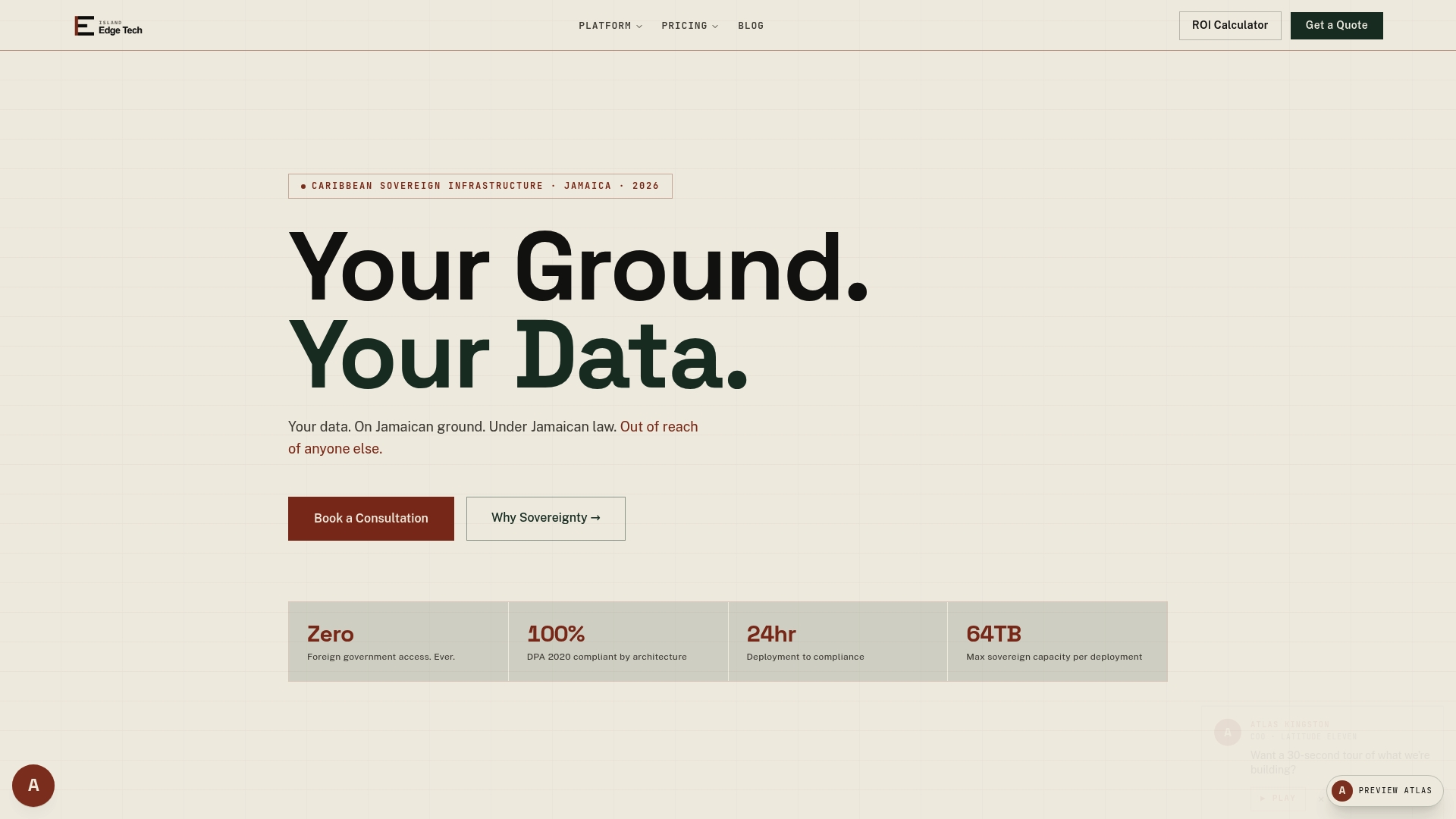
Islandedgetech supports organisations with pre-migration compliance audits, data residency architecture, and IAM frameworks aligned to DPA technical measure requirements. Products including EdgePod and the Abeng Work Suite give compliance officers the tools to govern data locally without relying on foreign cloud providers subject to conflicting legislation. For organisations ready to address their cloud compliance risks in Jamaica, Islandedgetech provides a structured path from assessment to full DPA readiness.
FAQ
What is the DPA 2020 reporting deadline for data breaches?
Data controllers must notify the Office of the Information Commissioner within 72 hours of becoming aware that a breach may have occurred. The clock starts at suspicion, not at confirmed investigation.
Does using a foreign cloud provider breach Jamaica's DPA?
Not automatically, but it requires documented safeguards. Without a transfer impact assessment and adequate contractual protections, cross-border data transfers likely breach the DPA's data sovereignty requirements.
What counts as a cloud compliance audit in Jamaica?
A cloud compliance audit reviews data classification, retention schedules, access controls, encryption standards, and third-party processor agreements against DPA 2020 obligations. It should be conducted before any cloud migration and reviewed annually.
How does shadow IT create cloud compliance risk?
Employees using unapproved cloud tools may transfer personal data to foreign servers without organisational knowledge. The organisation remains the data controller and bears full DPA liability for those transfers.
What are the penalties for DPA non-compliance in Jamaica?
The OIC can impose fines of up to JMD 5 million. Serious breaches carry criminal penalties including potential imprisonment for responsible individuals within the organisation.