
The Jamaica Data Protection Act 2020, formally administered by the Office of the Information Commissioner (OIC), is the primary legal framework governing how organisations collect, store, and process personal data in Jamaica. To comply with Jamaica's Data Protection Act 2026 requirements, every data controller must meet eight codified standards, register with the OIC, and embed data protection into daily operations before full enforcement mechanisms activate. The enforcement provisions have been fully active since december 2023, and government funding approved for 2026 completes the OIC's structural readiness. Penalties reach up to JMD 5 million for serious breaches, with additional criminal liability. The window for preparation is closing.
What are the core requirements of the Jamaica Data Protection Act?

The Act mandates eight data protection standards that every data controller must operationalise. New Data Protection Regulations issued in may 2026 clarify how each standard applies in practice. Compliance officers should treat these standards as the foundation of every policy, system, and vendor contract.
The eight standards are:
- Fairness and lawfulness. Personal data must be processed in a manner that is fair to the data subject and grounded in a lawful basis.
- Legitimate purpose. Data may only be collected for a specified, explicit, and legitimate purpose. Processing outside that purpose is a breach.
- Informed consent. Where consent is the lawful basis, it must be freely given, specific, and documented. Pre-ticked boxes do not satisfy this requirement.
- Transparency. Organisations must provide clear privacy notices explaining what data is collected, why, and how long it is retained.
- Data minimisation. Only the minimum data necessary for the stated purpose may be collected or held.
- Accuracy. Personal data must be kept accurate and up to date. Stale records create legal exposure.
- Retention limits. Data must not be held longer than necessary. Documented retention schedules are required.
- Transfer restrictions. Cross-border data transfers require documented safeguards, particularly when data moves to jurisdictions without equivalent protections.
Pro Tip: Review the may 2026 Data Protection Regulations alongside the original Act. The regulations resolve several ambiguities around consent mechanisms and cross-border transfers that the 2020 text left open.
The table below maps each standard to its primary compliance action.
| Standard | Primary compliance action |
|---|---|
| Fairness and lawfulness | Document the lawful basis for each processing activity |
| Legitimate purpose | Maintain a data processing register with stated purposes |
| Informed consent | Implement granular consent capture and withdrawal mechanisms |
| Transparency | Publish and maintain a current privacy notice |
| Data minimisation | Audit data fields collected and remove unnecessary ones |
| Accuracy | Schedule periodic data quality reviews |
| Retention limits | Create and enforce a documented retention schedule |
| Transfer restrictions | Assess and document safeguards for all cross-border transfers |
How should Jamaican businesses prepare for compliance?
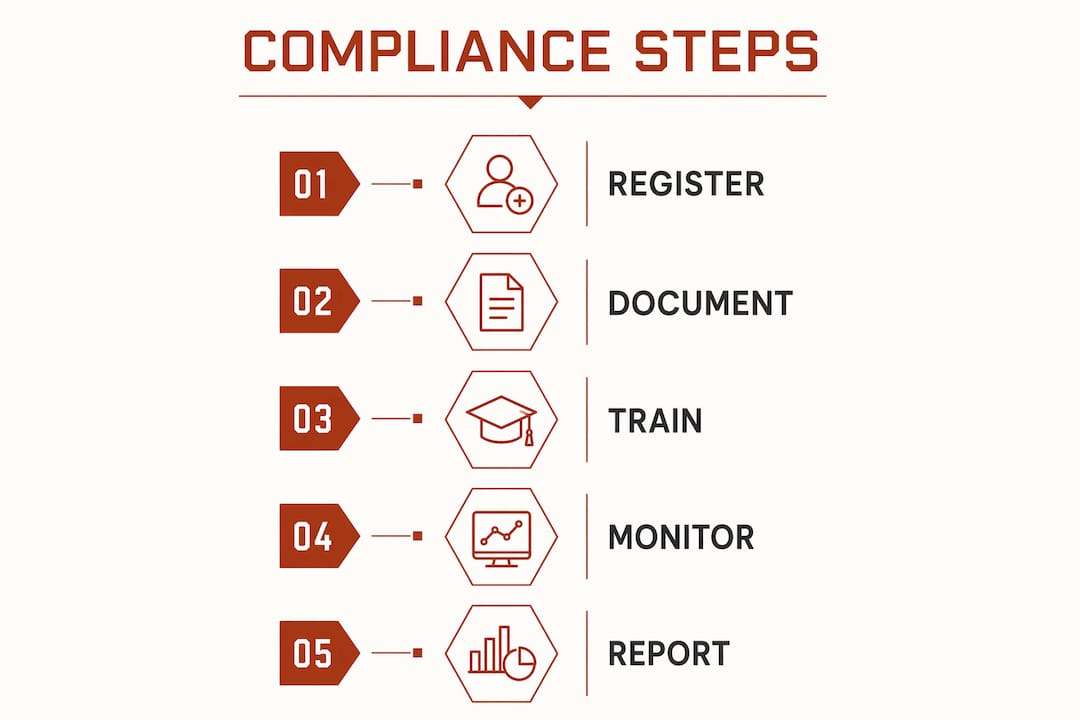
Preparation begins with registration. The OIC requires all data controllers to register via oic.gov.jm, and registration is free for most organisations. Failing to register is itself a breach, independent of any other non-compliance. Many organisations treat registration as the finish line. It is the starting line.
After registration, the following steps build the operational foundation:
-
Conduct a data flow mapping exercise. Identify every category of personal data your organisation holds, where it originates, where it is stored, who accesses it, and whether it crosses borders. This gap analysis is the crucial first step the OIC expects to see evidenced.
-
Appoint a Data Protection Officer (DPO) where applicable. The DPO must have clear authority and responsibility across business units. Without defined authority, the role becomes ceremonial rather than functional, and the OIC will note the absence of genuine governance.
-
Establish a governance framework. This includes internal data protection policies, staff responsibilities, escalation procedures, and a documented decision-making process for new data processing activities.
-
Implement cookie consent and website compliance tools. Website analytics tools require explicit consent under the Act. A cookie banner that pre-selects all categories does not meet the standard. Consent must be granular and withdrawable.
-
Review all vendor and processor contracts. Every third party that processes personal data on your behalf must be bound by a data processing agreement that mirrors your obligations under the Act. Vendor risk is your risk.
-
Build a central evidence repository. The OIC expects documented proof of compliance, not assertions. Collect data flow maps, retention schedules, consent records, training logs, and incident reports in a single, auditable location.
Pro Tip: Treat your evidence repository as a living document. Update it whenever a new processing activity begins, a vendor changes, or a policy is revised. Static documentation fails audits.
Implementing compliance in daily operations
Embedding the Act's standards into daily operations requires more than updated policies. Compliance must be operational, integrated into contracts, workflows, and staff behaviour. The following measures translate the eight standards into practice.
-
Update privacy notices and consent mechanisms. Every customer-facing touchpoint, including websites, intake forms, and email sign-ups, must carry a current privacy notice. Consent mechanisms must record the date, version of the notice presented, and the specific categories consented to.
-
Train staff on data subject rights. Individuals have the right to access, correct, and request deletion of their personal data. Staff must recognise these requests and know the internal process for responding within the statutory timeframe. Untrained staff are a direct compliance liability.
-
Enforce retention schedules. Define the retention period for each data category, automate deletion where possible, and document manual disposal procedures. Retention schedules without enforcement are worthless.
-
Control and monitor access to personal data. Role-based access controls limit who can view or edit personal data. Access logs create an audit trail. Both are expected by the OIC as evidence of the fairness and security standards.
-
Document cross-border transfer safeguards. If your organisation uses foreign cloud services, assess whether those jurisdictions offer equivalent data protection. The U.S. CLOUD Act, for example, can compel American providers to disclose data regardless of where it is physically stored. Document your assessment and the safeguards in place.
-
Prepare an incident response plan. The Act requires breach notification to the OIC. Your plan must define what constitutes a notifiable breach, who is responsible for the notification, and the timeframe for action. Practise the plan before an incident occurs.
Common compliance mistakes under the 2026 enforcement landscape
The grace period is ending, and the OIC's enforcement arm is being finalised. Organisations that have delayed action will face the most disruption. The following mistakes are the most common and the most costly.
-
Assuming size creates exemption. Small businesses are not exempt from the Act. Any organisation that processes personal data, regardless of headcount or revenue, carries the full obligations of a data controller. This misunderstanding has left many small and medium enterprises entirely unprepared.
-
Treating registration as full compliance. The OIC requires proof of internal governance through documented controls, not simply a registration certificate. Privacy policies and registration together do not constitute compliance.
-
Relying on generic policy templates. A downloaded privacy policy template that has not been adapted to your actual data processing activities will not satisfy an OIC inquiry. Policies must reflect operational reality.
-
Ignoring third-party risk. Vendor relationships create shared liability. If a processor you engage suffers a breach and you have no data processing agreement in place, the regulatory exposure falls on you as the data controller.
-
Delayed response to data subject requests. The Act sets statutory timeframes for responding to access, correction, and deletion requests. Missed deadlines are direct breaches, and the OIC can act on individual complaints.
-
Waiting for full enforcement before acting. A Data Protection Working Group was constituted to accelerate OIC readiness. Structural delays at the OIC do not suspend your legal obligations. Businesses that delay compliance until enforcement arrives will face significant operational disruption.
Compliance officers should prioritise centralising evidence, updating policies proactively, and managing overlapping regulatory obligations to reduce risk and audit overhead. The organisations that treat compliance as a continuous operational discipline, rather than a one-time project, will be the ones that face enforcement with confidence.
Key takeaways
Organisations that comply with Jamaica's Data Protection Act 2026 requirements must register with the OIC, operationalise all eight data protection standards, and maintain a documented evidence repository before enforcement fully activates.
| Point | Details |
|---|---|
| Registration is mandatory | All data controllers must register with the OIC at oic.gov.jm at no cost. |
| Eight standards govern all processing | Fairness, consent, transparency, minimisation, accuracy, retention, and transfer restrictions apply to every organisation. |
| Documentation is the proof | The OIC expects data flow maps, retention schedules, and governance records, not just policies. |
| Small businesses are not exempt | Any processing of personal data triggers full obligations under the Act, regardless of organisation size. |
| Enforcement is imminent | Government funding approved for 2026 completes the OIC's structural readiness; the grace period is closing. |
Why compliance culture matters more than compliance checklists
I have worked with compliance officers across multiple regulated industries, and the pattern is consistent. Organisations that treat data protection as a checklist exercise pass their first audit and fail their second. The ones that build a genuine compliance culture, where the DPO has real authority, where staff understand why the rules exist, and where evidence is maintained as a matter of routine, are the ones that hold up under scrutiny.
The Jamaica Data Protection Act is not a uniquely burdensome piece of legislation. Its eight standards align closely with the principles underpinning the EU's GDPR and HIPAA-equivalent frameworks in the Caribbean. Organisations that have already invested in healthcare data compliance or financial sector governance will find significant overlap. The work is not starting from zero.
What I find most underestimated is the reputational dimension. The OIC can impose fines of up to JMD 5 million, but the reputational damage from a publicised breach or enforcement action far exceeds the financial penalty for most consumer-facing businesses. Customers in Jamaica are becoming more aware of their data rights. Organisations that demonstrate genuine data stewardship will earn a competitive advantage that no marketing budget can replicate.
The practical starting point is not a policy document. It is a data flow map. Know what you hold, why you hold it, and where it goes. Everything else follows from that clarity.
— Michael
How Islandedgetech supports your Data Protection Act compliance
Islandedgetech builds sovereign data infrastructure specifically for Jamaican organisations. Its products, including EdgePod and the Abeng Work Suite, keep data resident on Jamaican soil under Jamaican law, eliminating the cross-border transfer risks that foreign cloud services create under frameworks such as the U.S. CLOUD Act.
For compliance officers building the evidence repository and governance controls the OIC requires, Islandedgetech's DPA 2020 ready platform provides the technical foundation. Data sovereignty, access controls, and audit-ready infrastructure are built into the architecture rather than added as afterthoughts. Organisations in healthcare, education, and financial services can explore sector-specific solutions aligned to Jamaica's regulatory context. The compliance roadmap starts with the right infrastructure.
FAQ
What is the deadline to comply with Jamaica's Data Protection Act?
The Data Protection Act 2020 has been fully enforceable since december 2023. Full enforcement mechanisms, including the OIC's investigative and penalty powers, are being finalised in 2026, making immediate compliance preparation the only prudent course.
Who must register with the Office of the Information Commissioner?
Every organisation that acts as a data controller, meaning any entity that determines the purpose and means of processing personal data, must register with the OIC. Registration is free for most data controllers via oic.gov.jm.
Does the Act apply to small businesses in Jamaica?
Yes. Small businesses are not exempt from the Act. Any processing of personal data, including website analytics, customer records, or employee data, triggers the full obligations of a data controller regardless of organisation size.
What is the maximum fine for breaching the Data Protection Act?
The OIC can impose fines of up to JMD 5 million for serious breaches. Criminal penalties also apply in certain circumstances, creating personal liability for directors and officers responsible for data governance.
How does using foreign cloud services affect compliance?
Foreign cloud providers, particularly those subject to U.S. law, may be compelled to disclose data under the CLOUD Act regardless of where data is physically stored. Organisations must document the safeguards governing any cross-border data transfer to satisfy the Act's transfer restriction standard.