
Auditing healthcare data storage practices is the process of systematically verifying that all storage environments holding Protected Health Information (PHI) meet regulatory standards and security controls. Healthcare organisations operating under HIPAA, Jamaica's Data Protection Act 2020, and related frameworks face legal obligations that go well beyond basic password protection. A data storage compliance audit must confirm encryption, access controls, audit log retention of at least 6 years, and documented data flows across every system that touches PHI. Failing to meet these standards exposes organisations to regulatory penalties, breach liability, and loss of patient trust.
How to audit healthcare data storage practices: mapping PHI locations
A successful audit begins with a complete inventory of every location where PHI is stored, processed, or transmitted. Without this map, compliance gaps are invisible and therefore unmanageable.
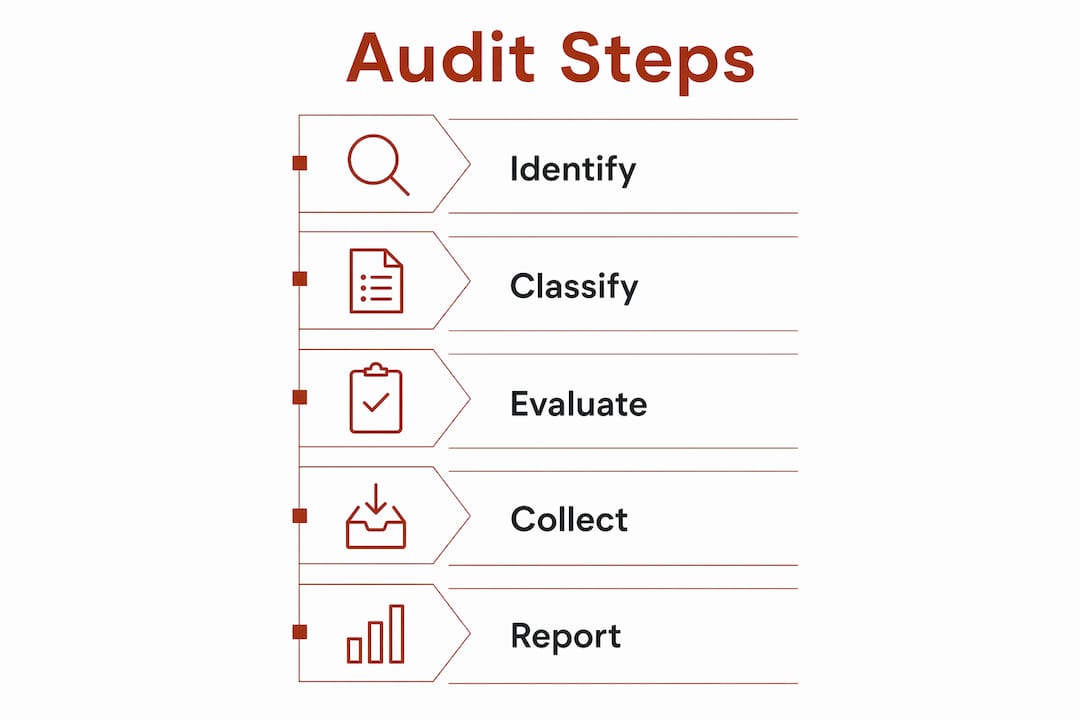
The inventory process follows a structured sequence:
- Identify primary systems. List all Electronic Health Record (EHR) platforms, laboratory information systems, billing databases, and patient portals. Document the storage medium, the data owner, and the regulatory classification for each.
- Catalogue cloud storage. Record every cloud bucket, virtual machine, and managed database service that holds PHI. Note the cloud region, the vendor, and whether a Business Associate Agreement (BAA) is in place.
- Include mobile and endpoint devices. Laptops, tablets, and smartphones used by clinical staff frequently cache PHI locally. Each device must appear in the inventory with its encryption status confirmed.
- Map backup and archive repositories. Backup tapes, off-site archives, and disaster recovery snapshots are common audit blind spots. A comprehensive PHI inventory must cover all storage media and data flows, not just primary production systems.
- Trace data flows between vendors. Document every integration point where PHI moves between systems, including third-party analytics platforms, insurance clearinghouses, and referral networks.
Pro Tip: Include shadow data stores in the inventory from the outset. Email attachments, developer sandboxes, and staff-managed spreadsheets regularly contain PHI but sit outside central IT management. Shadow data repositories are the most overlooked risk during audits, causing costly compliance gaps when excluded from PHI inventories.
Classifying data by sensitivity and storage type allows the audit team to apply proportionate controls. A database holding full patient records requires stricter access governance than an anonymised research dataset. Documenting the owner of each storage location per HIPAA's addressable and required implementation specifications creates clear accountability before the audit review begins.

What compliance controls must you evaluate during a storage audit?
Once the PHI inventory is complete, the audit moves to verifying that each storage location has the correct controls in place. The following areas require direct examination.
- Access controls. HIPAA mandates role-based access controls, unique user identification, multifactor authentication (MFA), and automatic logoff to protect electronic PHI. MFA reduces breach risk by 99%, according to Microsoft data. Every privileged account must be reviewed for least-privilege compliance.
- Encryption standards. Encryption at rest must use AES-256. Encryption in transit must use TLS 1.3. Both must be verified across all PHI endpoints, including backup systems and API connections between services.
- Audit log configuration. Logs must be enabled on every system holding PHI. Healthcare organisations must retain PHI-related audit logs for at least 6 years, with a 7-year retention period commonly adopted as a regulatory buffer. Logs must be stored in immutable environments, such as write-once, read-many (WORM) storage, to prevent tampering.
- Business Associate Agreements. Every cloud vendor and third-party processor handling PHI requires a current BAA. Under 45 CFR 164.410, breach notification procedures must be verified, with BAAs defining vendor roles and a 60-day notification timeline.
- Incident response documentation. The audit must confirm that incident reporting procedures are documented, tested, and reflect current configurations. Outdated procedures that reference decommissioned systems are a common finding.
- Policy and procedure currency. Written policies must match the controls actually in operation. A policy referencing a legacy system that no longer exists is a compliance liability, not a safeguard.
Pro Tip: Use automated compliance tools to verify encryption configurations and access control settings rather than relying on manual checks. Automated scans produce consistent, repeatable evidence that auditors can verify directly, reducing the risk of human error in the review process.
Reviewing these controls in sequence, rather than in isolation, reveals interdependencies. An access control gap in a backup repository, for example, may undermine an otherwise well-configured primary EHR system.
Tools and techniques for audit evidence collection and automation
| Audit area | Technique | Purpose |
|---|---|---|
| Log management | SIEM platforms (e.g., Azure Sentinel) | Centralise logs and detect anomalies in real time |
| Configuration proof | Infrastructure as Code (IaC) | Demonstrate actual system configuration, not just intent |
| Continuous monitoring | Automated guardrails against CIS benchmarks | Prevent enforcement drift between audit cycles |
| Evidence export | Native cloud audit tools (e.g., AWS CloudTrail) | Generate timestamped, tamper-evident audit trails automatically |
| Framework mapping | HIPAA, SOC 2, ISO 27001 control libraries | Align evidence to specific regulatory requirements |
Infrastructure as Code is the most powerful audit evidence available to IT teams. It proves actual configuration rather than documented intention, which is the distinction auditors care about most. A policy document stating that encryption is enabled carries far less weight than a version-controlled IaC template that enforces encryption at the infrastructure layer.
Embedding compliance controls within cloud architecture from the outset transforms the audit process. When controls are built in rather than bolted on, generating audit evidence becomes a report export rather than a manual evidence-gathering exercise. This approach also reduces the risk of enforcement drift, which occurs when compliant configurations are altered unintentionally over time.
Centralising logs through a Security Information and Event Management (SIEM) platform gives the audit team a single source of truth for access events, configuration changes, and anomaly alerts. Lifecycle management policies applied to the log repository confirm that retention periods meet the minimum 6-year requirement without manual intervention.
Pro Tip: Native cloud provider tools such as AWS CloudTrail and Azure Sentinel generate audit-ready logs automatically. Configure these tools to export evidence directly to an immutable archive, and map each log category to the relevant HIPAA control before the audit begins. This preparation reduces audit duration significantly.
Common pitfalls during healthcare data storage audits
Healthcare IT teams encounter predictable obstacles during storage audits. Recognising these pitfalls in advance allows organisations to address them before they become formal findings.
- Shadow data stores. Staff-managed file shares, email attachments, and developer test environments frequently hold PHI outside central oversight. These locations must be included in the PHI inventory and subject to the same controls as production systems.
- Policy drift. Documentation that describes controls as they were configured 18 months ago, rather than as they exist today, is one of the most common audit failures. Policies must be reviewed and updated whenever a system change occurs, not only at the annual audit cycle.
- Data misclassification. Applying the wrong sensitivity classification to a dataset results in inadequate controls. A dataset labelled as anonymised but containing indirect identifiers such as date of birth and postcode may still qualify as PHI under HIPAA's definition.
- Outdated BAAs. Vendor relationships change. A cloud provider that has updated its subprocessor list or changed its data centre locations may have invalidated the original BAA terms. Regular vendor reviews, at least annually, are necessary to maintain accountability.
- Periodic audits replacing continuous monitoring. An annual audit captures a single point in time. Enforcement drift occurs when initially compliant configurations are altered unintentionally, and automated guardrails that validate against security benchmarks such as CIS and NIST mitigate this risk continuously.
Audits should be viewed as a formal evidence-based dialogue, emphasising policy execution and live controls rather than a pass-or-fail judgement. Organisations that treat audit findings as operational improvement opportunities consistently achieve better outcomes in subsequent review cycles.
Remediation tracking is as important as the audit itself. Every finding must be assigned an owner, a remediation deadline, and a verification step. Reporting findings to senior leadership with clear remediation timelines demonstrates governance maturity and reduces the likelihood of repeat findings.
Key takeaways
A healthcare data storage audit succeeds when PHI is fully inventoried, compliance controls are verified against HIPAA and applicable local law, and evidence collection is automated rather than manual.
| Point | Details |
|---|---|
| Map every PHI location | Include EHR systems, cloud storage, backups, mobile devices, and shadow data stores in the inventory. |
| Verify encryption and access controls | Confirm AES-256 at rest, TLS 1.3 in transit, MFA on all privileged accounts, and role-based access across every PHI endpoint. |
| Retain audit logs for at least 6 years | Store logs in immutable WORM environments and apply lifecycle policies to enforce retention automatically. |
| Use IaC as primary audit evidence | Infrastructure as Code proves actual configuration and is more reliable than manual documentation or policy statements. |
| Treat compliance as continuous | Quarterly reviews, automated guardrails, and SIEM monitoring prevent enforcement drift between annual audit cycles. |
Why the audit mindset matters more than the audit schedule
The most significant shift I have observed in healthcare IT over the past decade is the move away from treating compliance as an annual event. Organisations that schedule a single yearly audit and consider the matter resolved are operating on a fundamentally flawed model. Configuration changes, staff turnover, new vendor integrations, and software updates all alter the compliance posture of a storage environment continuously. A point-in-time audit cannot capture that reality.
The teams that consistently pass regulatory reviews without significant findings share one characteristic: they have embedded compliance controls into their engineering processes from the start. Treating compliance as continuous engineering rather than a periodic review reduces manual errors and increases confidence in audit outcomes. When automated guardrails enforce encryption settings and access policies at the infrastructure layer, the audit becomes a verification exercise rather than a discovery exercise.
The framing of audits also matters. Audits are most productive when approached as evidence-based conversations about how controls function in practice, not as judgements on whether an organisation is compliant or not. Audit findings are data points. They identify where the gap between policy intent and operational reality is widest. Organisations that act on findings with structured remediation plans, rather than treating them as failures, build stronger compliance programmes over time.
The practical implication is straightforward. Build your healthcare data management architecture so that audit evidence is a by-product of normal operations, not a separate effort triggered by an upcoming review.
— Michael
How Islandedgetech supports healthcare data storage compliance
Healthcare organisations preparing for a data storage compliance audit need infrastructure that generates evidence automatically, not systems that require manual configuration checks before every review cycle.
Islandedgetech provides sovereign cloud infrastructure through its Groundwork platform, designed specifically for organisations operating under Jamaica's Data Protection Act 2020 and HIPAA-aligned standards. The platform includes immutable log storage, AES-256 encryption management, automated access controls, and real-time monitoring dashboards that map directly to compliance framework requirements. Data remains on Jamaican soil, eliminating exposure to foreign data access laws such as the US CLOUD Act. Contact Islandedgetech to discuss how its compliance-ready infrastructure can reduce audit preparation time and support continuous healthcare data protection.
FAQ
What is a healthcare data storage audit?
A healthcare data storage audit is a structured review of all systems, controls, and processes that store or handle PHI, verifying compliance with regulations such as HIPAA and Jamaica's Data Protection Act 2020. The audit confirms encryption, access controls, log retention, and vendor accountability.
How long must healthcare audit logs be retained?
Healthcare organisations must retain PHI-related audit logs for a minimum of 6 years under HIPAA, with many organisations adopting a 7-year retention period as a regulatory buffer. Logs must be stored in immutable environments to prevent tampering.
What is enforcement drift and why does it matter?
Enforcement drift occurs when storage configurations that were initially compliant are altered unintentionally over time, creating compliance gaps between audit cycles. Automated guardrails validated against benchmarks such as CIS and NIST prevent drift from going undetected.
What is a Business Associate Agreement and when is it required?
A Business Associate Agreement (BAA) is a legally binding contract between a healthcare organisation and any vendor that processes PHI on its behalf. Under 45 CFR 164.410, a BAA must define breach notification roles and a 60-day notification timeline, and must be reviewed whenever vendor terms or subprocessors change.
What is the most reliable form of audit evidence?
Infrastructure as Code (IaC) is the most reliable audit evidence because it proves actual system configuration rather than documented intent. Automated code and policies provide verifiable, version-controlled proof that auditors can examine directly.