
Data residency risks are defined as the legal, technical, and operational exposures that arise from where an organisation stores, processes, and transfers its data. For Jamaican businesses, these risks carry direct consequences: regulatory penalties under the Jamaican Data Protection Act, reputational damage, and potential suspension of critical data flows. Over 100 countries now have data sovereignty or localisation laws in place, meaning the global compliance environment has never been more demanding. Understanding the types of data residency risks is the first step towards building a compliance framework that protects sensitive information and sustains business continuity.
1. What are the main types of data residency risks?
Data residency risks fall into five primary categories: regulatory, technical, operational, access control, and third-party. Each category carries distinct exposures, and organisations that fail to address all five leave themselves vulnerable to compounding failures.

Regulatory and legal compliance risks are the most immediately consequential. Non-compliance with residency requirements can trigger regulatory investigations, financial penalties, and the suspension of data flows that underpin daily operations. For Jamaican organisations, this means aligning with the Data Protection Act 2020 while also accounting for the extraterritorial reach of laws such as the US CLOUD Act.
Technical leakage risks are less visible but equally serious. Five common technical leakage points risk violating data residency controls:
- Logging pipelines that route audit data to foreign servers
- Cross-region backup replication that copies data outside mandated boundaries
- AI and ML processing that sends data to inference endpoints in other jurisdictions
- Remote support access by engineers based abroad
- Third-party integrations that transfer data without adequate contractual controls
Operational risks stem from misconfiguration. Cloud environments are complex, and a single default setting can cause data to flow outside a mandated zone without any deliberate decision by the organisation.
Access control and governance risks arise when internal or third-party personnel access data across borders without proper authorisation frameworks in place.
Third-party and vendor risks reflect the gap between a cloud provider's regional offerings and genuine sovereignty. A provider may host data in a local region whilst remaining subject to foreign legal jurisdiction, creating what practitioners call the residency illusion: the false confidence that selecting a local cloud region is sufficient to ensure compliance.
Pro Tip: Classify your data by sensitivity before assessing risk. Health records, financial data, and government information carry higher regulatory exposure than operational metadata, so prioritise your gap analysis accordingly.
2. How emerging technologies amplify data residency challenges
AI and cloud-native services introduce risk vectors that traditional residency frameworks were not designed to address. The core problem is that these technologies move data as a function of how they operate, often without explicit configuration choices by the organisation.
AI and ML services process data outside residency boundaries through inference endpoints, model training pipelines, and retrieval-augmented generation systems. An organisation may store patient records within Jamaica whilst simultaneously feeding those records into a managed AI service that processes them on servers in the United States or Europe. The storage location is compliant; the processing is not.
Cloud environments compound this problem through default configurations. Cross-region replication and monitoring pipelines often activate automatically, causing unintended data movement that violates residency mandates before any IT team has reviewed the settings. Container orchestration platforms such as Kubernetes add further complexity, as workload scheduling can place data processing in unexpected geographic locations.
Remote support access presents a specific and underappreciated risk. Support access by foreign-based engineers for cloud resources constitutes a data transfer that can violate strict residency mandates, even when the underlying data never physically moves.
The practical implication for Jamaican organisations is that residency compliance now requires active governance of AI workflows, not just infrastructure configuration.
Pro Tip: Audit every managed AI or ML service your organisation uses and confirm where inference and training occur. Contractual assurances about storage location do not cover processing location unless explicitly stated.
3. What practical steps reduce data residency risks?
Effective risk management begins with visibility. Organisations cannot remediate exposures they have not mapped.
Step 1: Inventory all data flows. Document every system that creates, stores, transmits, or processes data. Include backups, logging systems, analytics platforms, and third-party integrations. This inventory forms the baseline for all subsequent analysis.
Step 2: Classify data by sensitivity and residency obligation. Health records, financial data, and personally identifiable information carry the highest regulatory exposure. Prioritise remediation based on data sensitivity, addressing special category data first before moving to lower-risk data types.
Step 3: Conduct a gap analysis. Map data flows against specific residency requirements and identify where actual data movement diverges from legal or contractual obligations. Treat each gap as a discrete risk item with its own severity rating.
Step 4: Implement technical controls. Specific measures include:
- Enabling region pinning on all cloud storage and compute resources
- Disabling cross-region replication unless explicitly required and legally permitted
- Applying encryption with customer-managed keys so that foreign access to ciphertext does not constitute a meaningful data transfer
- Restricting support access to locally based personnel or requiring explicit authorisation for remote access
Step 5: Review contracts and vendor agreements. Contractual residency guarantees must cover storage, processing, backups, and support access. Gaps in any of these areas create legal exposure regardless of technical controls.
Step 6: Automate compliance monitoring. Manual audits are insufficient for dynamic cloud environments. Automated tools that detect configuration drift and flag residency violations in real time reduce the window of exposure between a misconfiguration and its discovery.
Step 7: Establish a continuous review cycle. Data residency laws evolve, organisational data footprints change, and new services introduce new risks. A compliance framework that is not reviewed regularly becomes outdated quickly.
Pro Tip: Treat your data residency compliance programme as a living document. Schedule quarterly reviews that include legal, IT, and procurement teams, because residency obligations span all three functions.
4. How data residency risks intersect with data sovereignty and localisation
The difference between data residency and data sovereignty is not merely semantic. It determines which legal frameworks apply and what remediation is required.
Data residency refers to the physical location where data is stored. Data sovereignty refers to the legal jurisdiction that governs that data, regardless of where it physically sits. An organisation can store data in Jamaica whilst remaining subject to US law if the cloud provider is a US-incorporated entity. This distinction is the foundation of the CLOUD Act risk that many Jamaican organisations underestimate.
Data localisation is stricter still. Localisation laws prohibit data from leaving a specified territory entirely, covering not just primary storage but also backups, processing, and in some cases, the nationality of personnel with access. Organisations must distinguish residency from localisation to avoid compliance gaps that appear only during regulatory investigations.
The table below summarises the three concepts and their compliance implications for Jamaican organisations.
| Concept | Definition | Compliance implication |
|---|---|---|
| Data residency | Physical location of stored data | Must align with DPA 2020 and sector-specific rules |
| Data sovereignty | Legal jurisdiction governing data | Foreign-incorporated providers may expose data to foreign law |
| Data localisation | Prohibition on data leaving a territory | Covers backups, processing, and support access, not just storage |
For sectors such as healthcare and financial services in Jamaica, all three obligations apply simultaneously. A hospital that stores patient records locally but uses a foreign-incorporated cloud provider for analytics faces a sovereignty gap even if its residency obligation is technically met. Sovereign cloud providers address this by operating under local legal entities without foreign parent companies, removing the extraterritorial jurisdiction risk entirely. Jamaican organisations in healthcare data compliance and tourism face layered obligations that make this distinction operationally critical.
Key takeaways
Data residency compliance requires addressing regulatory, technical, operational, access control, and third-party risks simultaneously, not in isolation.
| Point | Details |
|---|---|
| Residency illusion is a real risk | Selecting a local cloud region does not guarantee compliance if logs, backups, or AI services cross borders. |
| AI workflows require specific auditing | Managed AI services process data in foreign jurisdictions regardless of where it is stored. |
| Sovereignty differs from residency | Foreign-incorporated providers can expose locally stored data to foreign legal jurisdiction. |
| Prioritise by data sensitivity | Address health, financial, and government data gaps before lower-risk data types. |
| Continuous review is non-negotiable | Laws, technologies, and data footprints change; static compliance frameworks become liabilities. |
A practitioner's view on data residency risk in Jamaica
The most persistent mistake I observe amongst Jamaican organisations is treating data residency as an infrastructure checkbox rather than a governance discipline. A team selects a cloud region, confirms the data centre is on the right side of a border, and considers the matter closed. That approach was inadequate five years ago. In 2026, with AI services, container orchestration, and multi-region logging as standard components of most IT environments, it is genuinely dangerous.
What I have found is that the organisations with the strongest residency posture are not necessarily those with the most sophisticated technology. They are the ones that have invested in cross-functional governance: legal, IT, and procurement working from a shared risk register. The technical controls matter, but they fail without the contractual and organisational structures to support them.
The sovereignty question deserves particular attention in the Jamaican context. The CLOUD Act means that data stored with a US-incorporated provider can be compelled for disclosure by US authorities, regardless of where the data physically sits. Most organisations I speak with are aware of this in the abstract but have not assessed which of their current vendors fall into this category. That assessment is not complex. It is simply not being done.
The arrival of AI services has made this more urgent, not less. Every managed AI tool an organisation adopts is a potential residency and sovereignty gap. Auditing those tools systematically, and building that audit into procurement processes, is the most practical step available to Jamaican organisations right now.
— Michael
How Islandedgetech addresses data residency risks for Jamaican organisations
Jamaican organisations that have completed a gap analysis often find that the most direct path to compliance is infrastructure that was built for sovereignty from the outset, not retrofitted for it.
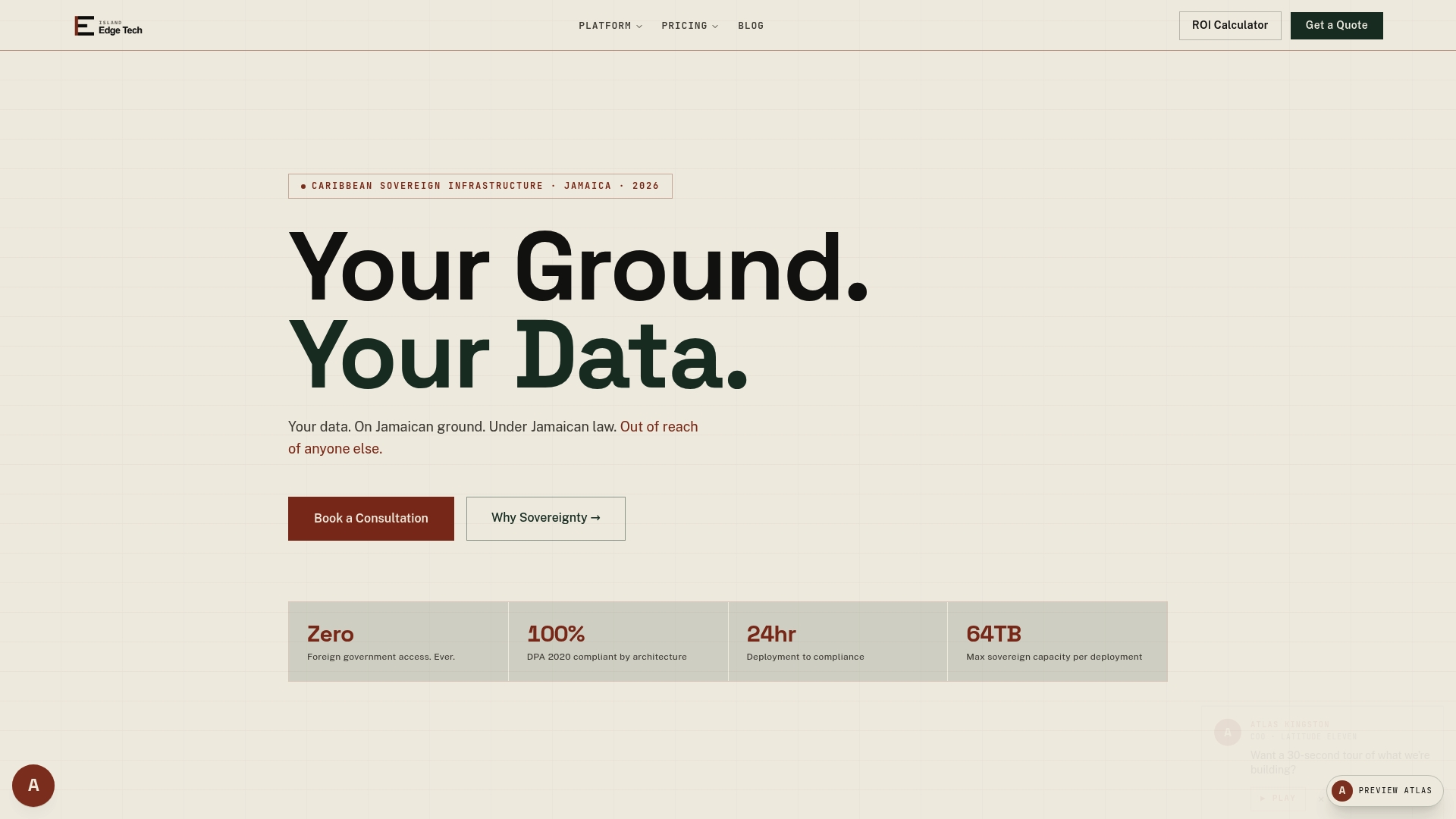
Islandedgetech provides sovereign cloud infrastructure hosted entirely on Jamaican soil, operated under a local legal entity, and designed to meet the requirements of the Data Protection Act 2020. Products including EdgePod and Abeng deliver compute, storage, and productivity tools with contractual residency guarantees that cover storage, backups, logging, and support access. Islandedgetech also provides risk assessment support to help organisations identify gaps and build remediation plans. For organisations in sectors with layered obligations, this removes the extraterritorial jurisdiction exposure that foreign-incorporated providers cannot eliminate by design.
FAQ
What is data residency risk?
Data residency risk is the legal, technical, or operational exposure that arises when an organisation's data is stored or processed in a location that violates applicable laws or contractual obligations. Non-compliance can result in regulatory penalties and suspension of data flows.
What is the difference between data residency and data sovereignty?
Data residency refers to the physical location of stored data, whilst data sovereignty refers to the legal jurisdiction that governs it. An organisation can satisfy residency requirements whilst still being subject to foreign legal jurisdiction if its cloud provider is incorporated abroad.
How does the US CLOUD Act affect Jamaican businesses?
The CLOUD Act allows US authorities to compel US-incorporated cloud providers to disclose data regardless of where that data is physically stored. Jamaican organisations using US-incorporated providers face this exposure even when data is hosted locally.
Why is selecting a local cloud region insufficient for compliance?
Selecting a local cloud region addresses only primary storage location. Logs, backups, AI processing, and remote support access can all transfer data outside the mandated zone without additional technical and contractual controls, creating the residency illusion.
What data types carry the highest residency risk in Jamaica?
Health records, financial data, and personally identifiable information carry the highest regulatory exposure under the Data Protection Act 2020. Organisations should prioritise remediation for these categories before addressing lower-sensitivity data types.