
A private cloud solution is a cloud computing environment where all infrastructure and resources are dedicated exclusively to a single organisation. Unlike shared public cloud platforms, a private cloud gives organisations full control over their hardware, software configurations, and security policies. This model is the standard choice for regulated industries such as finance, healthcare, and government, where data sovereignty and compliance are non-negotiable. The core principles underpinning any private cloud include virtualisation, software-defined networking, automation, and self-service provisioning. Understanding what a private cloud solution delivers, and where it falls short, is the first step towards making a sound infrastructure decision.
How does a private cloud solution work?
A private cloud operates on dedicated infrastructure, either hosted on an organisation's own premises or within a third-party data centre under an exclusive arrangement. The key distinction from traditional on-premises IT is that a true private cloud includes automation, software-defined networking, and self-service provisioning portals. Many IT teams confuse legacy data centres with private cloud. They are not the same thing.
The architecture of a private cloud relies on several interdependent layers:
- Virtualisation layer. Hypervisors such as VMware vSphere or KVM abstract physical hardware into virtual machines, enabling multiple workloads to run on shared physical servers without resource contention.
- Software-defined networking (SDN). SDN decouples network control from physical hardware, allowing IT teams to configure and segment networks through software rather than manual switch configuration.
- Automation and orchestration. Tools such as Ansible, Terraform, or OpenStack automate provisioning, patching, and resource allocation, reducing manual intervention and human error.
- Self-service portal. Authorised users can request and deploy computing resources without raising a ticket with the IT department, replicating the agility of public cloud within a controlled environment.
- Monitoring and governance. Centralised dashboards track resource utilisation, security events, and compliance posture across the entire private cloud estate.
Capacity planning is a critical discipline in private cloud architecture. Unlike pay-as-you-go public cloud, a private cloud demands upfront investment based on peak demand forecasts. Underestimate capacity and workloads suffer. Overestimate and capital sits idle.
Pro Tip: Build your capacity model around your 18-month peak demand projection, not your current average load. This prevents costly mid-cycle hardware procurement and avoids performance degradation during demand spikes.
Scalability in a private cloud is controlled rather than instant. Public cloud offers immediate elasticity, provisioning additional compute in minutes. Private cloud requires hardware procurement, rack installation, and software configuration, which can extend lead times by weeks or months. This trade-off is acceptable for organisations with predictable, steady workloads. It becomes a liability for those with highly variable demand.

What are the key benefits of private cloud solutions for businesses?
Private cloud solutions deliver a specific set of advantages that public cloud platforms structurally cannot match. These advantages are most pronounced in organisations operating under strict regulatory obligations or handling sensitive personal data.
- Exclusive data control. No other organisation shares the underlying infrastructure. This eliminates the multi-tenancy risks inherent in public cloud, where misconfigured access controls on a shared platform can expose one tenant's data to another.
- Regulatory compliance. Private cloud is predominantly adopted in finance, healthcare, and government precisely because it enables 100% data sovereignty. Organisations can demonstrate to regulators exactly where data resides and who can access it.
- Customisation. IT teams can configure hardware specifications, network topology, security policies, and software stacks to match precise operational requirements. Public cloud platforms impose standardised configurations that may not align with legacy system dependencies.
- Predictable cost structure. Capital expenditure on private cloud infrastructure is fixed once deployed. For organisations with stable, high-volume workloads, this predictability is valuable. 41% of IT decision-makers report that their private cloud infrastructure costs less to operate than comparable public cloud deployments over the long term.
- Performance consistency. Dedicated resources mean workloads do not compete with other organisations' traffic. This matters for latency-sensitive applications such as real-time financial transaction processing or clinical data systems.
- Legacy system integration. Private cloud environments can be architected to accommodate on-premises legacy applications that cannot be easily migrated to public cloud without significant re-engineering.
The cost advantage deserves context. The 41% figure reflects organisations with steady, predictable workloads. For organisations with variable or unpredictable demand, public cloud's pay-as-you-go model frequently proves cheaper. The decision to adopt private cloud is less about cost alone and more about control and compliance with complex regulatory demands.
What challenges and trade-offs do private cloud solutions entail?
Private cloud is not a universally superior choice. Organisations must weigh several significant operational and financial challenges before committing to this model.
- High upfront capital expenditure. Procuring servers, storage arrays, networking equipment, and licences requires substantial initial investment. Public cloud eliminates this barrier entirely by shifting costs to operational expenditure.
- Full operational responsibility. Private cloud shifts the entire operational burden to in-house IT teams. Hardware maintenance, firmware patching, security monitoring, and incident response all fall within the organisation's remit. Public cloud providers absorb these responsibilities on behalf of their clients.
- Legacy application complexity. Re-architecting legacy applications for a virtualised private cloud environment is complex and time-consuming. Applications built for bare-metal servers often require significant code changes to function efficiently within a virtualised stack.
- Longer provisioning lead times. Adding capacity requires physical hardware procurement and installation. This can take weeks, compared to the minutes required on a public cloud platform.
- Capacity planning risk. Inaccurate demand forecasting leads to either over-provisioning, which wastes capital, or under-provisioning, which degrades performance and availability.
Pro Tip: Before committing to private cloud, conduct a full workload audit. Classify each application by its regulatory sensitivity, performance requirements, and demand variability. This audit will reveal which workloads genuinely require private cloud and which can safely run on public or hybrid infrastructure.
The operational overhead is the most underestimated challenge. Organisations that lack a mature IT operations function frequently discover that managing a private cloud consumes more staff time and expertise than anticipated. Readiness investment in automation tooling and IT team capability is a prerequisite, not an afterthought.
How does private cloud compare with public and hybrid cloud models?
Understanding the differences between cloud deployment models is essential for IT decision-makers evaluating their infrastructure options.
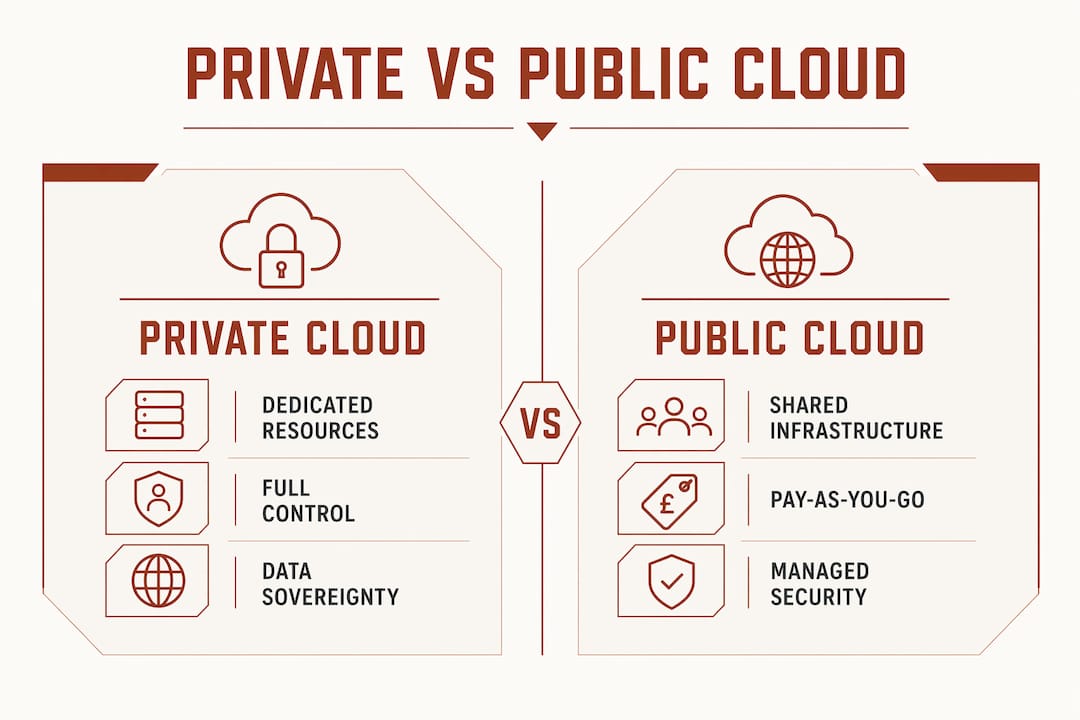
Public cloud delivers computing resources over the internet from shared, multi-tenant infrastructure managed entirely by a third-party provider. It offers near-instant scalability, minimal upfront cost, and broad geographic availability. The trade-off is reduced control over data residency, security configurations, and compliance posture. Organisations subject to data protection legislation must scrutinise where their data is processed and stored, particularly when using providers subject to foreign jurisdictions. The U.S. CLOUD Act, for example, can compel American cloud providers to disclose data regardless of its physical storage location.
Private cloud delivers the same cloud computing capabilities, including self-service provisioning and automation, within an environment dedicated to a single organisation. Control, security, and compliance are maximised. Cost and operational complexity are higher.
Hybrid cloud combines private and public cloud environments, connected through secure network links or APIs. Organisations use hybrid cloud to keep sensitive workloads on private infrastructure whilst running less sensitive or variable workloads on public cloud. This model requires careful data governance frameworks to manage data flows between environments.
| Factor | Public cloud | Private cloud | Hybrid cloud |
|---|---|---|---|
| Cost model | Operational expenditure, pay-as-you-go | High capital expenditure, predictable ongoing costs | Mixed; capital for private, operational for public |
| Control | Low; provider manages infrastructure | High; organisation manages full stack | Moderate; split by workload type |
| Data sovereignty | Variable; depends on provider jurisdiction | Full; data stays within defined boundaries | Partial; depends on workload placement |
| Scalability | Near-instant, elastic | Controlled; limited by physical capacity | Flexible; elastic on public side |
| Compliance suitability | Moderate; requires due diligence | High; preferred for regulated industries | High; if governed correctly |
| Operational burden | Low; provider absorbs management | High; in-house IT responsible for full stack | Moderate; split responsibilities |
The hybrid model is increasingly the pragmatic choice for large enterprises. It allows organisations to maintain a compliant, controlled private environment for their most sensitive data whilst benefiting from public cloud elasticity for development, testing, and less sensitive production workloads. For organisations in Jamaica and the Caribbean, assessing foreign cloud compliance risks is a necessary step before placing any workload on an internationally hosted public cloud platform.
Key takeaways
A private cloud solution delivers exclusive infrastructure control, full data sovereignty, and regulatory compliance, but demands significant capital investment and a capable in-house IT function to manage the full operational stack.
| Point | Details |
|---|---|
| Private cloud definition | A dedicated cloud environment for one organisation, combining virtualisation, automation, and self-service provisioning. |
| Primary adoption driver | Regulatory compliance and data sovereignty, not cost savings, are the principal reasons organisations choose private cloud. |
| Operational responsibility | In-house IT teams own the full stack, including hardware, patching, security monitoring, and incident response. |
| Capacity planning is critical | Private cloud requires upfront investment based on peak demand forecasts; inaccurate planning wastes capital or degrades performance. |
| Hybrid cloud as a middle path | Hybrid cloud allows sensitive workloads to remain on private infrastructure whilst variable workloads use public cloud elasticity. |
Why private cloud is a governance decision, not just a technical one
Having worked with IT decision-makers across regulated sectors, the most consistent mistake I observe is treating private cloud adoption as a purely technical procurement exercise. Organisations evaluate hardware specifications, virtualisation platforms, and network topology, then sign off on a capital budget. What they frequently neglect is the governance and operational readiness question: does the IT team have the skills, processes, and tooling to manage this environment at the standard the business requires?
A private cloud is not a product you purchase and then operate passively. It is a continuous operational commitment. Security patching, capacity monitoring, incident response, and compliance reporting all require dedicated attention. Organisations that have spent years relying on public cloud providers to absorb these responsibilities often underestimate how demanding this shift is.
The second misconception I encounter regularly is equating a private cloud with an existing on-premises data centre. Running physical servers in a server room is not a private cloud. A genuine private cloud requires automation, self-service provisioning, and software-defined infrastructure. Without these elements, you have traditional IT with a modern label.
My strongest advice to IT leaders is this: treat private cloud adoption as a risk management and capacity planning exercise first, and a technology selection exercise second. Define your regulatory obligations, your data residency requirements, and your risk appetite. Then assess whether your IT function has the maturity to manage the environment. If the answer to either question is uncertain, a managed private cloud service, or a carefully governed hybrid model, is the more prudent starting point.
— Michael
How Islandedgetech supports organisations with sovereign private cloud
Islandedgetech builds sovereign data infrastructure specifically for Jamaican organisations that cannot afford to compromise on data residency or regulatory compliance.
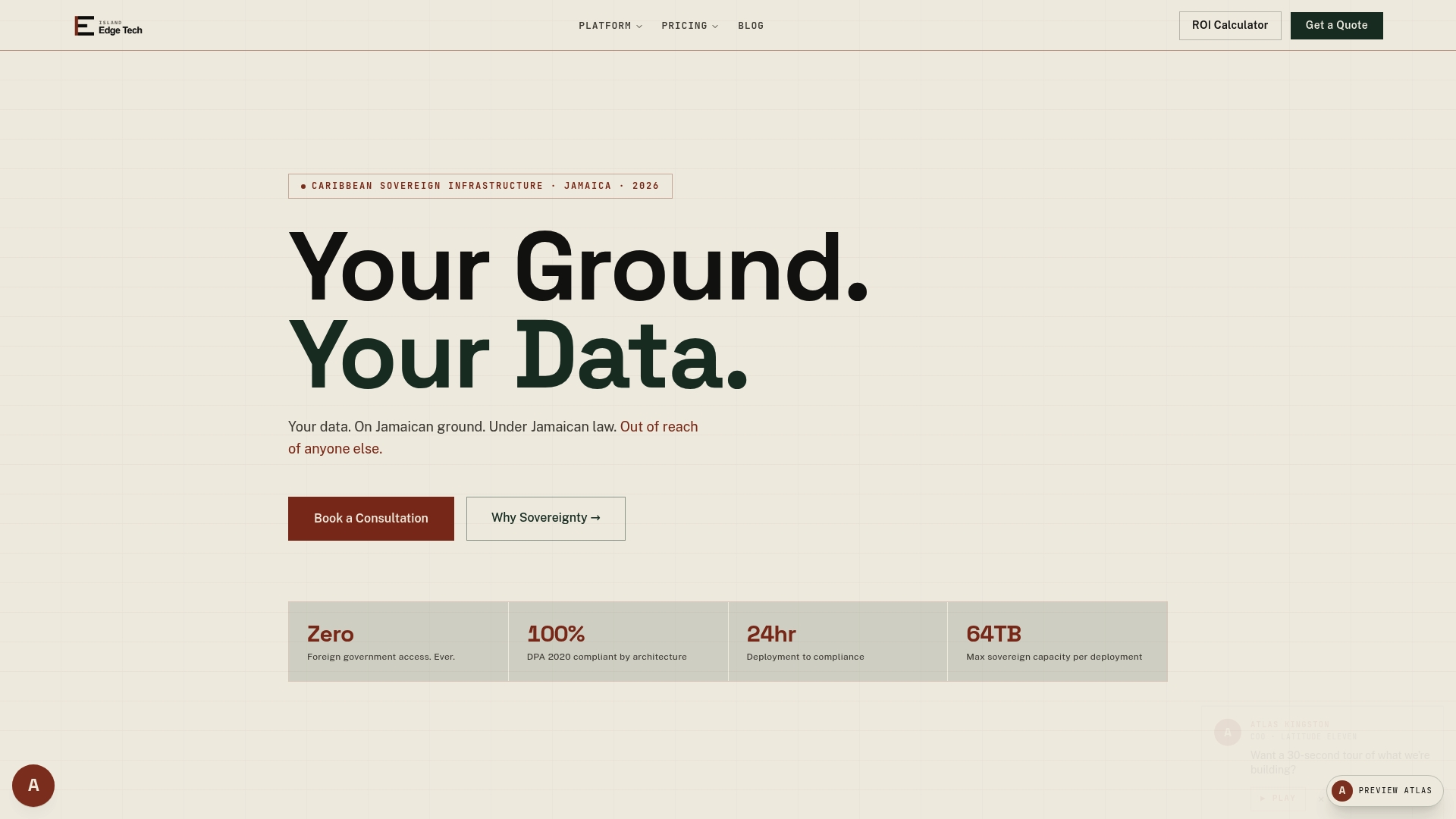
Its EdgePod platform delivers private cloud capabilities, including automation, self-service provisioning, and security policy enforcement, on Jamaican soil and under Jamaican law. This directly addresses the compliance gap created by foreign cloud providers subject to legislation such as the U.S. CLOUD Act. Islandedgetech's solutions are designed for regulated industries including healthcare, finance, and government, where data sovereignty is a legal obligation rather than a preference. Organisations seeking a compliant, managed private cloud environment can begin with Islandedgetech's sovereign infrastructure assessment to establish a clear compliance and deployment roadmap.
FAQ
What is the private cloud definition in simple terms?
A private cloud is a cloud computing environment where all resources, including servers, storage, and networking, are dedicated exclusively to one organisation. It delivers the automation and self-service capabilities of cloud computing within a controlled, single-tenant infrastructure.
Is private cloud more secure than public cloud?
Private cloud offers greater control over security configurations and data residency, making it the preferred choice for regulated industries. Security outcomes depend on the quality of the organisation's IT governance and operational practices, not the deployment model alone.
What are the main benefits of private cloud for regulated businesses?
The primary benefits are full data sovereignty, the ability to meet sector-specific compliance requirements such as Jamaica's Data Protection Act 2020, and exclusive control over hardware and security policies. 41% of IT decision-makers also report lower long-term operating costs compared with equivalent public cloud deployments.
How does private cloud differ from a traditional data centre?
A traditional data centre runs physical servers without automation or self-service provisioning. A private cloud adds virtualisation, software-defined networking, and automated orchestration, giving IT teams cloud-like agility within a dedicated environment.
When should an organisation choose hybrid cloud over private cloud?
Hybrid cloud suits organisations that have a mix of sensitive, compliance-bound workloads and variable, less sensitive workloads. Sensitive data remains on private infrastructure whilst public cloud handles demand spikes and non-regulated applications, provided a sound data governance framework governs data flows between environments.