
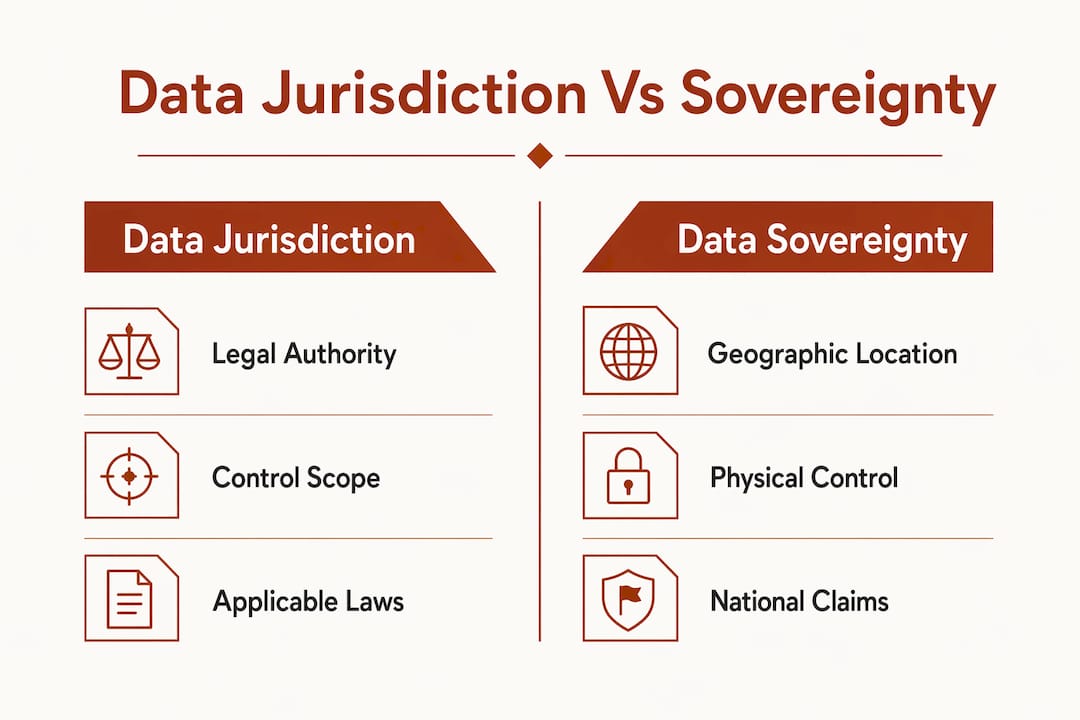
Data jurisdiction is defined as the legal authority that determines which nation's laws govern data, regardless of where that data physically resides. This concept sits at the heart of every cloud decision, cross-border data transfer, and compliance programme that Jamaican organisations must navigate in 2026. Understanding what is data jurisdiction means recognising that storing data on a server in Kingston does not automatically place it under Jamaican law, just as storing it in Miami does not automatically place it under US law. Jamaica's Data Protection Act 2020 and international frameworks such as the GDPR each assert their own jurisdictional reach, making this one of the most consequential legal questions for any data controller operating locally.
What is data jurisdiction, and how does it differ from related concepts?
Data jurisdiction refers to the legal authority a government holds over data, defining which laws apply beyond the mere physical location of that data. Three related but distinct concepts are frequently confused with it, and the distinctions carry real compliance consequences.
Data sovereignty is a nation's legal right to govern data within its borders and to assert control over data generated by its citizens. Data residency describes the physical location where data is stored, which may be a contractual requirement but does not, by itself, determine legal authority. Data localisation refers to laws that mandate data be stored within a specific country's borders, such as sector-specific rules in healthcare or finance.
The table below illustrates how these concepts relate and differ:
| Concept | Core focus | Determines legal authority? | Example |
|---|---|---|---|
| Data jurisdiction | Which laws apply to data | Yes | US CLOUD Act reaching data stored in Jamaica |
| Data sovereignty | Nation's right to govern data | Yes, at national level | Jamaica asserting control over citizen data |
| Data residency | Physical storage location | No | Server located in Kingston |
| Data localisation | Mandatory local storage rules | Partially | Law requiring health records stored in Jamaica |
True sovereignty requires jurisdiction, control, and accountability, not just physical location. A Jamaican business that stores data on a US-owned cloud platform may believe its data is protected by Jamaican law, when in practice the provider's legal obligations to US authorities may override that assumption entirely.
Pro Tip: When reviewing a cloud provider's sovereignty claims, ask three specific questions: Under which country's law is the provider incorporated? Who has legal access to the data under that law? What contractual protections exist if a foreign government issues a data disclosure order?

Why is data jurisdiction critical for Jamaican businesses?
The practical risks of misunderstanding jurisdictional control are significant for Jamaican organisations. The US CLOUD Act compels US-based providers to disclose data they control, even when that data is stored outside the United States. A Jamaican hospital using a US-headquartered cloud service for patient records could find those records subject to a US federal warrant, regardless of where the servers sit.
The compliance implications extend beyond US law. Jamaican organisations that handle personal data belonging to European Union residents must also comply with the GDPR, which carries its own extraterritorial reach and imposes substantial penalties for breaches. Jamaica's Data Protection Act 2020 adds a further layer of domestic obligation, requiring data controllers to document their legal basis for processing and to manage cross-border transfers with appropriate safeguards.
The risks Jamaican organisations face from unclear jurisdictional control include:
- Foreign government access to data held by overseas providers without prior notice to the Jamaican data controller
- Regulatory penalties under the Data Protection Act 2020 for failing to maintain adequate jurisdictional controls over personal data
- Reputational damage when clients or partners discover that sensitive data was accessible to foreign authorities
- Contractual liability where service agreements fail to specify which jurisdiction's law governs data disputes
Encryption does not prevent legal compulsion to disclose data. Government warrants can compel providers to decrypt and provide access, regardless of encryption strength. This means technical security measures alone cannot substitute for sound jurisdictional governance.
How do legal frameworks and international regulations shape data jurisdiction?
Several overlapping legal regimes directly affect how Jamaican organisations must manage jurisdictional control over their data. Understanding each framework's reach is a prerequisite for building a credible compliance roadmap.
-
Jamaica's Data Protection Act 2020 establishes the domestic baseline. It governs the collection, processing, storage, and transfer of personal data by Jamaican data controllers and processors. Cross-border transfers require either the receiving country to have adequate protections or the data controller to implement specific contractual safeguards.
-
The GDPR applies to any Jamaican organisation that processes personal data of EU residents, regardless of where the organisation is based. Its extraterritorial scope means Jamaican tourism operators, for example, must comply when handling data from European visitors.
-
The US CLOUD Act extends US legal authority to data held by US-incorporated providers anywhere in the world. Jamaican businesses using US-based cloud services are therefore indirectly subject to US disclosure obligations.
-
The EU Data Act, which came into force in 2024, introduces new rules on data access and portability across cloud services. It adds further complexity for Jamaican organisations operating in or trading with the EU.
"Effective data sovereignty requires a comprehensive 'sovereign stack' integrating contractual, legal, and technical layers, not just local data storage. Organisations that rely solely on the physical location of their servers as proof of jurisdictional control are operating on a false assumption that courts and regulators will not accept."
Contractual safeguards, such as data processing agreements and standard contractual clauses, provide one layer of protection. Technical measures, including jurisdiction-aware access controls and audit logging, provide another. Neither is sufficient without the other, and both must be grounded in a clear understanding of which legal regime governs the data at each stage of its lifecycle.
What technological measures help enforce data jurisdiction?
Technical controls are a necessary component of jurisdictional compliance, but they must be designed with legal requirements in mind, not applied generically. A solid data map documenting data origin, location, access rights, and applicable laws is the foundation of any sovereignty programme. Without this visibility, organisations cannot demonstrate compliance to regulators or respond effectively to a jurisdictional incident.
The key technical and procedural measures Jamaican organisations should implement include:
- Data mapping and classification: Document every data asset, its origin, its storage location, and the legal regime that governs it. This is the starting point for all jurisdictional governance.
- Sovereign cloud infrastructure: Use providers that are incorporated and operate under Jamaican law, with no parent company obligations to foreign governments. Local providers offer clearer legal ownership and direct accountability that global platforms cannot match.
- Jurisdiction-aware access controls: Configure systems so that data access is governed by role, location, and legal authority, not just technical credentials.
- Contractual due diligence: Review every cloud and service provider agreement for clauses that specify governing law, dispute resolution jurisdiction, and data disclosure obligations.
- Audit logging: Maintain records of who accessed data, when, and under what legal authority. This documentation supports accountability under the Data Protection Act 2020.
Organisations should not accept sovereignty claims without rigorous questioning of providers' ownership structures and legal obligations. Vague answers to direct questions about foreign government access indicate insufficient protection.
Pro Tip: When assessing a cloud provider's foreign cloud compliance risks, request a written statement of the provider's legal obligations to foreign governments and the process they follow when a disclosure order is received. If they cannot provide this, treat it as a significant risk indicator.
How can Jamaican organisations build a data jurisdiction compliance strategy?
A compliance strategy for data jurisdiction requires more than a one-time audit. It demands ongoing governance, clear accountability, and staff who understand the legal stakes. The following steps provide a practical framework for Jamaican organisations.
-
Appoint a data controller with jurisdictional responsibility. Designate a senior officer accountable for jurisdictional compliance decisions, including vendor selection, cross-border transfer approvals, and incident response.
-
Develop a sovereignty-aware data governance framework. A data governance framework should incorporate jurisdictional mapping as a core component, not an afterthought. Document which laws apply to each data category and review this mapping annually.
-
Implement an incident response process for jurisdiction breaches. Jurisdictional compliance documentation must include a defined process for responding when a foreign authority requests access to data. This process should specify notification obligations, legal counsel engagement, and regulator reporting timelines.
-
Train staff on jurisdictional risks. Employees who procure cloud services, manage vendor contracts, or handle personal data must understand the difference between data residency and data jurisdiction. Misunderstanding this distinction is one of the most common cloud compliance mistakes Jamaican businesses make.
-
Engage partners with proven sovereign infrastructure. Islandedgetech provides locally based sovereign cloud infrastructure, including its EdgePod product, designed specifically to keep Jamaican organisations' data under Jamaican legal authority. Partnering with a provider whose legal obligations are governed by Jamaican law removes the principal source of jurisdictional ambiguity.
Key takeaways
Data jurisdiction is the legal authority that governs data, and for Jamaican organisations, physical data location alone provides no guarantee of protection from foreign legal compulsion.
| Point | Details |
|---|---|
| Jurisdiction is not location | Storing data in Jamaica does not place it under Jamaican law if the provider is US-incorporated. |
| CLOUD Act is a live risk | US-based cloud providers can be compelled to disclose data held anywhere, including Jamaica. |
| DPA 2020 requires active governance | Jamaican data controllers must document jurisdictional controls, not merely assert compliance. |
| Encryption is insufficient alone | Government warrants override encryption; jurisdictional control must be addressed separately. |
| Sovereign cloud removes ambiguity | Providers incorporated and operating under Jamaican law offer the clearest jurisdictional protection. |
The gap between assumption and reality in Jamaican data governance
Having worked closely with Jamaican organisations navigating these questions, the most consistent problem I observe is not ignorance of the law. It is the gap between what organisations assume their cloud provider's sovereignty claims mean and what those claims actually deliver in a legal dispute.
Most businesses in Jamaica that use a major US or European cloud platform believe, in good faith, that their data is protected because it is stored locally or because the contract says Jamaican law applies. Neither assumption holds when a US federal authority issues a disclosure order to the provider's parent company. The contract clause is irrelevant to the US court. The server location is irrelevant to the US court. What matters is who controls the data and under which country's law that controller operates.
The data ownership question is therefore not abstract. It is the single most consequential question a Jamaican data controller can ask before signing a cloud services agreement. I have seen organisations in the tourism and healthcare sectors discover this only after a compliance audit, at which point remediation is expensive and disruptive.
The opportunity for Jamaican businesses is real. Local sovereign cloud infrastructure, built and operated under Jamaican law, resolves the jurisdictional ambiguity that foreign platforms cannot. The regulatory environment, with the Data Protection Act 2020 now fully in force, makes this the right moment to act. Organisations that build jurisdictional compliance into their governance frameworks now will be better positioned as international data regulations continue to tighten.
— Michael
Islandedgetech's sovereign cloud infrastructure for Jamaican compliance
Jamaican organisations that need to resolve jurisdictional ambiguity have a locally built option.
Islandedgetech provides sovereign cloud infrastructure designed specifically for Jamaican data controllers, with products including EdgePod and Abeng built to operate entirely under Jamaican legal authority. Every component of the Islandedgetech stack is incorporated, operated, and governed in Jamaica, which means no parent company obligations to foreign governments and no exposure to the US CLOUD Act. For organisations in healthcare, tourism, agriculture, and financial services, this translates directly into Data Protection Act 2020 compliance and demonstrable jurisdictional control. Speak to the Islandedgetech team to assess your current jurisdictional exposure and build a governance framework grounded in Jamaican law.
FAQ
What is data jurisdiction in simple terms?
Data jurisdiction is the legal authority that determines which country's laws govern data. It is based on who controls the data and where that controller is legally incorporated, not where the data is physically stored.
How does the US CLOUD Act affect Jamaican businesses?
The US CLOUD Act compels US-incorporated cloud providers to disclose data they control, even when that data is stored outside the United States. Jamaican organisations using US-based cloud services are therefore exposed to US legal authority over their data.
Does Jamaica's Data Protection Act 2020 address data jurisdiction?
Jamaica's Data Protection Act 2020 governs the processing and cross-border transfer of personal data by Jamaican data controllers. It requires that transfers to other jurisdictions include adequate safeguards, making jurisdictional assessment a direct compliance obligation.
Is encrypting data sufficient to protect it from foreign government access?
Encryption protects against unauthorised access but not against lawful government requests. A government warrant can compel a provider to decrypt and disclose data, which means encryption alone does not resolve jurisdictional risk.
What is the difference between data residency and data jurisdiction?
Data residency describes where data is physically stored. Data jurisdiction describes which country's laws govern that data. A server in Kingston can hold data that is legally subject to US law if the cloud provider is a US-incorporated entity.