
Data ownership in business is defined as the clear assignment of accountability and control over specific data assets to named individuals or teams within an organisation. Without this accountability, data quality deteriorates, compliance obligations go unmet, and strategic decisions rest on unreliable foundations. The question of why data ownership matters for business has become urgent in 2026, as regulatory pressure intensifies and the financial consequences of poor governance grow measurable. Organisations that establish formal data ownership gain a direct advantage in revenue growth, audit readiness, and operational resilience. Those that do not face compounding risks across every function that depends on data.
Why data ownership matters for business outcomes
Well-governed data ownership produces measurable financial results. Businesses with clear data ownership practices achieve up to 62% higher revenue growth and profit margins up to 97% higher than those without. These figures reflect a direct relationship between data accountability and the quality of decisions made from that data.
The mechanism is straightforward. When a named data owner holds authority over a specific domain, such as customer records or financial transactions, that person is responsible for accuracy, completeness, and access. Errors get corrected faster. Duplicate records are resolved. Reports drawn from that domain are trusted by the teams using them.

Faster, more confident decision-making follows naturally from trusted data. When executives know who owns a dataset and that the owner has enforced quality standards, they act on the data rather than questioning it. This removes a significant source of organisational friction.
Cross-department collaboration also improves. A shared understanding of who controls which data, and under what conditions it can be accessed, removes the ambiguity that causes interdepartmental disputes and project delays.
Pro Tip: Assign ownership at the domain level, not the dataset level. A single owner responsible for all customer data across systems is far more effective than multiple owners each responsible for individual tables.
The benefits of data ownership extend beyond internal efficiency. 94% of businesses agree that unclear data ownership and insufficient data protection actively discourage clients from engaging with them. That figure represents a direct commercial risk, not an abstract governance concern.
How data privacy laws make ownership indispensable
The regulatory environment in 2026 leaves no room for ambiguity about data accountability. There are 137 active data privacy laws globally, up from 89 in 2023. Each of these laws requires organisations to demonstrate control over personal data, document processing activities, and respond to subject access requests within defined timeframes.
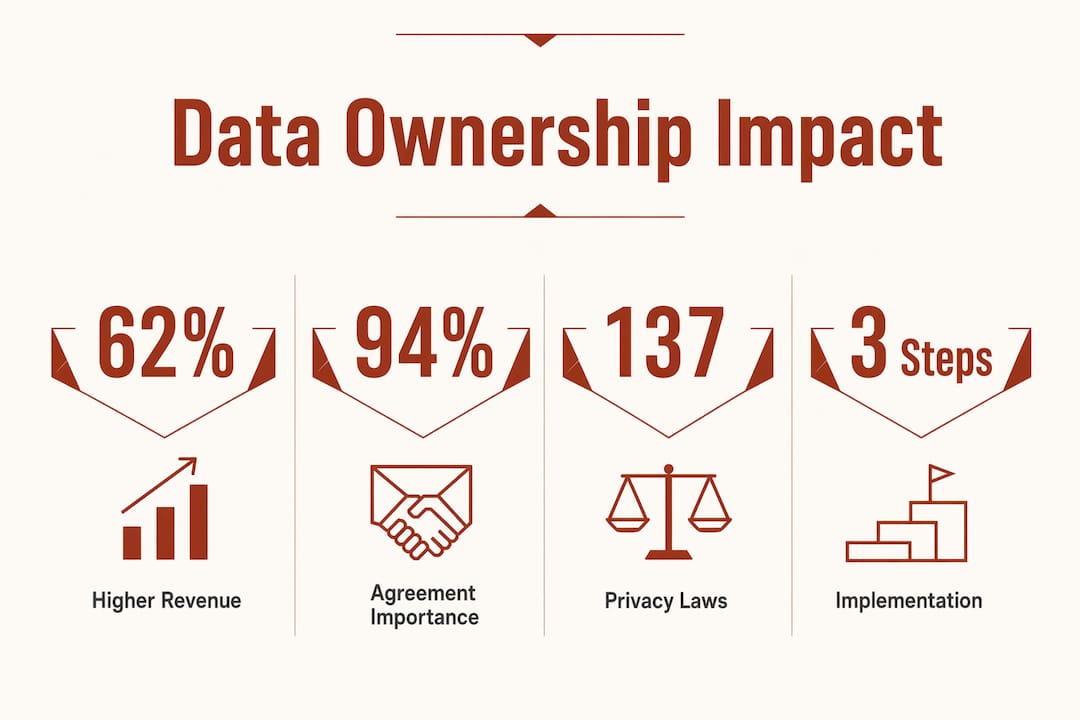
Clear data ownership is the operational mechanism that makes compliance possible. Without a named data controller or owner for each domain, organisations cannot produce the audit trails, processing records, or access logs that regulators require.
The risks of non-compliance are concrete:
- Financial penalties under regulations such as the GDPR can reach tens of millions of pounds or a percentage of global annual turnover, whichever is higher.
- Reputational damage from a publicised breach or regulatory action can erode client trust for years.
- Operational disruption from enforcement investigations diverts resources from core business activities.
- Contractual liability arises when data processing agreements with partners or clients cannot be substantiated.
Named data owners support compliance directly. During an audit, a data owner can produce documentation of who accessed a dataset, when changes were made, and how data quality was maintained. Without that named accountability, the organisation relies on reconstructed records, which regulators treat with scepticism.
Jamaica's Data Protection Act 2020 imposes obligations on data controllers that mirror this international pattern. Organisations operating under Jamaican law must identify their data controllers, document processing purposes, and restrict cross-border transfers. Data ownership is not a governance preference under these conditions. It is a legal requirement.
Does legal ownership guarantee operational control?
Legal ownership and operational control are not the same thing. A contract may state that an organisation owns its data, but SaaS vendor restrictions such as API rate limits, export constraints, and pricing penalties can make it practically impossible to access or move that data freely.
This distinction matters enormously for long-term resilience. An organisation that stores its customer records on a foreign cloud platform may own those records in a legal sense, yet find itself unable to export them in bulk without paying significant fees or waiting weeks for a vendor-managed process.
Vendor lock-in creates several specific risks:
- API dependency means that data access is mediated by a third party whose terms of service can change without notice.
- Export format restrictions can render data unusable outside the vendor's own ecosystem.
- Pricing penalties for high-volume data retrieval make switching costs prohibitive.
- Jurisdictional exposure arises when data sits on servers governed by foreign law, such as the US CLOUD Act, which can compel American companies to disclose data regardless of where it is physically stored.
Pro Tip: Before signing any SaaS agreement, test the export function. Download a full copy of your data in a standard format and verify that it is complete and usable. If the vendor restricts this, treat it as a contractual red flag.
First-party data strategies and self-hosted infrastructure address these risks directly. When an organisation hosts its own data on sovereign infrastructure, operational control matches legal ownership. There are no intermediaries, no export fees, and no exposure to foreign legal instruments.
How to implement effective data ownership in your organisation
Effective data ownership requires deliberate assignment, not assumption. Governance experts confirm that without named data owners holding explicit authority, governance policies become documentation without accountability. The policy exists, but no one enforces it.
A practical implementation follows this sequence:
- Identify your highest-risk or highest-value data domains. Customer records, financial data, and health information typically qualify. Starting with a few domains builds momentum without overwhelming the organisation.
- Assign a named data owner to each domain. This person must be a business leader, not an IT administrator. Ownership belongs in the business unit that creates and uses the data.
- Define the owner's authority explicitly. The owner must have the power to approve access requests, enforce quality standards, and resolve definitional conflicts. Without delegated authority, ownership is a title without teeth.
- Appoint data stewards to support each owner. Stewards handle day-to-day quality tasks and act as the operational layer beneath the owner's strategic accountability.
- Use a RACI framework to document who is Responsible, Accountable, Consulted, and Informed for each data domain. This prevents ambiguity and supports audit documentation.
- Measure business outcomes, not governance activity. Track error rates, decision speed, and compliance incidents rather than the number of policies written.
Organisations that embed ownership within business units rather than centralising governance in a data office consistently achieve better outcomes. Centralised governance creates bottlenecks. Distributed ownership, with clear authority at the domain level, scales as the organisation grows.
Avoiding the IT-only trap is critical. When data governance is treated as a technology project, business leaders disengage. Ownership must be framed as a business responsibility with technology as the enabler.
Why digital sovereignty depends on data ownership
Digital sovereignty is now a non-negotiable right for organisations that intend to control their own business strategy and AI initiatives. The World Economic Forum confirmed in 2026 that sovereignty over data has transitioned from an optional governance preference to a foundational requirement for competitive independence.
The connection to AI strategy is direct. Organisations training or deploying AI models on their own data must own and control that data completely. Data siloes, vendor restrictions, and unclear ownership undermine AI effectiveness by limiting the quality and completeness of training datasets.
"Digital sovereignty is no longer a luxury or a technical preference. It is the foundation upon which organisations build their capacity to act independently, to innovate without permission, and to protect the interests of the people whose data they hold. Without ownership, there is no sovereignty. Without sovereignty, there is no genuine strategy."
World Economic Forum, 2026
Ownership also determines an organisation's capacity to respond to regulatory change. When data is clearly owned, documented, and controlled, adapting to a new privacy law requires updating policies and access controls. When ownership is unclear, regulatory change triggers an expensive and disruptive audit of the entire data estate.
The economic case for data sovereignty is particularly clear for organisations operating in jurisdictions with their own data protection frameworks. Keeping data on local infrastructure, under local law, removes exposure to conflicting international legal instruments and strengthens the organisation's position with local regulators and clients.
Key takeaways
Data ownership is the single most important governance decision an organisation makes, because it determines whether every other governance policy has anyone accountable for enforcing it.
| Point | Details |
|---|---|
| Financial impact is measurable | Clear data ownership correlates with up to 62% higher revenue growth and 97% higher profit margins. |
| Regulatory compliance requires named owners | With 137 active global privacy laws in 2026, named data controllers are a legal necessity, not a best practice. |
| Legal ownership differs from operational control | SaaS vendor restrictions can prevent access to data you legally own; sovereign infrastructure closes this gap. |
| Ownership belongs in business units | Embedding data owners within business domains, not IT, produces accountability that scales and sustains. |
| Digital sovereignty depends on ownership | Organisations without clear data ownership cannot achieve genuine control over their AI strategy or competitive independence. |
Data ownership: what I have learned from watching organisations get it wrong
Most organisations I have observed treat data ownership as a governance formality. They appoint a Chief Data Officer, publish a data policy, and assume the work is done. The policy sits in a shared drive. Nobody enforces it. Data quality continues to deteriorate, and when a regulator asks who is accountable for a specific dataset, the answer is a committee.
The uncomfortable truth is that governance without ownership is not governance at all. It is documentation. The moment you remove a named individual with explicit authority from the equation, you have created a system that looks accountable on paper and is accountable to no one in practice.
The organisations that get this right share one characteristic. They treat data ownership as a business leadership responsibility, not a technology project. The owner of the customer data domain is the Head of Sales or the Chief Commercial Officer, not the database administrator. That person has authority to reject a data request that does not meet quality standards, and they use it.
Regulatory change and the rise of AI are accelerating the consequences of getting this wrong. Organisations that have not established clear ownership will find themselves unable to train reliable AI models, unable to respond to subject access requests within legal timeframes, and unable to demonstrate compliance to auditors. The data governance framework that supports ownership is not complex. The discipline to implement it is what most organisations lack.
My observation is that the organisations most at risk are those that have grown quickly through SaaS adoption without ever asking who actually controls their data. They have legal ownership in their contracts and operational dependency in their architecture. That gap is where risk lives.
— Michael
How Islandedgetech supports sovereign data ownership
Islandedgetech builds sovereign cloud infrastructure specifically for organisations that need data ownership to mean something in practice, not just in contracts.
The EdgePod, Ackee, and Abeng product suite keeps data on Jamaican soil, under Jamaican law, and under the direct operational control of the organisations that own it. This eliminates exposure to the US CLOUD Act, supports full compliance with Jamaica's Data Protection Act 2020, and removes the vendor lock-in risks that undermine genuine data control. For organisations in healthcare, tourism, and financial services, this is not a technical preference. It is a compliance and resilience requirement. Explore Islandedgetech's sovereign cloud solutions to understand how clear data ownership and operational control can be built into your infrastructure from the ground up.
FAQ
What is data ownership in a business context?
Data ownership is the formal assignment of accountability and control over a specific data domain to a named individual or team. The owner holds authority over data quality, access, and compliance for that domain.
Why does data ownership matter for regulatory compliance?
With 137 active data privacy laws globally in 2026, regulators require organisations to identify named data controllers and produce audit trails. Without clear ownership, compliance documentation cannot be substantiated.
Can a business own data it stores on a third-party platform?
Legal ownership and operational control frequently diverge. SaaS vendor restrictions including API limits and export constraints can prevent an organisation from accessing or moving data it legally owns.
How does data ownership affect AI strategy?
AI models depend on complete, high-quality data. Without clear ownership, data siloes persist, quality enforcement fails, and the datasets used to train or operate AI systems become unreliable.
Who should be assigned as a data owner?
Data owners should be senior business leaders within the unit that creates and uses the data, not IT staff. The owner must hold explicit authority to approve access, enforce quality standards, and resolve definitional disputes.