
Data residency refers to the physical or geographic location where an organisation's data is stored and processed. Under frameworks such as the UK GDPR and the Data Protection Act 2018, where data physically resides determines which legal jurisdiction applies, which regulatory obligations attach, and which enforcement authorities hold power. For UK professionals, this is not an abstract technical detail. It is a compliance obligation with direct legal and operational consequences.
Key principles of data residency:
- Physical location matters: Data must reside on servers within a defined geographic boundary, as specified by applicable law.
- Regulatory compliance: The jurisdiction of data storage determines which privacy laws govern its processing and transfer.
- Operational control: Organisations must be able to demonstrate, audit, and enforce where their data sits at any given time.
- Transfer restrictions: Moving data across borders may require specific legal mechanisms, such as Standard Contractual Clauses under UK GDPR.
- Sector-specific rules: Industries including financial services, healthcare, and public sector face additional residency obligations beyond general data protection law.
Understanding data residency is the foundation for every subsequent compliance decision an organisation makes about its data infrastructure.
Table of Contents
- Why data residency matters more than most organisations realise
- What UK law says about data residency
- Data residency, data sovereignty, and data localisation: what is the difference?
- What makes data residency compliance genuinely difficult
- Best practices for data residency compliance in modern architectures
- Applying data residency principles in the UK market
- Key takeaways
- The discipline that technology alone cannot replace
Why data residency matters more than most organisations realise
Non-compliance with data residency regulations can result in financial penalties of up to 4% of an organisation's global annual revenue. For a mid-sized UK enterprise, that figure translates into a penalty that can materially threaten financial stability, not merely inconvenience it.

Beyond fines, the consequences extend further. Operational disruption, legal injunctions, and reputational damage are all documented outcomes of inadequate data residency management. A regulatory investigation alone, regardless of its outcome, consumes legal resource, management attention, and public credibility. Organisations in regulated sectors such as financial services or healthcare face the additional risk of losing operating licences.
The operational complexity of modern cloud environments compounds the risk. Data replicates across availability zones, backups travel to secondary regions, and AI or analytics services may process data in jurisdictions the data controller never explicitly authorised. Many organisations discover their data residency posture only when an audit or incident forces the question.
Statistic callout: Non-compliance with data residency regulations can trigger penalties of up to 4% of global annual revenue, making it one of the costlier regulatory risks in data governance.
Pro Tip: A common misconception is that selecting a cloud provider's "UK region" automatically satisfies data residency requirements. It does not. Contractual rights, encryption controls, and audit mechanisms are equally necessary to demonstrate genuine compliance.
What UK law says about data residency
The primary legislative instruments governing data residency in the United Kingdom are the Data Protection Act 2018 and the UK General Data Protection Regulation (UK GDPR), which was retained in domestic law following the UK's departure from the European Union. Together, they establish the conditions under which personal data may be stored, processed, and transferred, including the geographic constraints that define data residency obligations.
Key legal obligations under UK law:
- Lawful basis for processing: Data controllers must establish a lawful basis before processing personal data, regardless of where it is stored.
- Cross-border transfer restrictions: Transfers of personal data outside the UK require an adequacy decision, Standard Contractual Clauses, or another approved transfer mechanism.
- Right to erasure: Under Article 17 of UK GDPR, organisations must respond to erasure requests within one month, extendable by two months for complex cases, which has direct implications for data stored across multiple jurisdictions.
- Data minimisation and storage limitation: Data must not be retained longer than necessary, requiring organisations to know precisely where data resides to enforce deletion.
- Accountability principle: Controllers must be able to demonstrate compliance, which requires documented evidence of data locations and transfer mechanisms.
The UK GDPR imposes strict limits on cross-border transfers but does not mandate absolute data localisation. In practice, however, the transfer restrictions produce effects that closely resemble localisation for many categories of personal data. Sector-specific regulation adds further layers: the Financial Conduct Authority, NHS Digital, and the National Cyber Security Centre each publish guidance that effectively tightens residency expectations for their respective industries.
| Regulation | Scope | Key Residency Requirement |
|---|---|---|
| UK GDPR | All personal data processing in the UK | Restricts transfers outside UK without adequate safeguards |
| Data Protection Act 2018 | Supplements UK GDPR; covers law enforcement and intelligence | Applies strict processing conditions; limits international transfers |
| FCA Data Rules | Financial services firms | Requires data to remain accessible and auditable within UK jurisdiction |
| NHS Data Security Standards | Health and social care organisations | Mandates UK-based storage for patient data; restricts offshore processing |
| NIS Regulations 2018 | Operators of essential services and digital service providers | Requires security measures including geographic controls over critical data |
For organisations managing health data residency requirements, the intersection of general data protection law and sector-specific standards creates a particularly demanding compliance environment.
Data residency, data sovereignty, and data localisation: what is the difference?
These three terms appear together frequently, and they are often used interchangeably. They are not the same concept, and conflating them leads to compliance gaps.
Data residency specifies the physical location of data storage and processing, while data sovereignty denotes the legal jurisdiction and laws applied to data regardless of location. A UK company storing data on servers in Frankfurt satisfies a German residency requirement, but the data may still be subject to UK law if the data controller is a UK-established entity. Location and jurisdiction do not always align.
Data localisation is a stricter requirement than data residency, prohibiting the transfer or processing of data outside specified national borders entirely. Russia's Federal Law No. 242-FZ and China's Data Security Law are examples of localisation regimes. The UK does not currently impose absolute localisation, but the practical effect of UK GDPR transfer restrictions approaches it for certain categories of sensitive personal data.
| Concept | Core Requirement | Legal Mechanism | Strictness |
|---|---|---|---|
| Data residency | Data stored within a defined geographic location | Regulatory mandate or contractual obligation | Moderate |
| Data sovereignty | Data subject to the laws of a specific jurisdiction | Jurisdictional law; may follow data controller's domicile | Variable |
| Data localisation | Data prohibited from leaving national borders | Statutory prohibition on cross-border transfer | Highest |
The practical distinction matters for architectural decisions. An organisation satisfying data residency by storing data in a UK data centre may still face data sovereignty exposure if its cloud provider is subject to the US CLOUD Act, which can compel American companies to produce data regardless of where it physically resides. Residency without sovereignty is an incomplete compliance posture.
Additional distinctions worth noting:
- Data residency is primarily a geographic concept; data sovereignty is primarily a legal one.
- A data localisation regime subsumes residency requirements but adds the prohibition on export.
- Sovereignty risk can arise even when residency requirements are fully met, particularly where foreign-owned cloud infrastructure is involved.
- Understanding data sovereignty advantages is increasingly relevant for any sector handling sensitive personal or commercial data.
What makes data residency compliance genuinely difficult
The technical and organisational challenges of enforcing data residency are frequently underestimated at the point of architectural design. Cloud environments, by their nature, are built for efficiency through distribution. Data replication, geo-redundant backups, and globally distributed AI inference services all move data across borders as a matter of routine operation, often without explicit configuration by the data controller.
Cloud providers offering data residency in the EU may not guarantee data sovereignty due to extraterritorial laws such as the US CLOUD Act. The same principle applies to UK-region cloud deployments: physical location in the UK does not insulate data from foreign legal compulsion if the provider is incorporated in a jurisdiction with extraterritorial reach.
Key operational challenges:
- Data flow mapping: Organisations frequently lack a complete, current map of where data travels, including through third-party processors and sub-processors.
- Classification gaps: Without accurate data classification, it is impossible to determine which data is subject to residency requirements and which is not.
- Cloud replication and backups: Automated replication to secondary regions may silently violate residency constraints unless explicitly disabled and contractually restricted.
- AI and analytics services: Machine learning pipelines often process data in regions selected for computational efficiency rather than regulatory compliance.
- Accidental cross-jurisdictional access: Support personnel, DevOps teams, or third-party vendors accessing data from outside the designated jurisdiction can constitute a transfer under UK GDPR.
- Sub-processor chains: A primary cloud provider may engage sub-processors in multiple jurisdictions, each introducing residency risk.
Pro Tip: Contractual controls are as important as technical ones. Data Processing Agreements with cloud providers and sub-processors should explicitly restrict data to approved jurisdictions, prohibit cross-border access without authorisation, and require notification of any change to processing locations. Review these agreements annually.
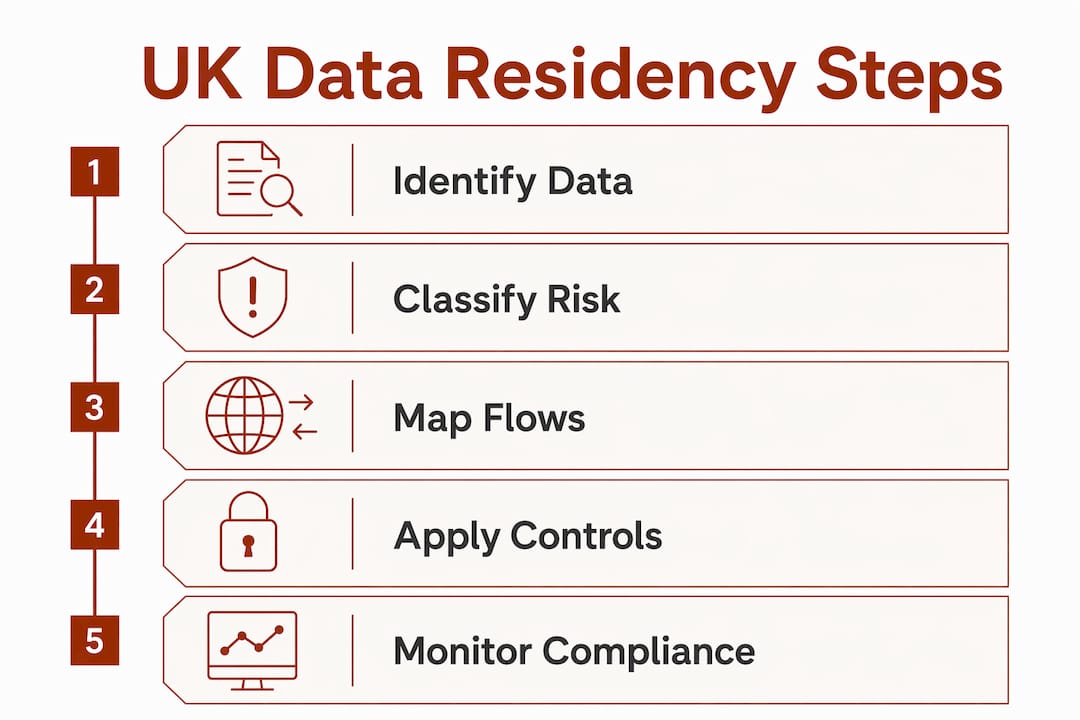
Data residency compliance is a continuous process, involving data classification, flow mapping, gap analysis, and ongoing monitoring. Treating it as a one-off project at the point of system deployment is one of the most common and consequential errors organisations make.
For a structured view of the types of data residency risks that organisations face across different operational contexts, the taxonomy of risk categories provides a useful starting framework.
Best practices for data residency compliance in modern architectures
Effective compliance in distributed and cloud-native environments requires a combination of architectural discipline, cryptographic controls, and automated policy enforcement. No single measure is sufficient on its own.
Regional data planes with global control planes represent the most mature architectural pattern for multi-tenant systems with residency requirements. Sensitive personal data, particularly personally identifiable information (PII), is processed and stored within isolated regional infrastructure. Metadata and control-plane operations, which carry no residency obligation, operate globally. This separation allows organisations to meet residency requirements without sacrificing the operational benefits of centralised management.
Encryption key sovereignty is critical to true data sovereignty. Customer-managed encryption keys prevent cloud providers from accessing data under compulsion from foreign legal authorities. Bring Your Own Key (BYOK) and Hold Your Own Key (HYOK) models give the data controller exclusive cryptographic control, meaning that even if a provider receives a legal order, the data remains inaccessible without the controller's keys.
Technical and organisational controls for residency compliance:
- Automated geo-fencing: Policy enforcement tools that prevent data from being written to or read from non-approved regions, enforced at the infrastructure layer rather than relying on manual configuration.
- Data classification and tagging: Every data asset tagged with its residency requirement at creation, enabling automated routing and storage decisions.
- Continuous monitoring and alerting: Real-time detection of data leaving approved geographic boundaries, with automated remediation where possible.
- Crypto-shredding for erasure compliance: Per-subject key destruction renders all copies of data, including backups and replicas, cryptographically unrecoverable, satisfying the right to erasure without requiring physical deletion from every storage location.
- Third-party audit rights: Contractual rights to audit cloud providers and sub-processors for compliance with residency obligations, exercised at least annually.
- Access control by geography: Restricting administrative and support access to data based on the geographic location of the accessor, preventing inadvertent cross-border transfers through support channels.
Strong compliance architectures leverage cryptographic key control, rigorous access restrictions, and automation to address complex multi-jurisdictional environments. Organisations that rely solely on contractual commitments from cloud providers, without implementing independent technical controls, carry residency risk that their contracts cannot fully mitigate.
Statistic callout: Regulatory penalties for data residency non-compliance can reach 4% of global annual revenue. Architectural investment in residency controls is measurably less costly than enforcement action.
For a broader view of legal data compliance requirements, the intersection of residency, sovereignty, and sector-specific regulation defines the full compliance perimeter organisations must address.
Applying data residency principles in the UK market
UK organisations face a compliance environment shaped by the Data Protection Act 2018, UK GDPR, and a growing body of sector-specific guidance from regulators including the Information Commissioner's Office (ICO), the Financial Conduct Authority, and NHS England. The post-Brexit landscape has introduced additional complexity: the UK now operates its own adequacy framework, and transfers between the UK and EU require separate legal mechanisms from those governing EU-to-third-country transfers.
A practical illustration of residency risk in the UK context involves financial services firms using US-headquartered cloud providers for customer data storage. Even when data is held in a UK-region data centre, the provider's US incorporation means the CLOUD Act potentially applies. The ICO has acknowledged this tension but has not issued a blanket prohibition; instead, it expects data controllers to conduct transfer impact assessments and implement supplementary measures, including encryption key sovereignty.
UK-specific considerations for data residency compliance:
- The ICO's accountability framework requires documented evidence of data locations, transfer mechanisms, and residency controls.
- UK GDPR adequacy decisions for third countries are assessed independently of EU GDPR adequacy decisions; a country deemed adequate by the EU is not automatically adequate under UK law.
- The UK's International Data Transfer Agreement (IDTA) is the domestic equivalent of the EU's Standard Contractual Clauses and must be used for transfers from the UK to non-adequate countries.
- Public sector bodies are subject to additional constraints under the Government Security Classifications policy, which imposes residency requirements on data classified as OFFICIAL-SENSITIVE or above.
- Healthcare organisations must comply with NHS Data Security and Protection Toolkit requirements, which include explicit data location controls.
Common questions from UK professionals:
Does storing data in a UK data centre automatically satisfy UK GDPR residency requirements? Not entirely. Physical location is necessary but not sufficient. Organisations must also ensure that contractual controls, access restrictions, and encryption measures prevent unauthorised cross-border access or transfer.
What happens if a sub-processor moves data outside the UK without notification? The data controller remains liable under UK GDPR. Sub-processor agreements must require prior notification of any change to processing locations, and controllers must conduct a transfer impact assessment before approving any such change.
How does the CLOUD Act affect UK data residency compliance? The CLOUD Act allows US authorities to compel US-incorporated cloud providers to produce data regardless of its physical location. UK data controllers using such providers should implement customer-managed encryption keys and conduct transfer impact assessments to document and mitigate this risk.
Islandedgetech's approach to sovereign cloud infrastructure demonstrates how organisations can achieve genuine data residency by combining physical location controls with encryption key sovereignty and contractual restrictions, eliminating the gap between where data sits and where legal jurisdiction applies.
Key takeaways
Data residency compliance requires physical location controls, encryption key sovereignty, and continuous monitoring working together; no single measure is sufficient on its own.
| Point | Details |
|---|---|
| Data residency is a legal obligation | Physical data location determines regulatory jurisdiction and compliance obligations under the UK GDPR and the Data Protection Act 2018. |
| Regulatory penalties for non-compliance with data residency regulations can reach up to 4% of an organisation's global annual revenue, making it one of the most significant financial risks in data governance. | |
| Residency differs from sovereignty | Data residency addresses where data is stored; data sovereignty addresses which laws govern it, and the two do not always align. |
| Cloud location alone is insufficient | Selecting a UK cloud region does not guarantee compliance; contractual controls, encryption key sovereignty, and audit rights are equally necessary. |
| Compliance is continuous | Data classification, flow mapping, gap analysis, and monitoring must be ongoing processes, not one-off exercises at system deployment. |
The discipline that technology alone cannot replace
The most consequential observation about data residency compliance is one that architectural diagrams rarely capture: the gap between what an organisation believes its data posture to be and what it actually is. Organisations invest in regional cloud deployments, draft data processing agreements, and implement encryption. Then an audit reveals that a support engineer accessed production data from outside the approved jurisdiction, or that a backup job quietly replicated to a secondary region months ago.
Technology creates the conditions for compliance. Discipline maintains it. The organisations that manage data residency most effectively treat it as an operational practice, not a project. They classify data continuously, review sub-processor agreements annually, test geo-fencing controls, and conduct transfer impact assessments before onboarding new services, not after an incident forces the question.
There is also a forward-looking dimension that UK professionals should take seriously. Regulatory enforcement of data residency obligations is intensifying globally, and the ICO has signalled increased scrutiny of international transfer mechanisms following post-Brexit divergence from EU standards. The organisations that will navigate this environment with the least disruption are those that have already built residency controls into their architecture and governance processes, rather than those scrambling to retrofit compliance onto systems designed without it.
The distinction between data residency, data sovereignty, and data localisation is not academic. It determines whether an organisation's compliance posture holds under legal challenge, and whether its data remains genuinely protected from extraterritorial reach. Getting that distinction right, and building infrastructure that reflects it, is the work that separates organisations that are compliant from those that merely believe they are.