
A private education cloud is a single-tenant, education-tailored cloud environment where compute, storage, and networking resources are reserved exclusively for one institution, never shared with other organisations. Unlike public cloud arrangements, this dedicated infrastructure gives educational bodies direct control over where data lives, who can access it, and how it is protected. For Jamaican organisations operating under the Data Protection Act 2020, and for institutions in the UK subject to UK GDPR and the Data Protection Act 2018, that control is not a preference; it is a legal obligation. Shifting from capital-intensive on-premises hardware to a private cloud model also converts unpredictable capital refresh cycles into predictable operational expenditure, which matters considerably when budgets are fixed and audit obligations are ongoing.
Table of Contents
- What does a private education cloud actually include?
- Why educational institutions choose a private cloud
- Data residency and compliance: what to verify before signing
- Which deployment model fits your institution?
- How to evaluate private education cloud providers: a procurement checklist
- Costs and total cost of ownership
- How to implement a private cloud: a migration roadmap
- Common risks and how to mitigate them
- Practical next steps for decision-makers
- Key takeaways
- Why sovereign control matters more than most institutions realise
What does a private education cloud actually include?
A private education cloud is rarely just hardware. It is a software-defined infrastructure layer that separates the management plane from physical servers, enabling granular policy enforcement across distinct data classes.
Core technical capabilities to expect:
- Virtualised compute: Dedicated processing capacity that scales without sharing CPU or memory with external tenants.
- Block and object storage: Separate storage tiers for structured records (student information systems) and unstructured data (research files, media).
- Private networking (VLANs): Logically isolated network segments that prevent lateral movement between departments or faculties.
- Identity and access management (IAM): Role-based access control (RBAC) and attribute-based access control (ABAC), with single sign-on and federation via SAML or OIDC for student and staff accounts.
- Encryption: At-rest and in-transit encryption with customer-managed key (CMK) options and documented key rotation schedules.
- Audit logging and immutable backups: Tamper-evident logs and retention controls aligned to institutional data retention policies.
- LMS and SIS integration: Pre-built connectors or open APIs for learning management systems, student information systems, research databases, and analytics pipelines.
- Self-service provisioning: A portal for IT teams to allocate resources, monitor capacity, and manage SLAs without raising tickets for every change.
| Capability | Why it matters for education |
|---|---|
| RBAC / ABAC | Separates student records from research datasets and administrative finance data |
| CMK encryption | Institution retains key custody; provider cannot access data unilaterally |
| Immutable backups | Protects against ransomware and satisfies audit evidence requirements |
| LMS / SIS APIs | Avoids data silos and manual re-entry between teaching and administrative systems |
| Private VLANs | Enforces network-level separation between faculties and administrative functions |
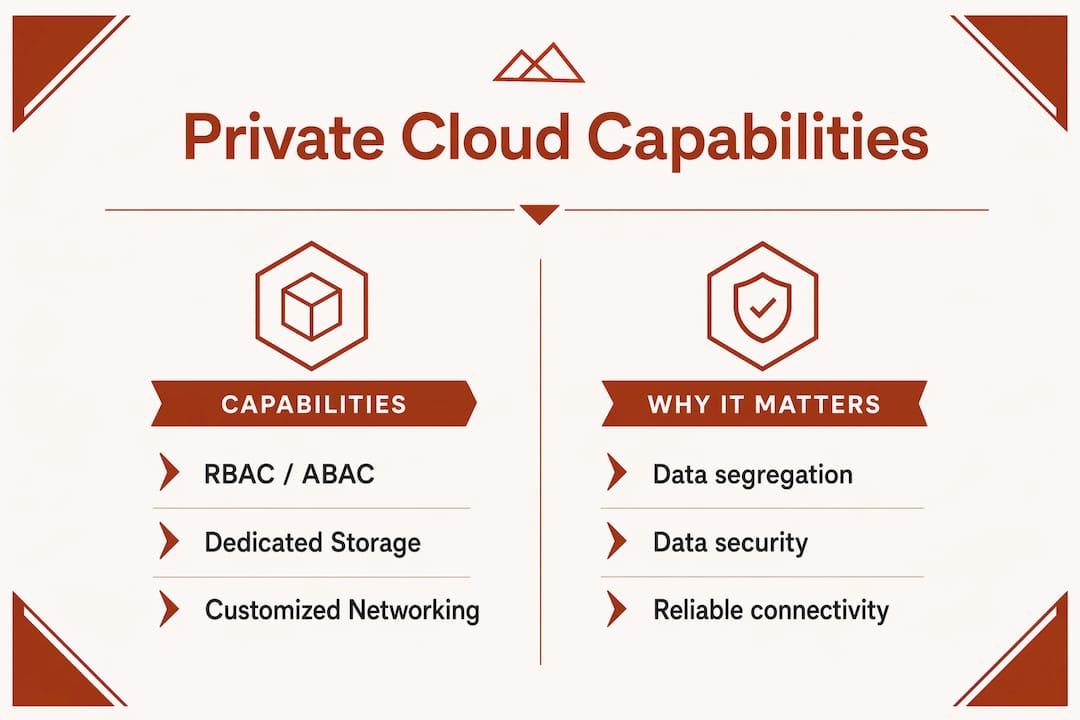
Why educational institutions choose a private cloud
Private clouds help educational institutions centralise sensitive data, including student records, financial information, and research data, while maintaining strict data residency and compliance with applicable regulations.
Primary benefits:
- Data residency control: Data stays within a defined physical location, satisfying jurisdictional requirements and simplifying subject access request responses.
- Compliance posture: A single-tenant environment makes it substantially easier to demonstrate compliance with UK GDPR, the Data Protection Act 2018, and equivalent Jamaican legislation, because the institution controls the technical and organisational measures directly.
- Predictable spend: Moving from capital hardware refresh cycles to operational expenditure removes budget surprises and makes multi-year financial planning more reliable.
- Performance for specialist workloads: Assessment platforms, high-throughput research datasets, and real-time analytics perform more consistently on dedicated infrastructure than on shared public tenancies.
- Customisation: Institutions can configure security policies, retention schedules, and network topology to match their specific governance requirements rather than accepting a provider's defaults.
Pro Tip: Before modelling any migration, run a TCO conversation that maps current staff time, compliance monitoring costs, and hardware refresh schedules against the proposed operational expenditure. Assuming a straightforward lift-and-shift consistently underestimates total cost.

Data residency and compliance: what to verify before signing
Private cloud adoption enables localised governance and stronger technical controls, but contractual guarantees matter as much as technical architecture.
Checklist for procurement and compliance teams:
- Physical location of data centres: Contracts must specify the country and, where possible, the facility where primary data, backups, and disaster recovery copies reside. Cross-border replication without explicit consent is a breach of UK GDPR Article 44 obligations.
- Data processing agreement (DPA): Require a DPA aligned to UK GDPR and the Data Protection Act 2018, covering processor obligations, data subject rights, and breach notification within 72 hours.
- Certifications: Require evidence of ISO 27001 certification, Cyber Essentials (or Cyber Essentials Plus), and, where the provider serves regulated sectors, SOC 2 Type II audit reports.
- Encryption and key management: Confirm who holds encryption keys, the key rotation schedule, and whether customer-managed keys are available so the institution retains unilateral control.
- Audit rights: Contracts should grant the institution the right to commission or review independent audits of the provider's controls.
- Exit and portability terms: Define data export formats, the timeline for data return on contract termination, and the provider's obligation to assist with migration.
UK GDPR and the Data Protection Act 2018 require data controllers to implement appropriate technical and organisational measures. For educational institutions, that means documented residency guarantees, not just verbal assurances from a sales team.
Understanding student data privacy obligations is foundational before any provider contract is signed.
Which deployment model fits your institution?
Confusing deployment types is one of the most common causes of project failure when organisational maturity is not matched to the chosen model.
Deployment options and their trade-offs:
- On-premises private cloud: Greatest control over physical infrastructure and data location. Highest CAPEX, staffing requirement, and maintenance burden. Suited to institutions with mature in-house IT teams and long asset lifecycles.
- Hosted private cloud (UK-based): Dedicated infrastructure in a UK data centre operated by a third-party provider. Sovereignty is maintained through contractual residency guarantees; operational burden shifts to the provider. Appropriate for most mid-sized institutions.
- Managed private cloud: The provider handles day-to-day operations, patching, and monitoring under agreed SLAs. Reduces internal staffing requirements significantly, though the institution must verify that management access does not create residency or access-control risks.
- Hybrid model: Sensitive workloads (student records, financial data) remain on a private cloud; non-sensitive services (public-facing websites, open research repositories) use hosted or public resources. Requires clear data classification policies to govern which workload sits where.
- Edge deployments: Campus-local infrastructure for performance-sensitive services (assessment platforms, laboratory systems) and offline resilience. Relevant where connectivity is unreliable or latency requirements are strict.
Match the model to IT maturity and the lifecycle of the application: a legacy student information system with complex integrations warrants a different approach than a new analytics workload built on open APIs.
How to evaluate private education cloud providers: a procurement checklist
A structured evaluation reduces the risk of selecting a provider whose capabilities do not match the institution's compliance obligations. Assessing workload fit before committing to a provider is as important as evaluating the technology itself.
Technical and security requirements:
- Written data residency guarantee specifying data centre location(s) for primary data, backups, and DR copies.
- Encryption at rest and in transit, with CMK options and documented key rotation.
- SLA definitions covering uptime (minimum 99.9%), incident response times, and escalation paths.
- Integration APIs for LMS, SIS, and identity federation (SAML 2.0 / OIDC).
- Evidence of ISO 27001 certification and Cyber Essentials; SOC 2 Type II where applicable.
- Penetration testing cadence (minimum annual) and access to redacted reports.
- Audit log retention aligned to the institution's data retention schedule.
- Documented incident response process and breach notification within 72 hours.
Commercial and contractual requirements:
- Clear OPEX pricing with no hidden egress fees or change-of-service charges.
- Exit assistance: data export in open formats, migration support, and a tested export process.
- Service credits for SLA breaches, with defined measurement methodology.
- Local support hours, named escalation contacts, and a dedicated account manager.
Reviewing common cloud compliance mistakes before issuing an RFP helps procurement teams frame the right questions.
Costs and total cost of ownership
Hidden TCO frequently exceeds initial estimates because compliance monitoring, logging retention, and specialist staff managing encryption and key custody create sustained operational costs that headline pricing does not capture.
Main cost buckets:
- Infrastructure (CAPEX for on-premises; OPEX for hosted or managed models).
- Software licences: hypervisor, management platform, security tooling, and backup software.
- Staff or managed services: in-house cloud operations, security monitoring, and compliance support.
- Compliance and audit costs: annual certification renewals, penetration testing, and DPO time.
- Backup, disaster recovery, and replication costs.
- Network and egress fees, particularly for hybrid models with public cloud components.
Hidden TCO items to quantify explicitly: specialist staff time for key management, log review, DR testing, and audit evidence preparation. These are recurring costs that a three-year TCO model must include alongside infrastructure spend.
Pro Tip: Request a three-year TCO comparison from shortlisted providers that maps current spend (including staff time and compliance overhead) to proposed OPEX. A provider unwilling to produce this comparison is a procurement risk.
How to implement a private cloud: a migration roadmap
Governance, strategic planning, and stakeholder training are as decisive as technical choices for successful cloud adoption. A phased approach reduces risk and creates evidence of compliance at each stage.
Migration steps:
- Assess and classify: Inventory all data and workloads; classify by sensitivity, regulatory obligation, and business criticality.
- Pilot: Select a non-critical system (a staff intranet or a test LMS environment) and migrate it first. Validate compliance controls, performance, and SLAs before proceeding.
- Validate: Confirm data residency, encryption, and access controls meet contractual and legal requirements. Conduct a post-pilot audit.
- Scale in waves: Migrate workloads in priority order with rollback plans for each wave. Initial phase: several months. Organisational scale thereafter.
Governance roles to assign:
- Data Protection Officer (DPO): Oversees compliance obligations and breach notification.
- Cloud operations lead: Manages day-to-day infrastructure, SLA monitoring, and capacity planning.
- Application owners: Accountable for individual systems and their data classification.
- Governance board: Reviews policy, approves changes, and conducts periodic TCO reviews.
Policies to establish before go-live: data classification, retention schedules, access review cadence, and an incident response playbook. Training for IT staff, faculty, and administrative users should be scheduled before each migration wave, not after.
Operational guidance for implementing a data privacy policy in educational settings provides a practical complement to the technical migration plan.
Common risks and how to mitigate them
| Risk | Mitigation |
|---|---|
| Vendor lock-in | Require open data export formats, portability clauses, and migration assistance in the contract |
| Compliance drift | Schedule annual policy reviews, access audits, and certification renewals; assign DPO oversight |
| DR failure | Test disaster recovery quarterly; require provider to evidence RTO and RPO against SLA commitments |
| Staff skill shortages | Include managed services or training obligations in the contract; maintain runbooks for all critical processes |
| Governance gaps | Establish a governance board before go-live; define escalation paths and incident response playbooks |
Procurement mitigations: Require evidence of previous education-sector deployments, references from comparable institutions, and service credits for SLA breaches. A provider with no demonstrable education-sector experience presents a higher delivery risk regardless of technical capability.
Practical next steps for decision-makers
Immediate actions (next 30 days):
- Convene a TCO workshop with IT, finance, legal/DPO, and an academic systems representative.
- Classify critical datasets by sensitivity and regulatory obligation.
- Select a two-to-four week pilot scope (a non-critical system with clear success criteria).
- Request written evidence of data residency guarantees and current certifications from shortlisted providers.
- Draft an RFP skeleton covering the technical, security, and commercial requirements listed in the procurement checklist above.
The roles required in the first planning meeting: DPO or legal counsel, IT lead, finance lead, an academic systems representative, and the procurement sponsor. The deliverable from that meeting is a pilot scope, a preliminary TCO model, and an agreed RFP timeline.
Key takeaways
A private education cloud is a single-tenant, education-tailored environment that gives institutions direct control over data residency, compliance posture, and operational spend, making it the most defensible infrastructure choice for organisations with regulatory obligations under UK GDPR or the Data Protection Act 2018.
| Point | Details |
|---|---|
| Single-tenant by design | Dedicated compute, storage, and networking ensure no data is shared with external tenants. |
| TCO before migration | Map staff time, compliance costs, and hardware refresh cycles before committing to any model. |
| Contract residency guarantees | Require written data centre location commitments for primary data, backups, and DR copies. |
| Phased pilot with governance | Start with a non-critical workload; assign DPO, cloud operations lead, and governance board before go-live. |
| Match model to IT maturity | On-premises suits mature in-house teams; hosted or managed private cloud suits most mid-sized institutions. |
Why sovereign control matters more than most institutions realise
The conversation about private education clouds tends to focus on technical architecture, and that focus, while understandable, consistently leads institutions to underestimate the governance dimension. The technical stack is solvable; the harder problem is building the organisational structures, policies, and training programmes that make the infrastructure defensible under audit.
What is frequently overlooked is the compounding cost of getting governance wrong after go-live. Compliance drift, access control gaps, and untested disaster recovery processes are not theoretical risks; they are the failure modes that appear in post-incident reviews. The institutions that navigate private cloud deployments most successfully are those that treat the governance board, the DPO's oversight role, and the incident response playbook as launch-critical deliverables, not post-launch housekeeping.
For Jamaican organisations specifically, the risk calculus is sharper still. Foreign cloud providers subject to the US CLOUD Act can be compelled to disclose data regardless of where it is physically stored. Sovereign infrastructure, kept on local soil under local law, is not a premium option; it is the only arrangement that genuinely removes that exposure. Islandedgetech's sovereign cloud infrastructure is built precisely around this principle, with data residency on Jamaican ground and compliance with the Data Protection Act 2020 as foundational design requirements, not optional add-ons.