
Patient data privacy is the legal and ethical protection of individuals' health information, governing how it is collected, stored, used, and shared. In the United Kingdom, this protection rests on three principal legal instruments: the Data Protection Act 2018 (DPA 2018), the UK General Data Protection Regulation (UK GDPR), and the Common Law Duty of Confidentiality (CLDC). Together, these frameworks require that processing be fair, lawful, and transparent, with no surprises for patients about how their information is used.
Patient data covers a broad range of identifiable information, including:
- Names, addresses, dates of birth, and National Insurance numbers
- Diagnoses, treatment records, and clinical notes
- Mental health information and prescription histories
- Genetic and biometric data
- Any combination of data that could identify an individual, directly or indirectly
Processing this information without a valid lawful basis, or without meeting the obligations of the CLDC, constitutes a breach of UK law. Healthcare organisations must satisfy both the statutory data protection requirements and the common law duty simultaneously; compliance with one does not substitute for the other.
How the Data Protection Act 2018 and UK GDPR govern patient consent
The DPA 2018 incorporated the EU GDPR into UK domestic law, creating what is now referred to as the UK GDPR. For healthcare organisations, this means that every collection, use, or disclosure of patient data requires a valid lawful basis under Article 6 of the UK GDPR, and, because health data is a special category, an additional condition under Article 9.
The lawful bases most relevant to healthcare include:
- Consent: The patient has given explicit, freely given, specific, and informed agreement.
- Vital interests: Processing is necessary to protect the life of the patient or another person.
- Public task: Processing is necessary for the performance of a task in the public interest, such as NHS service delivery.
- Legal obligation: Processing is required to comply with a legal duty.
Transparency is not optional. Articles 12, 13, and 14 of the UK GDPR set out detailed requirements for what organisations must communicate to patients, including the identity of the data controller, the purposes and legal bases for processing, how long data will be retained, and patients' rights to access or object. Organisations typically fulfil this through a privacy notice or fair processing information, which must be concise, written in plain language, and readily accessible.
Consent in healthcare carries particular weight. It must be distinguishable from other agreements, easy to withdraw, and documented. Where consent is the chosen lawful basis, organisations cannot make treatment conditional on patients agreeing to uses of their data that are unrelated to their direct care.

Pro Tip: Review your organisation's privacy notice against Articles 13 and 14 of the UK GDPR annually. Outdated notices that omit retention periods or fail to list all processing purposes are among the most common findings in Information Commissioner's Office (ICO) audits.
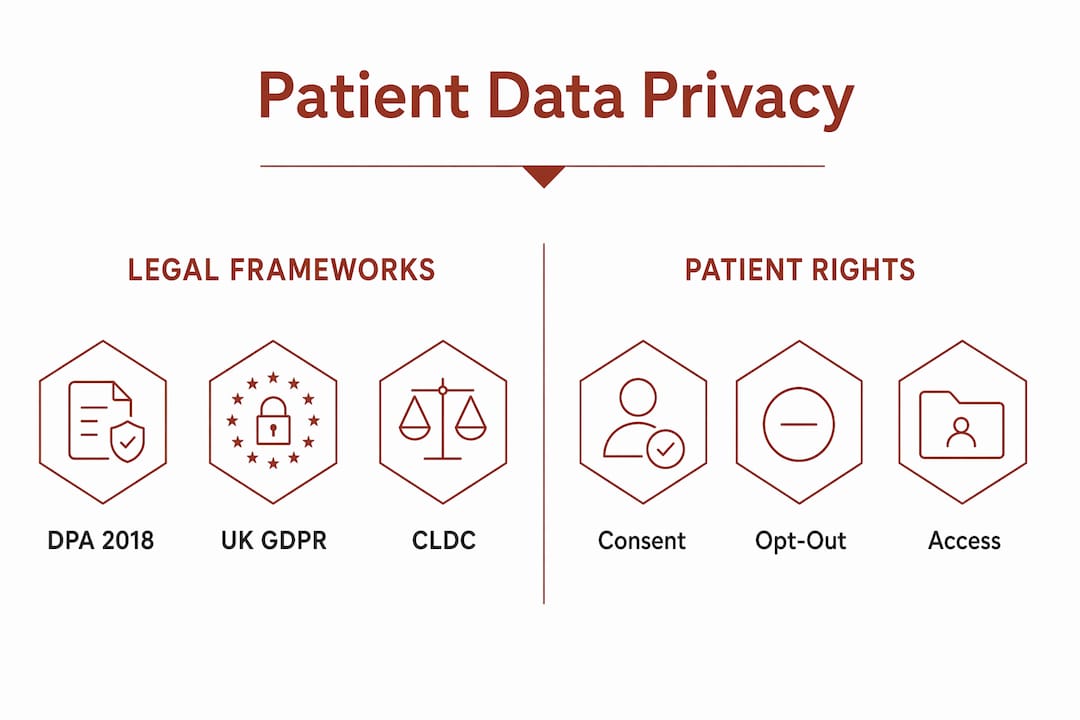
What the Common Law Duty of Confidentiality means for patient data
The Common Law Duty of Confidentiality predates modern data protection legislation by centuries and remains a distinct legal obligation. It applies whenever information is shared in circumstances that carry an expectation of confidence, which is precisely the situation in every clinical encounter.
The CLDC operates alongside, not instead of, the DPA 2018 and UK GDPR. An organisation that satisfies the statutory data protection requirements must still separately justify any disclosure under the common law. The key circumstances in which confidentiality may lawfully be overridden include:
- Explicit patient consent: The patient has agreed to the specific disclosure.
- Public interest: Disclosure is necessary to prevent serious harm to the patient or others, such as in cases of communicable disease or safeguarding concerns.
- Statutory authority: A specific law requires or permits the disclosure, for example, mandatory reporting of notifiable diseases.
- Court order: A judge has ordered disclosure.
Breaches of the CLDC can result in civil liability, professional regulatory action, and reputational damage to the organisation. A clinician who shares a patient's HIV status with an employer without consent, for example, faces potential action from both the ICO and their professional regulator. The duty applies to all staff who handle patient information, not only clinicians.
What Section 251 of the NHS Act 2006 authorises and when it applies
Section 251 of the NHS Act 2006 provides a statutory mechanism that permits the use of confidential patient information without individual consent in specific, tightly controlled circumstances. It is not a general exemption; it applies only where obtaining consent is not practicable and where the public benefit of the activity is clear.
Section 251 approval is most commonly used to support:
- Health research: Epidemiological studies and clinical trials where linking patient records is necessary but individual consent cannot reasonably be obtained.
- Service planning: NHS commissioning and health needs assessments that require identifiable data to produce accurate population-level analysis.
- Disease surveillance: Monitoring outbreaks and tracking the spread of communicable conditions across populations.
The approval process is overseen by the Health Research Authority's Confidentiality Advisory Group (CAG), which scrutinises each application to confirm that the proposed use is genuinely in the public interest, that the minimum necessary data is requested, and that appropriate safeguards are in place. Approval is time-limited and subject to conditions, including restrictions on onward disclosure and requirements for data security.
Organisations relying on Section 251 approval must still comply with the UK GDPR and the DPA 2018 in parallel. The approval addresses the common law confidentiality barrier; it does not remove the obligation to identify a lawful basis under data protection legislation.
Pro Tip: Section 251 approval does not override the national data opt-out. If a patient has registered an opt-out, their data must be excluded from Section 251-approved uses unless a specific exemption applies, such as direct care or a statutory requirement.
Organisational and professional standards that protect patient data
Healthcare organisations carry significant operational responsibilities for securing patient information, beyond simply knowing the law. The roles of data controller and data processor are central to this. The data controller determines the purposes and means of processing; the data processor acts on the controller's instructions. In NHS settings, an NHS trust is typically the data controller, while a third-party IT supplier processing data on its behalf is the data processor. Both carry distinct legal obligations.

The NHS Data Security and Protection Toolkit is the primary self-assessment tool for organisations with access to NHS patient data. It measures performance against the National Data Guardian's ten data security standards, covering areas including staff training, system access controls, and incident response. Completion is mandatory for NHS organisations and required for many third-party suppliers.
Technical safeguards in use across the NHS include:
- Pseudonymisation: Replacing direct identifiers with codes so that data cannot be attributed to an individual without additional information held separately.
- Anonymisation: Removing or aggregating identifiers to a degree where re-identification is not reasonably possible, allowing data to be used outside the scope of data protection law.
- Access controls: Role-based permissions that restrict data access to staff with a legitimate need, enforced through audit logs and regular access reviews.
- NHS Privacy Enhancing Technology: A suite of tools designed to enable data analysis and sharing while minimising the exposure of identifiable information.
- Encryption: Applied to data in transit and at rest, preventing interception or unauthorised access.
Beyond NHS-specific tools, zero trust security architecture is increasingly adopted in healthcare to address the limitations of perimeter-based security in complex, mobile clinical environments. Under a zero trust model, every user and device must authenticate before accessing any system, regardless of whether they are inside or outside the organisational network. ISO 27799:2025 extends the ISO 27002 information security controls to healthcare-specific contexts, including electronic health records and connected medical devices, providing a best-practice framework for information security management in health organisations.
| Standard / Tool | Scope | Primary Function |
|---|---|---|
| NHS Data Security and Protection Toolkit | NHS organisations and suppliers | Self-assessment against National Data Guardian standards |
| ISO 27799:2025 | Health organisations globally | Healthcare-specific information security controls |
| NHS Privacy Enhancing Technology | NHS data sharing | Minimise identifiable data exposure during analysis |
| Zero trust architecture | Clinical IT environments | Authenticate every access request, regardless of location |
| UK GDPR pseudonymisation | All data controllers | Reduce re-identification risk while retaining data utility |
Professional codes reinforce these technical controls. The General Medical Council, Nursing and Midwifery Council, and other regulatory bodies all impose confidentiality obligations on registered practitioners, with fitness-to-practise consequences for breaches. Staff training on data handling is not a discretionary activity; it is a requirement under the NHS Data Security and Protection Toolkit and a condition of employment in most healthcare settings.
What patients need to know about their rights over health data
Patients hold a defined set of rights under the UK GDPR that apply directly to their health records and to any other personal data held by healthcare organisations. These rights are not aspirational; they are legally enforceable.
The core rights are:
- Right of access (Subject Access Request): Patients can request a copy of all personal data held about them, including medical records, clinical notes, and correspondence. Organisations must respond within one calendar month.
- Right to rectification: Where data is inaccurate or incomplete, patients can request correction. This is particularly relevant for clinical records where a diagnosis or medication entry contains an error.
- Right to erasure: Also known as the "right to be forgotten," this applies in specific circumstances, such as where data is no longer necessary for the purpose it was collected. It does not override statutory retention obligations, so NHS records held under legal retention schedules cannot generally be erased on request.
- Right to data portability: Patients can request their data in a structured, machine-readable format for transfer to another provider, where the processing is based on consent or contract.
- Right to object: Patients can object to processing based on public task or legitimate interests, including the use of their data for research or planning purposes.
The national data opt-out is a separate but related mechanism. It allows patients to opt out of their confidential data being used for purposes beyond their direct care, such as research and planning. Organisations that fail to honour registered opt-outs risk being found non-compliant with the transparency requirements of the UK GDPR, as the ICO has confirmed that ignoring opt-outs may constitute a failure to process data fairly.
Patients who believe their rights have been violated can raise a complaint directly with the organisation, escalate to the ICO, or seek legal redress through the courts. The ICO can investigate, issue enforcement notices, and impose financial penalties.
Pro Tip: Patients should request a copy of their GP summary care record through the NHS App before submitting a formal Subject Access Request. Many queries about what data is held can be resolved quickly through this route, without the administrative burden of a formal request.
Consequences for healthcare organisations that breach data privacy laws
The ICO can impose fines of up to £17 million or 4% of global annual turnover for the most serious breaches of data protection legislation, whichever figure is higher. For NHS trusts and large private healthcare groups, this is not a theoretical ceiling. The ICO has demonstrated willingness to use its enforcement powers against healthcare organisations that fail to implement adequate technical and organisational safeguards.
Mandatory breach notification adds a further layer of pressure. Under the UK GDPR, organisations must report a personal data breach to the ICO within the legally required timeframe after becoming aware of it, where the breach is likely to result in a risk to individuals' rights and freedoms. Where the risk is high, affected patients must also be notified directly. Failures to report, or delayed reporting, attract separate enforcement action.
The operational consequences of a breach extend well beyond regulatory fines:
- Loss of patient trust: Patients who learn their data has been mishandled may disengage from care, decline to share clinically relevant information, or transfer to alternative providers.
- Litigation: Individuals affected by a breach can bring civil claims for compensation, including for distress caused by the loss of control over their personal data.
- Reputational damage: Media coverage of a breach, particularly one involving sensitive mental health or sexual health data, can affect an organisation's ability to recruit staff and maintain partnerships.
- Operational disruption: Ransomware attacks on hospital IT systems demonstrate how cybersecurity failures translate directly into patient care risks, including cancelled appointments, delayed diagnoses, and diverted emergency admissions.
Healthcare organisations that treat data security as a compliance checkbox rather than a clinical governance priority expose themselves to all of these consequences simultaneously. The ICO's published enforcement decisions consistently show that the breaches attracting the largest penalties involve not sophisticated external attacks, but preventable failures: unencrypted devices, inadequate access controls, and untrained staff.
Patient privacy versus patient confidentiality: understanding the difference
Patient privacy and patient confidentiality are frequently used interchangeably, but they describe distinct concepts with different legal and ethical foundations. Privacy is a personal right; confidentiality is a professional duty. Conflating them leads to gaps in both policy and practice.
Patient privacy encompasses the individual's right to control information about themselves. It extends beyond data to include physical privacy (freedom from unwanted observation during examination), decisional privacy (the right to make healthcare decisions without external interference), and associational privacy (the right to choose who is present during care). A patient who objects to a medical student observing their consultation is exercising a privacy right, not a confidentiality right.
Patient confidentiality is the obligation imposed on healthcare professionals to protect information disclosed during the course of care. It arises from the therapeutic relationship and is reinforced by professional codes, the CLDC, and the UK GDPR. A clinician who discusses a patient's diagnosis in a hospital corridor, within earshot of others, breaches confidentiality regardless of whether any data system is involved.
The practical implications of this distinction are significant. An organisation can have technically compliant data systems and still breach patient privacy by, for example, failing to provide private consultation spaces. Conversely, a clinician can breach confidentiality without any digital data being involved at all. Both dimensions require active management.
Physicians must also be transparent with patients about the limits of anonymity. No system guarantees absolute protection against re-identification or breach, and patients are entitled to understand this. Honest communication about residual risks, rather than blanket reassurance, is what sustains trust over time.
Pro Tip: When drafting patient-facing communications about data use, address both privacy and confidentiality explicitly. Patients who understand the distinction are better equipped to exercise their rights and are less likely to be surprised by disclosures that are lawful but unexpected.
Handling data sharing with third parties and data sharing agreements
Healthcare organisations rarely operate in isolation. Data flows to and from NHS Digital, commissioning bodies, research institutions, private suppliers, and, increasingly, technology companies providing AI-driven diagnostic tools. Each of these flows requires a formal legal basis and, in most cases, a data sharing agreement.
Where personal data is transferred from one organisation to another for purposes beyond an individual's direct care, a data sharing agreement must be in place. The agreement must confirm:
- Which organisation acts as data controller and which as data processor, or whether both are joint controllers.
- The specific purposes for which data may be used by the receiving party.
- The technical and organisational security measures the receiving party must maintain.
- Restrictions on onward transfer, sub-processing, and retention.
- Procedures for handling data subject rights requests and breach notifications.
The ICO's Data Sharing Code of Practice provides detailed guidance on structuring these agreements, and organisations are expected to follow it. A data sharing agreement that is vague about purpose or silent on security measures will not provide adequate legal protection in the event of a breach by the third party.
Third-party suppliers, including cloud service providers, present particular risks. Organisations must conduct due diligence on any processor before engaging them, including assessing their security certifications, their data residency practices, and their exposure to foreign legal jurisdictions. A supplier subject to the laws of a jurisdiction with broad government access powers, for example, may be compelled to disclose patient data in ways that conflict with UK data protection obligations, regardless of where the data is physically stored. Understanding data protection across legal frameworks is therefore a practical necessity, not an academic exercise.
The evolving use of AI and secondary data analysis in healthcare creates additional complexity. Traditional anonymisation techniques may be insufficient when AI models can re-identify individuals from apparently anonymised datasets. Techniques such as differential privacy and synthetic data generation are gaining traction as more reliable alternatives, though the legal and technical standards for their use in NHS contexts are still developing. For organisations managing health data compliance across complex environments, a documented data governance framework is the foundation on which all third-party agreements and technical controls must rest.
For health data tracking technologies specifically, understanding privacy in health tracking is increasingly relevant as wearables and patient-facing apps become part of clinical pathways, each generating identifiable data that falls squarely within the scope of the UK GDPR.
Key takeaways
Patient data privacy in the UK is governed by the DPA 2018, UK GDPR, and the Common Law Duty of Confidentiality, all of which must be satisfied simultaneously by every healthcare organisation processing identifiable patient information.
| Point | Details |
|---|---|
| Dual legal obligation | The DPA 2018 and CLDC are separate duties; satisfying one does not fulfil the other. |
| ICO enforcement ceiling | Fines reach up to £17 million or 4% of global turnover for serious data protection breaches. |
| — | Organisations must report qualifying breaches to the ICO without undue delay. |
| Privacy versus confidentiality | Privacy is a patient right covering physical and informational dimensions; confidentiality is a professional duty arising from the clinical relationship. |
| Third-party data sharing | Every transfer of patient data beyond direct care requires a formal data sharing agreement specifying controller roles, purposes, and security obligations. |
Is your organisation's data infrastructure fit for purpose?
Healthcare organisations that store patient data on foreign cloud platforms face a risk that no privacy notice or data sharing agreement can fully mitigate: exposure to foreign legal jurisdiction. Islandedgetech's sovereign cloud infrastructure keeps data on local soil, under local law, with no pathway for compelled disclosure under instruments such as the US CLOUD Act. For organisations operating in regulated sectors where patient confidentiality is a legal obligation, data residency is not a preference. It is a compliance requirement.
Contact Islandedgetech to assess whether your current infrastructure meets the data protection obligations your patients and regulators expect.