
Healthcare data sovereignty is defined as the principle that a healthcare organisation retains full legal control and governance over patient data within its national jurisdiction. This principle sits at the intersection of compliance, security, and patient trust, making it one of the most consequential decisions a healthcare administrator can take. Regulations such as GDPR, HIPAA, and Jamaica's Data Protection Act 2020 all impose jurisdictional obligations that foreign cloud arrangements routinely undermine. Understanding why healthcare data sovereignty matters is no longer optional for healthcare decision-makers. It is a legal and operational imperative.
What are the key compliance and regulatory drivers behind healthcare data sovereignty?
Health data privacy regulations have multiplied and sharpened significantly since 2020. Healthcare administrators now face a layered compliance environment that spans global frameworks, regional statutes, and sector-specific rules, each carrying its own enforcement timeline and penalty structure.
The major frameworks shaping this environment include:
- GDPR (General Data Protection Regulation): Governs health data processing for organisations operating in or serving EU residents, with strict rules on cross-border transfers and data controller accountability.
- HIPAA (Health Insurance Portability and Accountability Act): The United States federal standard for protected health information, requiring administrative, physical, and technical safeguards.
- NYHIPA (New York Health Information Privacy Act): Enforces strict health data privacy rules with civil penalties of $15,000 per violation and a six-year statute of limitations, effective december 2026. That penalty structure means a single data-sharing arrangement with an unvetted foreign processor could generate liability running into millions.
- MHMDA (My Health My Data Act, Washington State): Extends health data protections beyond HIPAA to cover consumer-generated health information.
- Jamaica's Data Protection Act 2020: Establishes obligations for data controllers operating in Jamaica, including healthcare providers, with requirements for lawful processing and data subject rights.
A critical misconception persists among healthcare administrators: physical data location and legal control are not the same thing. A server sitting in Kingston does not guarantee sovereignty if the software platform processing that data is incorporated in Delaware and subject to the US CLOUD Act. The CLOUD Act compels American companies to disclose data held anywhere in the world upon government request, regardless of where the server physically sits. Sovereignty requires enforceable legal jurisdiction over the data controller, not merely the data centre.
Consumer-grade health devices compound this problem further. Wearables and consumer health devices often fall outside regulatory protection entirely, creating gaps linked to foreign jurisdictional controls. Healthcare administrators who rely on third-party wellness platforms for patient monitoring inherit those gaps directly.
The regulatory trajectory through 2026 points in one direction: tighter rules, broader scope, and higher penalties. Administrators who treat compliance as a periodic audit exercise rather than a continuous governance posture will find themselves exposed.
How does healthcare data sovereignty affect operational security and patient trust?
Healthcare data sovereignty is now a strategic priority that directly affects operational resilience, not merely a compliance checkbox. Losing control of patient data does not produce an isolated incident. It triggers cascading consequences across clinical operations, regulatory standing, and public confidence.
"The NHS risks shifting from data owner to data provider, ceding the strategic and economic value of clinical datasets to private AI platforms that control the processing layer." — British Medical Association analysis of AI and NHS data sovereignty.
That warning carries direct implications for any healthcare organisation that outsources data processing to foreign platforms. When a third party controls the processing layer, the healthcare organisation loses the ability to audit what inferences are drawn, what data is retained, and what secondary uses occur. Patient trust erodes when organisations cannot answer those questions.
The operational consequences of sovereignty failures include compromised patient safety, disrupted clinical workflows, and reputational damage that takes years to repair. A breach involving patient records does not merely trigger a regulatory fine. It undermines the confidence of patients who shared sensitive diagnoses, mental health histories, and genetic information under an assumption of institutional protection.

Sovereignty also strengthens security controls in a practical sense. When data remains within a defined jurisdiction under a single data controller's authority, audit trails become coherent and enforceable. Security teams can verify who accessed what, when, and from where, without relying on contractual assurances from a foreign vendor. That auditability is the foundation of both regulatory defence and patient-facing transparency.
Pro Tip: Publish a plain-language data governance summary for patients. Organisations that explain where data is held and who controls it report stronger patient engagement and fewer subject access request disputes.
What technical and governance measures enable effective healthcare data sovereignty?
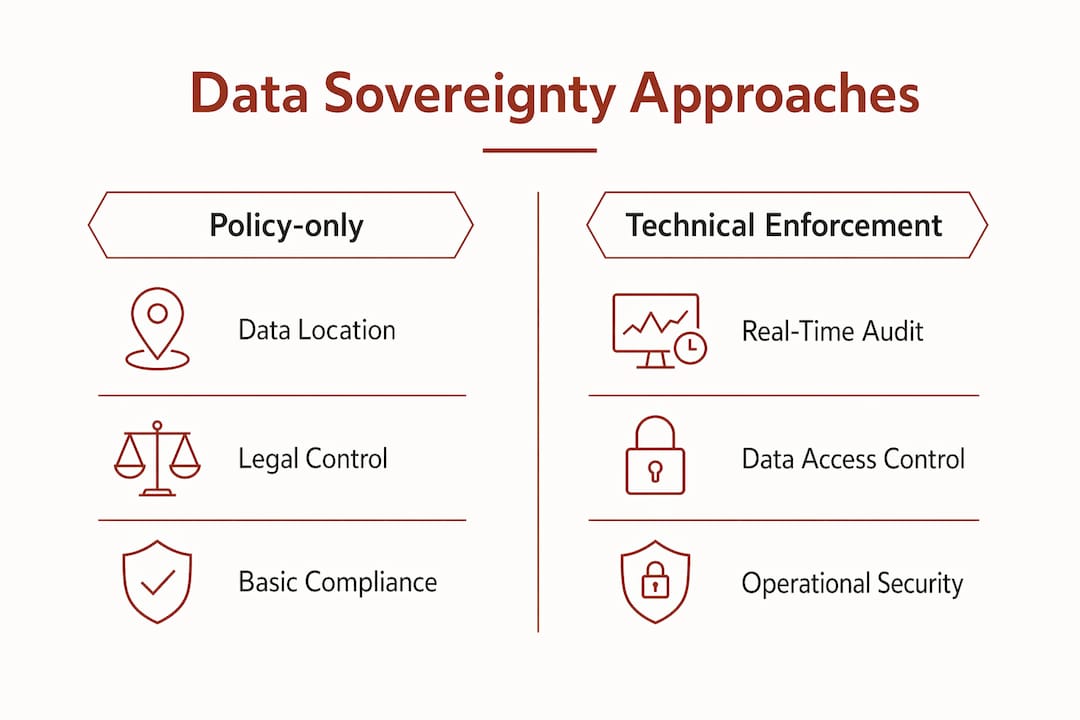
Technical sovereignty requires more than a policy document. Sovereignty must be enforced through technical architecture that proves data never leaves sovereign jurisdictions, not merely asserted through contractual clauses. The distinction matters enormously in an enforcement context.
The following table contrasts a policy-only approach with a technically enforced sovereignty model:
| Dimension | Policy-only approach | Technically enforced sovereignty |
|---|---|---|
| Data location assurance | Contractual declaration | Verified via audit logs and residency controls |
| Cross-border transfer control | Vendor agreement | Technical egress restrictions |
| Auditability | Periodic vendor reports | Continuous, real-time audit trails |
| Regulatory defensibility | Moderate | High |
| Research partnership eligibility | Limited | Significantly expanded |
Federated analytics and Trusted Research Environments are the two technical patterns most widely adopted for jurisdictionally compliant cross-border health data use. Federated analytics allows computation to occur at the data source, so raw patient records never leave the sovereign environment. Trusted Research Environments provide controlled access to de-identified datasets within a governed perimeter, enabling research collaboration without transferring data to external parties.
Demonstrable compliance via technical architecture, such as audit logs proving data location and export activities, doubles the chances of securing research partnerships. That is a direct commercial and scientific benefit, not merely a compliance outcome.
Governance must match the technical architecture. Effective sovereignty requires integrating governance into organisational DNA with board engagement, not delegating it entirely to IT departments. A board that cannot articulate the organisation's data residency position cannot credibly oversee its clinical risk profile.
Pro Tip: Assign a named data sovereignty lead at executive level. Organisations that treat sovereignty as an IT problem alone consistently produce inconsistent system-wide approaches, as NHS experience has demonstrated.
A risk-based approach to prioritising data workloads by sensitivity is the most practical starting point. Not every dataset carries the same sovereignty risk. Genetic data, mental health records, and HIV status information warrant the highest controls. Administrative scheduling data warrants a different tier. Mapping workloads to sensitivity levels allows administrators to direct resources where the exposure is greatest.
How can healthcare administrators practically implement data sovereignty?
Implementation requires a structured sequence, not a single procurement decision. The following steps provide a practical compliance roadmap for healthcare decision-makers.
-
Conduct a data mapping audit. Identify every dataset the organisation holds, where it is processed, and who the data controller is for each processing activity. Pay particular attention to third-party processors, including AI tools, analytics platforms, and cloud storage providers.
-
Assess jurisdictional exposure. For each processor identified, determine whether they are subject to foreign legislation, including the US CLOUD Act or equivalent instruments, that could compel disclosure without the organisation's consent.
-
Classify data by sensitivity. Apply a tiered classification model. Place genetic data, mental health records, and paediatric records in the highest sovereignty tier. Assign proportionate technical controls to each tier.
-
Implement technical residency controls. Move beyond contractual assurances. Deploy health data residency requirements through technical egress restrictions, encrypted local storage, and continuous audit logging that proves data location in real time.
-
Establish a vendor governance framework. Require all third-party processors to demonstrate sovereignty-compatible architecture before onboarding. Contractual clauses alone are insufficient. Require technical evidence, including audit log access and residency certification.
-
Integrate sovereignty into board reporting. Sovereignty status should appear in quarterly risk reports alongside financial and clinical risk metrics. Boards that receive regular sovereignty updates make faster, better-informed decisions when incidents occur.
-
Prepare for research partnership due diligence. Research funders and academic partners increasingly require evidence of sovereign data governance before sharing datasets. Organisations with verified audit trails and Trusted Research Environments gain access to partnerships that others cannot pursue.
The consequences of delay are concrete. NYHIPA's $15,000 per-violation penalty structure, effective december 2026, means that a healthcare organisation processing New York residents' health data through a non-compliant arrangement faces compounding liability from the first day of enforcement. Early adoption of sovereignty-compliant infrastructure converts a regulatory liability into a competitive and reputational asset.
Digital sovereignty frameworks that integrate technical controls with governance structures provide the most defensible posture. Administrators who implement these frameworks before enforcement deadlines arrive avoid the cost and reputational damage of reactive compliance.
Key takeaways
Healthcare data sovereignty is the single most consequential governance decision a healthcare administrator will make in 2026, affecting compliance standing, operational resilience, and patient trust simultaneously.
| Point | Details |
|---|---|
| Sovereignty is not location alone | Physical server location does not guarantee sovereignty; legal control of the data controller matters. |
| Regulatory penalties are material | NYHIPA imposes $15,000 per violation from december 2026, making non-compliance financially significant. |
| Technical controls outperform contracts | Audit logs and residency restrictions provide enforceable sovereignty; policy documents alone do not. |
| Board engagement is non-negotiable | Sovereignty delegated solely to IT produces inconsistent governance and increased organisational risk. |
| Early adoption creates advantage | Organisations with verified sovereign infrastructure gain research partnerships and patient trust that others cannot access. |
My assessment of where healthcare sovereignty is heading
The conversation about healthcare data sovereignty has been dominated by compliance teams and IT architects for too long. What I observe consistently is that the organisations most exposed to sovereignty risk are not the ones with weak technology. They are the ones where the board has never been asked to take a position on data jurisdiction.
The NHS experience is instructive here. Sovereignty remains under-discussed at board level, leading to inconsistent system-wide approaches even as AI reliance accelerates. That gap between technical capability and governance accountability is where the real risk lives.
The emerging challenge that most administrators are not yet tracking is AI training data transparency. Transformed and de-identified data introduces new sovereignty challenges that localisation policies alone cannot address. When a foreign AI platform trains a model on de-identified patient records, the organisation has not transferred a file. It has transferred clinical insight. The economic and strategic value of that insight accrues to the platform, not the healthcare system that generated it.
Sovereignty functions as an enabler of innovation, not a constraint on it. Organisations that frame it as a regulatory burden will always under-invest. Those that frame it as the foundation for trustworthy AI adoption, research collaboration, and patient confidence will build durable institutional advantage. The framing choice is a leadership decision, not a technical one.
— Michael
How Islandedgetech supports healthcare data sovereignty
Healthcare organisations in Jamaica face a specific and urgent version of this challenge. Foreign cloud platforms subject to the US CLOUD Act cannot provide the jurisdictional certainty that Jamaica's Data Protection Act 2020 demands.
Islandedgetech addresses this directly through its sovereign cloud infrastructure, including the EdgePod and Abeng product suite, designed to keep data on Jamaican soil under Jamaican law. Organisations working with Islandedgetech gain DPA 2020-ready sovereign infrastructure with continuous audit logging, technical residency controls, and board-level governance support. For healthcare administrators ready to move from policy intent to technical enforcement, Islandedgetech provides the architecture to do so without dependency on foreign platforms. Contact the team to assess your current sovereignty posture and build a compliant roadmap for 2026.
FAQ
What is healthcare data sovereignty?
Healthcare data sovereignty is the principle that a healthcare organisation maintains full legal control and governance over patient data within its national jurisdiction. It requires both technical enforcement and legal accountability, not merely physical data location.
Why does data sovereignty matter more than data localisation?
Data localisation refers only to where data is stored physically. Sovereignty addresses who controls the processing, under which law, and with what audit rights. A server in Jamaica operated by a US-incorporated company remains subject to the US CLOUD Act regardless of its physical location.
What are the penalties for non-compliance with health data privacy regulations?
NYHIPA imposes civil penalties of $15,000 per violation with a six-year statute of limitations, effective december 2026. GDPR penalties can reach €20 million or 4% of global annual turnover, whichever is higher.
How does data sovereignty affect research partnerships?
Organisations with verified audit logs and sovereign governance are significantly more likely to qualify for research partnerships. Funders and academic institutions increasingly require technical evidence of data residency before granting access to collaborative datasets.
How can Jamaican healthcare providers meet DPA 2020 sovereignty requirements?
Jamaican healthcare providers must appoint a data controller, implement technical residency controls, and maintain continuous audit trails. Islandedgetech's sovereign cloud solutions for healthcare are built specifically to meet DPA 2020 obligations with on-island data residency and enforceable governance architecture.