
Data sovereignty is defined as an organisation's legal and operational right to control where its data resides, who can access it, and under which jurisdiction's laws it is governed. For Jamaican businesses, achieving data sovereignty through local infrastructure is not an optional upgrade. It is a compliance obligation under Jamaica's Data Protection Act 2020 and a direct defence against foreign legislation such as the U.S. CLOUD Act, which can compel American cloud providers to hand over data regardless of where it is physically stored. Best-practice sovereignty frameworks now prioritise data residency, jurisdictional control, supply chain transparency, and operational resilience over mere physical location. That shift means Jamaican organisations must move beyond signing contracts with offshore providers and start building or adopting infrastructure that enforces sovereignty by design.
What are the essential infrastructure components to achieve data sovereignty locally?
Local infrastructure is a strategic imperative for digital sovereignty, not merely a security measure, because ownership of physical fibre and storage protects against legal vulnerabilities. For Jamaican organisations, this means controlling the full stack: the physical data centre, the network layer, and the compute and storage hardware.

The core infrastructure categories break down as follows:
| Infrastructure category | Sovereignty role |
|---|---|
| Local data centres | Keep data physically within Jamaican jurisdiction under DPA 2020 |
| Sovereign fibre networks | Prevent data from transiting international nodes, reducing surveillance risk |
| Workload-aware compute | Classify and tag individual VMs or containers by residency requirement |
| Local control planes | Manage orchestration without routing commands through foreign systems |
| Hardware bill of materials | Verify firmware and supply chain integrity under local oversight |
Secure local fibre networks prevent data from passing through international nodes, reducing both surveillance risk and latency. This is particularly relevant for sectors such as healthcare and tourism, where patient records and guest data carry strict residency obligations.
At the orchestration layer, platforms such as Kubernetes and OpenStack provide the foundation for workload-aware architectures. Systems managing individual VMs or containers enable easy classification, residency tagging, and quick recovery. That granularity makes it possible to enforce data residency rules at the application level rather than relying on broad network perimeter controls.
Policy-as-code engines such as OPA/Gatekeeper evaluate 100% of API requests for sovereignty compliance. That means every infrastructure action is checked against residency rules before it executes, removing the risk of accidental cross-border data movement.
Pro Tip: Before procuring hardware, request a full firmware bill of materials from your supplier. Hardware verification and firmware monitoring are sovereignty layer requirements, not optional security extras.
How to design architecture that enforces jurisdictional control
True sovereignty goes beyond physical servers. Workload-aware architectures with local-first control planes ensure that even infrastructure configuration remains within jurisdictional boundaries. The architectural pattern that best achieves this for Jamaican organisations is the tenant cluster model.
The tenant cluster pattern provides isolated Kubernetes control planes per jurisdiction. Independent control planes avoid centralised administrative authority that could breach sovereignty. In practice, this means each organisational unit or regulatory domain operates its own control plane, with no shared administrative access that could route commands through a foreign system.
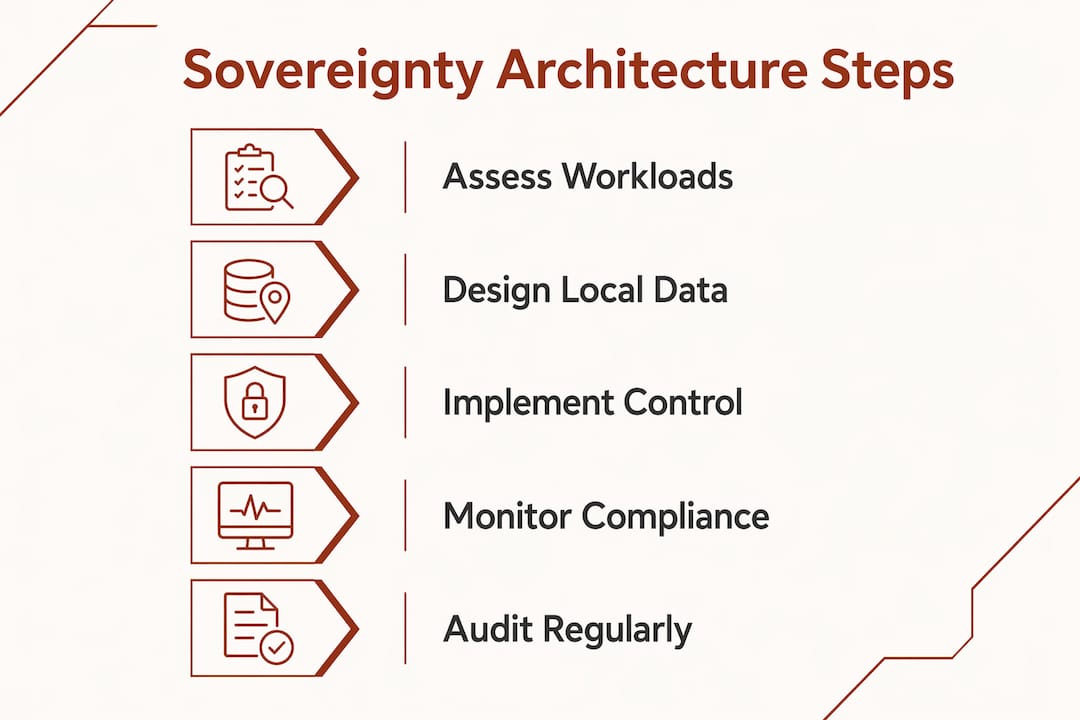
A step-by-step architectural implementation follows this sequence:
- Define jurisdiction boundaries. Map which data classifications require Jamaican residency and document the legal basis under the DPA 2020.
- Deploy isolated tenant clusters. Provision separate Kubernetes clusters per jurisdiction boundary, each with its own API server and etcd store hosted on local hardware.
- Establish local key management. Host cryptographic keys and secrets within a local Hardware Security Module (HSM) or equivalent on-premises vault. Never route key operations through a foreign provider's key management service.
- Implement GitOps for policy enforcement. Use a GitOps model where all infrastructure changes are declared in version-controlled repositories and applied by local agents. This creates an auditable trail of every configuration change.
- Embed policy-as-code at admission. Deploy OPA/Gatekeeper or Kyverno as admission controllers. Policy-as-code tools automatically reject non-compliant infrastructure requests before deployment, removing human error from the compliance chain.
- Enforce metadata sovereignty. Audit logs, API tokens, and secrets must remain within the local jurisdiction. Offloading metadata outside jurisdiction risks legal exposure despite localised data storage.
Developing a 'sovereignty-by-design' approach involves embedding jurisdiction tags and residency policies into the application lifecycle. Compliance is then enforced automatically rather than via manual audits, which are unreliable at scale.
Pro Tip: Treat your GitOps repository as a legal record. Every pull request that changes infrastructure policy should require a named approver and a compliance justification comment. This satisfies audit requirements under the DPA 2020 without additional tooling.
What tools and policies maintain ongoing sovereignty compliance?
Sovereignty is not a one-time deployment. It requires continuous governance, and that governance must be embedded in the platform rather than delegated to periodic reviews.
The following practices form the operational backbone of sustained compliance:
- Policy-as-code enforcement. OPA/Gatekeeper or Kyverno should run as admission controllers on every cluster. Any resource request that violates a residency rule is rejected before it reaches production.
- Audit log retention within jurisdiction. All audit logs, including Kubernetes API server logs and application-level event logs, must be stored on local infrastructure. Sending logs to a foreign SIEM platform creates a cross-border transfer that may breach the DPA 2020.
- Data classification labelling. Apply residency tags to all workloads at creation. Labels such as
data-residency: JMallow automated policies to enforce placement rules without manual intervention. - Supply chain verification. Hardware verification and firmware monitoring are sovereignty layer requirements. Maintain a hardware bill of materials and verify firmware signatures before deployment.
- Regular sovereignty audits. Schedule quarterly reviews of all data flows, including metadata flows, to identify any paths that cross jurisdictional boundaries.
Common pitfalls that undermine sovereignty programmes include:
- Assuming physical data location alone satisfies the DPA 2020, without addressing metadata and audit log residency.
- Using a foreign provider's managed Kubernetes service, which routes control plane traffic outside Jamaica.
- Neglecting to classify data at ingestion, making residency enforcement retroactively difficult.
- Relying on contractual clauses rather than technical controls to enforce residency.
Organisations can review common cloud compliance mistakes in Jamaica to avoid repeating errors that have already cost other businesses significant remediation effort.
Pro Tip: Run a metadata audit before your next compliance review. Audit logs, secrets, and API tokens are frequently overlooked, yet require as much sovereignty control as core data to avoid cross-border risks.
What steps should Jamaican businesses take to transition to sovereign infrastructure?
A sovereignty transition succeeds when it is phased, risk-prioritised, and grounded in a clear readiness assessment. Organisations that attempt a full migration in a single step typically encounter operational disruption and compliance gaps.
A sovereignty readiness assessment should catalogue all digital tools and prioritise sensitive workloads for transition to sovereign environments first. For Jamaican organisations, this means beginning with AI inference workloads, patient data systems, financial records, and any processing that involves personally identifiable information under the DPA 2020.
Hybrid sovereignty architectures allow sensitive data to reside on local infrastructure while less critical workloads run on global public clouds. This balance supports operational continuity without sacrificing residency requirements for regulated data.
| Approach | Sovereignty level | Best suited for |
|---|---|---|
| Fully on-premises | Highest | Regulated data, healthcare records, financial systems |
| Sovereign cloud (local provider) | High | Organisations without capital for own data centre |
| Hybrid architecture | Moderate to high | Mixed workloads with tiered sensitivity |
| Public cloud with contractual controls | Low | Non-sensitive, non-regulated workloads only |
Islandedgetech's EdgePod infrastructure provides a pre-configured sovereign deployment option for organisations that need local residency without building a full data centre. Products such as Ackee and Abeng extend sovereignty to the productivity and application layer, ensuring that the software stack does not create cross-border data flows even when the underlying infrastructure is local.
Organisations seeking a structured compliance roadmap can explore digital sovereignty frameworks that align technical implementation with DPA 2020 obligations.
Key takeaways
Achieving data sovereignty through local infrastructure requires technical enforcement at every layer of the stack, from physical hardware to policy-as-code admission controls, not just contractual agreements with cloud providers.
| Point | Details |
|---|---|
| Define jurisdiction boundaries first | Map data classifications and legal obligations under the DPA 2020 before selecting infrastructure. |
| Use isolated control planes | Tenant cluster architectures prevent foreign administrative access to Jamaican workloads. |
| Enforce policy-as-code | OPA/Gatekeeper or Kyverno reject non-compliant requests automatically, removing human error. |
| Control metadata as strictly as data | Audit logs, API tokens, and secrets must remain within Jamaican jurisdiction to avoid legal exposure. |
| Phase the transition by risk | Begin with the most sensitive workloads and use hybrid architectures to maintain continuity. |
Why sovereignty is a strategic asset, not just a compliance checkbox
Working with Jamaican organisations on data residency compliance has shown me one consistent pattern: the businesses that treat sovereignty as a technical obligation to be ticked off tend to build fragile programmes. They achieve physical residency but leave metadata flowing offshore. They sign contracts with local providers but use foreign key management services. The compliance gap is not in their intentions. It is in the architecture.
The organisations that build durable sovereignty programmes treat it as a strategic asset for business success. They ask not only "where is our data?" but "who controls every system that touches our data?" That second question is harder to answer, and it is the one that matters most under the DPA 2020.
My practical advice is to start with the metadata audit, not the data migration. Most organisations discover that their audit logs, secrets management, and API telemetry are already crossing borders before a single byte of core data moves. Fix that layer first, and the rest of the sovereignty programme becomes significantly more tractable.
Gradual transition is not a weakness. A phased approach with clear milestones and measurable sovereignty checkpoints is more defensible to a regulator than a rushed full migration that introduces new gaps.
— Michael
How Islandedgetech supports sovereign infrastructure in Jamaica
Jamaican organisations that need to move from compliance intent to technical reality have a local option built specifically for this purpose.
Islandedgetech delivers sovereign cloud infrastructure that keeps data, control planes, and cryptographic keys on Jamaican soil under Jamaican law. The EdgePod product line provides pre-configured edge infrastructure for organisations that cannot build their own data centre. The Abeng work suite extends sovereignty to the productivity layer, preventing application-level data from creating cross-border transfers. Islandedgetech's architecture eliminates exposure to the U.S. CLOUD Act and is built to satisfy DPA 2020 obligations across healthcare, tourism, and financial services. Contact Islandedgetech to discuss a sovereignty readiness assessment tailored to your organisation's workload profile.
FAQ
What is data sovereignty under Jamaica's DPA 2020?
Data sovereignty under the Data Protection Act 2020 is the obligation for data controllers to maintain lawful control over personal data, including where it is stored and processed. Organisations that store data with foreign providers remain legally accountable for any cross-border transfers that result.
How does local infrastructure enforce data residency compliance?
Local infrastructure enforces data residency by keeping data, metadata, and control plane operations within Jamaican jurisdiction. Policy-as-code tools such as OPA/Gatekeeper reject any resource request that would place data outside the defined residency boundary before it reaches production.
What is the difference between data residency and data sovereignty?
Data residency refers to the physical location of stored data. Data sovereignty is broader: it includes jurisdictional control, operational autonomy, and the legal right to govern data without interference from foreign laws. Residency is a component of sovereignty, not a substitute for it.
Can a hybrid architecture still achieve full sovereignty for sensitive workloads?
Yes. Hybrid sovereignty architectures place sensitive workloads on local infrastructure while routing non-regulated workloads to public cloud. Sovereignty is maintained for regulated data as long as the local tier uses isolated control planes and local key management.
What are the biggest risks of relying on contractual controls alone?
Contractual controls cannot override foreign legislation such as the U.S. CLOUD Act. A foreign provider can be legally compelled to disclose data regardless of contract terms. Technical controls, including local control planes and policy-as-code enforcement, are the only reliable defence.