
Data compliance is the systematic management of personal and sensitive information in accordance with legal, regulatory, and internal standards, and its role in business extends well beyond avoiding fines. For UK and Jamaican organisations operating under evolving frameworks such as the UK GDPR and Jamaica's Data Protection Act 2020, compliance is the operational foundation that determines whether an organisation can be trusted with data at all. Non-compliance carries consequences that now extend beyond financial penalties to include operational restrictions and outright denial of market access.
Key elements of data compliance in practice:
- Lawful collection: obtaining valid consent and limiting data gathered to what is strictly necessary
- Secure processing: applying encryption, access controls, and pseudonymisation to protect data in transit and at rest
- Subject rights: honouring individuals' rights to access, correct, or delete their personal information
- Accountability: maintaining audit trails, impact assessments, and documented evidence of policy enforcement
- Cross-border transfer controls: governing how data moves across jurisdictions, particularly relevant under UK GDPR and the CLOUD Act
- Breach response: notifying regulators and affected individuals within prescribed timeframes
Organisations that treat compliance as a checkbox exercise consistently fail audits and face escalating enforcement. Those that embed it into architecture and culture build the trust that sustains long-term growth.
Who is responsible for data compliance in your organisation?
Responsibility for data compliance is shared across functions, spanning executives, legal and compliance teams, IT and security departments, and business unit data stewards. No single team can carry it alone.
- Executive leadership (CDO/CIO): provides sponsorship, budget authority, and the mandate to enforce compliance across all functions
- Legal and compliance teams: interpret regulatory obligations under UK GDPR, the Data Protection Act 2018, and Jamaica's Data Protection Act 2020, translating them into enforceable internal policies
- IT and security teams: implement technical controls including role-based access control (RBAC), encryption, and audit logging
- Data stewards: embedded in business units, they monitor data quality, maintain definitions, and enforce governance policies day to day
- Data owners: senior representatives accountable for specific data domains, approving access to sensitive data and resolving classification disputes
- Data governance council: a cross-functional body that sets policy, resolves disputes, and holds teams accountable for implementation
Poor data quality is itself a signal of neglected governance. Effective programmes assign accountable data owners to every data asset and back them with automated quality monitoring. Escalation paths must be clearly defined so that compliance failures surface to senior management before they become regulatory incidents.

Why data compliance delivers competitive advantage, not just legal cover
Compliance is a competitive advantage that attracts customers who value privacy, improves market position, and builds loyalty that persists through market disruption. Organisations that demonstrate rigorous data protection practices win contracts, retain clients, and differentiate themselves from competitors who treat compliance as an afterthought.
- Customer trust and loyalty: clients are more likely to return and refer others when they are confident their data is protected
- Breach cost reduction: data breaches cost an average of $4.45 million globally in 2023, and non-compliant organisations pay nearly $220,000 more per breach than compliant ones
- Avoidance of regulatory investigations: proactive compliance prevents the operational disruption and legal costs of a regulatory inquiry
- Market access preservation: enforcement actions now extend to operational restrictions and denial of market access, not merely fines
- Reputational protection: a single publicised breach can erode years of brand equity and trigger customer churn
- Faster partner due diligence: organisations with documented compliance programmes close procurement and partnership agreements more quickly
The financial case is clear. Beyond the numbers, organisations that handle data ethically attract the kind of long-term institutional relationships that define sector leadership.
How to build a tailored data governance strategy for your organisation
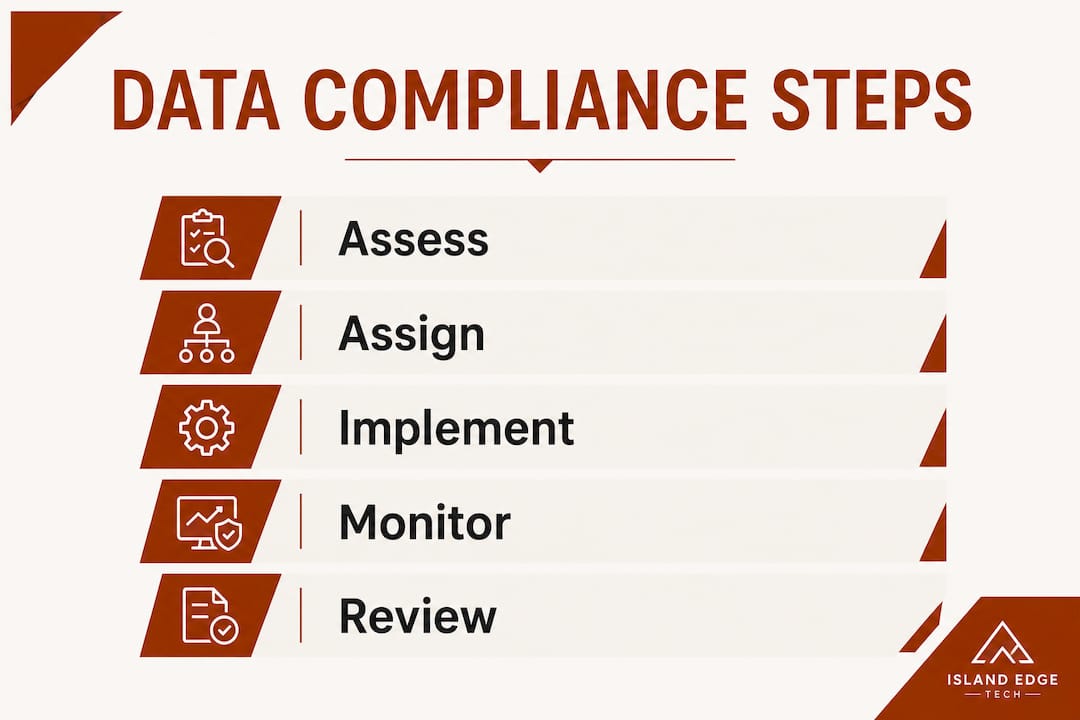
A tailored governance strategy involves multiple departments and is prioritised at C-suite level, because governance that lives only in the IT department never achieves the cultural embedding that compliance demands. The following steps provide a practical framework.
- Map your regulatory obligations: identify every applicable framework, including UK GDPR, the Data Protection Act 2018, Jamaica's Data Protection Act 2020, and any sector-specific standards such as PCI DSS or HIPAA for healthcare data
- Classify your data: mark personally identifiable information (PII), sensitive personal data, and health records so that access controls and retention rules apply systematically
- Enforce least-privilege access: centralise identity management and align roles with approved purposes; make exceptions explicit and time-bound
- Build a data subject registry: track individuals and the regulations that apply to them, then build jurisdiction-specific workflows from that registry
- Embed compliance into architecture: compliance must be embedded into system architecture and culture as a living operational model, not a static checklist
- Establish a governance council: include senior stakeholders with decision-making authority, not merely representatives who report upward
- Review policies regularly: at minimum annually, to keep pace with regulatory change and organisational growth
For a detailed framework aligned to 2026 requirements, Islandedgetech's data governance guide covers cross-functional implementation in depth.
Pro Tip: Align your governance strategy with a sovereign cloud infrastructure that keeps data on local soil. For Jamaican organisations, this means data residency under Jamaican law, eliminating exposure to extraterritorial instruments such as the US CLOUD Act, and satisfying the Data Protection Act 2020's requirements by design rather than by remediation.
How does data compliance shape AI readiness under UK regulations?
AI projects raise the compliance bar considerably. They often combine datasets, expand data access, and generate outputs that require their own governance controls. Regulators and risk teams expect control, traceability, and justified use of data even when a model never stores raw records directly.
- Data lineage: every dataset feeding an AI model must be traceable back to its origin, with documented transformations and access history
- Jurisdiction-aware architecture: sovereign AI solutions keep data within jurisdictional boundaries, satisfying both UK GDPR and Jamaica's Data Protection Act 2020 while enabling analytics
- Auditability: access logs must show who queried which data, under what authorisation, and for what purpose
- Purpose limitation: AI models must use data only for the defined, documented purpose for which it was collected
- Consent management: lawful bases for processing must be tracked per jurisdiction and honoured across all systems when withdrawn
- EU AI Act alignment: for organisations with EU customers, algorithmic decision-making systems carry their own compliance obligations that sit alongside GDPR requirements
AI readiness and data compliance are deeply linked. Organisations that build jurisdiction-aware governance layers now will deploy AI faster and with lower regulatory risk than those that attempt to retrofit compliance after model deployment. Islandedgetech's sovereign infrastructure, including the EdgePod appliance, is designed to support precisely this kind of compliant AI deployment on Jamaican soil.
Key UK data protection laws and what they require of your organisation
UK GDPR is the primary framework governing personal data processing in the United Kingdom. Retained from EU law following Brexit and amended by the Data Protection Act 2018, it imposes six lawful bases for processing, strict data minimisation requirements, mandatory breach notification within 72 hours, and substantial fines for violations. Organisations acting as data controllers must document their processing activities, conduct Data Protection Impact Assessments for high-risk processing, and appoint a Data Protection Officer where required.
The Data Protection Act 2018 supplements UK GDPR by addressing areas such as law enforcement processing, intelligence services, and specific national exemptions. Together, these two instruments form the backbone of UK data protection law.
For organisations operating in or with Jamaica, the Data Protection Act 2020 mirrors many GDPR principles, including rights of access, correction, and erasure, and imposes obligations on data controllers and processors handling personal data of Jamaican residents. Compliance with the Jamaican DPA 2020 requires data residency considerations that foreign cloud providers cannot guarantee.
Sector-specific obligations add further layers. Healthcare organisations must address HIPAA-equivalent controls for health data. Financial services firms face PCI DSS requirements for payment card data. Organisations holding ISO/IEC 27001 certification demonstrate a structured information security management system that satisfies many of the technical control requirements common to all these frameworks.
The practical implication is that a single governance layer must be jurisdiction-aware, capable of applying different controls to different data subjects depending on where they reside and what regulations govern their data. Building that layer once, correctly, is far less costly than managing separate compliance programmes for each framework independently.
Key takeaways
Data compliance is a core operational discipline that protects organisations from legal, financial, and reputational harm while enabling trusted data use, AI readiness, and sustainable growth.
| Point | Details |
|---|---|
| Compliance scope | UK GDPR, the Data Protection Act 2018, and Jamaica's DPA 2020 all impose binding obligations on data controllers and processors. |
| Shared accountability | Executives, legal teams, IT, data stewards, and business units each carry defined compliance responsibilities within a governance council structure. |
| Financial stakes | Non-compliant organisations pay nearly $220,000 more per breach than compliant ones, and enforcement now extends to market access denial. |
| Governance as architecture | Compliance embedded into system design and culture outperforms checklist-based programmes in audit outcomes and operational resilience. |
| AI and sovereignty | Jurisdiction-aware sovereign infrastructure is the practical foundation for both regulatory compliance and safe AI deployment in Jamaica. |
Islandedgetech: sovereign compliance infrastructure for Jamaican organisations
Islandedgetech builds the infrastructure that makes data compliance structurally achievable for Jamaican organisations, rather than a matter of policy documents and good intentions. The EdgePod sovereign cloud appliance keeps data on Jamaican soil under Jamaican law, eliminating exposure to the US CLOUD Act and satisfying the Data Protection Act 2020 by design. For organisations in healthcare, finance, agriculture, and tourism, that means audit-ready data residency, access controls, and operational continuity without dependence on foreign cloud infrastructure.
Islandedgetech's Groundwork compliance programme provides the technical and governance foundation your organisation needs to meet its obligations under both UK GDPR and Jamaica's DPA 2020, with the sovereignty guarantees that no foreign provider can match.