
Sovereign cloud infrastructure is a cloud environment architected so that data, operations, and the underlying technology stack remain subject to a specified jurisdiction's laws and controls at all times. For UK organisations, the practical implication is direct: where you must demonstrably keep data and operations under UK or EU legal control to satisfy GDPR, the UK Data Protection Act 2018, and ICO expectations about cross-border transfers, a sovereign cloud model is not optional. The European Commission's Cloud Sovereignty Framework formalises this through its SEAL levels, ranging from no sovereignty to full digital sovereignty, providing a structured basis for procurement scoring that UK compliance officers can apply directly.
Table of Contents
- What 'sovereign' actually covers: residency, sovereignty, and operational control
- What a genuine sovereign cloud must technically provide
- How sovereign cloud architectures are implemented in practice
- Why UK organisations need sovereign cloud now
- Actionable procurement and contract checklist for UK compliance
- Practical challenges and trade-offs you should plan for
- How to select a sovereign cloud provider: questions that surface real evidence
- Which UK sectors most need sovereign cloud
- How to measure real sovereignty: maturity metrics and verifiable governance
- Verdict and next steps for UK IT and compliance teams
- Key takeaways
- Balancing sovereignty with the operational realities of modern IT
- Islandedgetech: sovereign data infrastructure built for jurisdictional certainty
- Authoritative sources and further reading
What 'sovereign' actually covers: residency, sovereignty, and operational control
Three terms appear constantly in procurement discussions, and conflating them creates material compliance gaps.
- Data residency refers solely to the physical location where data is stored. A contractual clause stating "data stored in UK data centres" satisfies residency but says nothing about which legal system governs access to that data or who can compel its disclosure.
- Data sovereignty addresses the legal question: which jurisdiction's laws apply to the data and its processing? A UK-resident dataset held by a US-incorporated provider may still be subject to US law, regardless of where the servers sit.
- Operational sovereignty goes further still. It requires that the infrastructure can be operated, maintained, and recovered independently, with personnel, processes, and supply chains subject to the same jurisdictional controls. This is the hardest level to verify and the most consequential for continuity.
Metadata and backup copies are frequently overlooked. Encryption key material stored in a foreign jurisdiction, or backup replicas routed through a provider's global network, can expose an organisation to the same extraterritorial risks as the primary dataset. Data residency explained covers these distinctions in detail for UK professionals.
A practical example: an NHS trust that stores patient records in a UK data centre but relies on a US parent company's global control plane for administration has residency without operational sovereignty. If that parent company is compelled to act under foreign law, the trust's data is exposed regardless of where it physically sits. Sovereign cloud as defined by Cisco embeds legal and regulatory requirements directly into the technical architecture, not merely the contract.
What a genuine sovereign cloud must technically provide
Vendor marketing frequently claims sovereignty on the basis of a single data centre location. The following capabilities distinguish a genuine sovereign deployment from a residency-only arrangement.
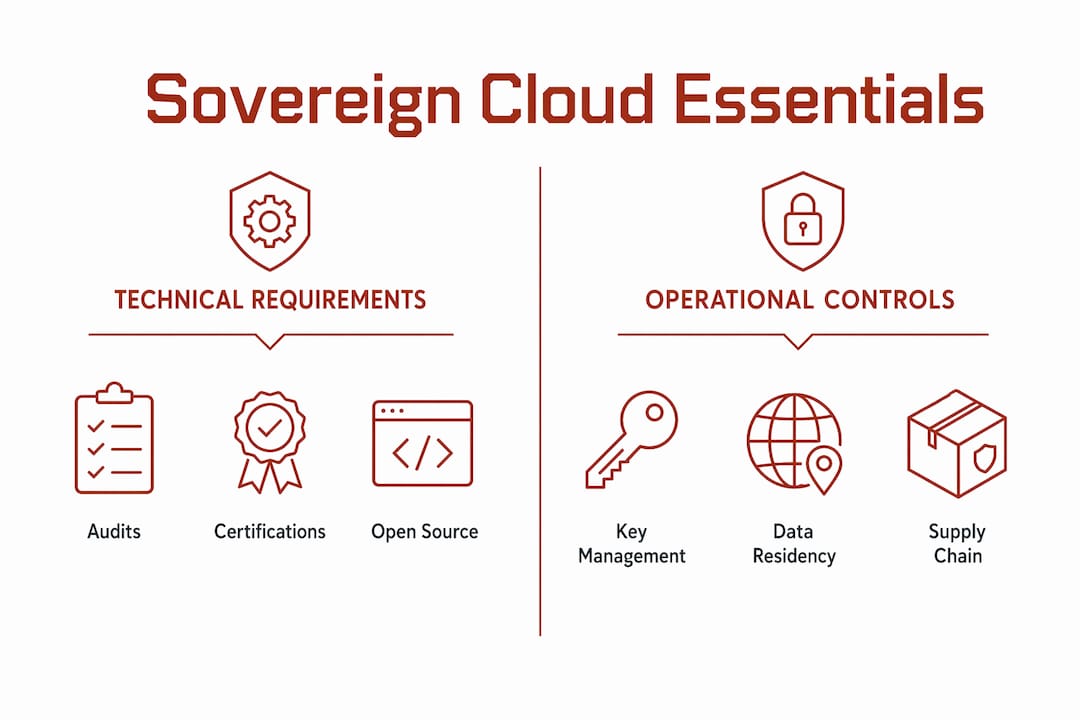
- Jurisdictional data residency for primary and backup copies, with contractual guarantees covering metadata, logs, and key material, not just primary datasets.
- Customer-controlled encryption and key management, where cryptographic keys are held in Hardware Security Modules (HSMs) under the customer's custody, not the provider's. Microsoft's Sovereign Public Cloud, for instance, supports customer-managed keys in HSM-based key stores as a core sovereignty control.
- Localised administration and personnel jurisdiction, meaning that administrative access to the infrastructure is restricted to personnel resident and legally subject to the same jurisdiction. Administrative actions must be logged and limited to in-jurisdiction personnel to produce audit-ready compliance evidence.
- Tamper-evident logging and audit trails, providing an immutable record of all access and operational events that can be independently verified.
- Verifiable supply-chain provenance, including Software Bill of Materials (SBOMs) and attestations covering hardware, firmware, and software components.
- Control-plane locality, so that the management layer governing the infrastructure is itself subject to the same jurisdictional constraints as the data plane.
- Cloud-native backup and disaster recovery within the jurisdiction, because traditional backup tools are frequently inadequate for cloud-native environments and can create cross-border compliance gaps when metadata or replicas are routed outside the jurisdiction.
Assurance artefacts to demand include recent independent audit reports, ISO 27001 certification, Cyber Essentials or Cyber Essentials Plus, sector-specific certifications (for example, NHS Digital's Data Security and Protection Toolkit for healthcare), and contractual audit rights that allow the customer to inspect or commission independent assessments.
Open-source foundations and SBOMs are increasingly required to meet transparency goals. As Trilio notes, supply-chain visibility and open infrastructure are common prerequisites for true digital sovereignty, because proprietary stacks make independent verification structurally impossible.
Pro Tip: When reviewing a vendor's sovereignty claims, ask specifically whether their SBOM covers firmware and hardware components, not just application-layer software. Firmware-level supply-chain exposure is a common blind spot in procurement assessments.
How sovereign cloud architectures are implemented in practice
Sovereign cloud is not a single product. It is delivered through several distinct architectural models, each suited to different workload sensitivities and regulatory exposures.

National or local-only cloud is operated entirely by domestic providers under domestic law, with no foreign parent company involvement in operations, supply chain, or legal structure. This model offers the highest degree of sovereignty but typically involves smaller ecosystems and higher unit costs.
Sovereign regions within global providers are dedicated cloud regions operated under stricter local governance agreements, often with a local legal entity acting as data controller and local personnel restrictions applied to administrative access. Microsoft's EU Data Boundary and the associated Data Guardian programme are examples of this model applied to European contexts.
Hybrid sovereign models combine a locally governed sovereign segment for sensitive workloads with broader hyperscale capabilities for non-sensitive processing. IDC advises organisations to select sovereignty by workload and maturity rather than applying a single architecture across the entire estate.
Key technical patterns across all models include:
- Dedicated hardware and fenced network zones that prevent co-mingling of sovereign and non-sovereign traffic.
- Isolated control planes that cannot be accessed or overridden from outside the jurisdiction.
- Local key management, with HSMs physically located within the jurisdiction.
- Air-gapped or quasi-disconnected options for critical national infrastructure workloads where network isolation is a regulatory requirement.
- Personnel residency checks and contractual restrictions on remote access from outside the jurisdiction.
- Disaster recovery and failover arrangements that keep data and operations within the same legal boundary throughout an incident.
Sovereign data pods represent one implementation of localised hardware sovereignty, providing deployable, jurisdiction-bound infrastructure for organisations that require physical as well as legal separation.
Why UK organisations need sovereign cloud now
The legal drivers are specific and enforceable. GDPR, retained in UK law through the UK Data Protection Act 2018, requires that personal data transferred outside the UK is subject to equivalent protections. The ICO's guidance on international transfers makes clear that contractual clauses alone are insufficient where a foreign provider is subject to laws that could override those clauses. The US CLOUD Act is the most cited example: it can compel US-incorporated providers to produce data held anywhere in the world, regardless of contractual data residency commitments. The CLOUD Act explained provides a detailed analysis of this exposure for UK and EU organisations.
Financial services and regulated sectors in the UK and EU cite enhanced data security and strict access controls as the primary benefits driving sovereign cloud adoption, with administrative actions required to be logged and limited to in-jurisdiction personnel to produce audit-ready compliance evidence.
Sovereign cloud deployments enforce that administrative actions are logged and limited to personnel inside the jurisdiction, ensuring audit-ready compliance for regulated sectors.
The risk is not theoretical. An organisation that cannot demonstrate to the ICO that it has taken all reasonable technical and organisational measures to prevent unauthorised access, including access compelled by foreign law, faces enforcement action under the UK GDPR. Sovereign cloud architecture provides the verifiable, documented controls that make that demonstration possible.
Actionable procurement and contract checklist for UK compliance
Compliance officers issuing RFPs or reviewing supplier contracts should treat the following as mandatory pass/fail criteria, not desirable features.
Contractual guarantees to require:
- Written confirmation that all primary data, backups, metadata, and encryption key material are stored and processed within the specified jurisdiction at all times.
- Local key custody: the customer holds cryptographic keys in HSMs under their own control, with no provider access without explicit customer authorisation.
- In-jurisdiction personnel restrictions: contractual prohibition on administrative access by personnel outside the jurisdiction, with named exceptions requiring documented approval.
- Explicit audit and inspection rights: the right to commission independent third-party assessments and to receive tamper-evident logs on demand.
Evidence to request before contract signature:
- Recent independent audit reports (within the last 12 months).
- ISO 27001 certificate with scope statement covering the sovereign service.
- Cyber Essentials or Cyber Essentials Plus certification.
- SBOMs covering application, firmware, and hardware layers.
- Supply-chain attestations for critical components.
- SEAL-equivalent assurance documentation aligned to the European Commission's Cloud Sovereignty Framework for EU/UK procurement contexts.
Operational clauses to include:
- Incident response jurisdiction: all incident response activities must be conducted by in-jurisdiction personnel under UK law.
- Continuity and disaster recovery within the same legal boundary, with recovery time objectives (RTOs) and recovery point objectives (RPOs) that do not require data to leave the jurisdiction.
- SLAs that include sovereignty-specific breach definitions, not just availability metrics.
Pro Tip: Include a sovereignty audit right as a named termination trigger. If a provider cannot or will not produce independent audit evidence within a defined period, the contract should allow exit without penalty. This clause is rarely contested by providers who genuinely deliver sovereignty.
Practical challenges and trade-offs you should plan for
Sovereign cloud is not without cost, and decision-makers who treat it as a universal default will encounter operational friction.
- Higher unit costs are common, particularly for national or local-only models where the provider cannot amortise infrastructure across a global customer base. Budget planning should anticipate a cost premium relative to equivalent hyperscale services.
- Feature gaps versus global hyperscalers are real. Sovereign regions and local providers often lag behind global platforms in managed AI services, developer tooling, and marketplace integrations. Organisations should map workload requirements against available sovereign services before committing.
- Smaller ecosystem and toolchain limitations affect integration, skills availability, and long-term vendor resilience. A sovereign provider with a limited customer base carries concentration risk.
- Vendor maturity varies significantly. Some providers make sovereignty claims that do not withstand scrutiny under the SEAL framework or ISO 27001 scope review. Independent assessment is not optional.
- Local skills and resilience planning require investment. Sovereign deployments depend on in-jurisdiction personnel for administration and incident response; organisations must plan for skills development and succession.
- Latency is rarely a significant issue for UK-based sovereign deployments given the density of UK data centre infrastructure, but it warrants assessment for latency-sensitive workloads.
Where workloads carry low sensitivity and contractual and technical mitigations suffice, full sovereign cloud may not be warranted. A tiered approach, classifying workloads by sensitivity and applying proportionate controls, is the approach IDC recommends and the one most consistent with the SEAL framework's spectrum of sovereignty levels.
How to select a sovereign cloud provider: questions that surface real evidence
Evaluation frameworks that rely on vendor self-attestation consistently produce false positives. The following questions are designed to surface verifiable evidence rather than marketing claims.

Mapping workload sensitivity to sovereignty level:
Before approaching vendors, classify workloads across three levels: residency-only (data location matters but operational sovereignty is not required), operational sovereignty (full jurisdictional control over operations and personnel is required), and full digital sovereignty (supply-chain independence and technological autonomy are required). Score providers against the level each workload demands.
Specific questions to put to prospective providers:
- Where are backup copies and metadata stored, and can you provide contractual confirmation that neither leaves the specified jurisdiction?
- Who holds cryptographic keys, and can the customer bring and manage their own keys in an HSM physically located within the jurisdiction?
- What are your personnel residency policies, and how are exceptions documented and audited?
- Can you provide a current SBOM covering firmware and hardware components, and a supply-chain attestation for critical infrastructure elements?
- What are your failover and recovery arrangements, and can you demonstrate that all recovery operations remain within the jurisdiction?
- Can you provide tamper-evident logs of all administrative access, and are these available to the customer on demand?
Scoring and proof requirements:
Treat audit reports, SBOMs, independent attestations, and contractual audit rights as mandatory pass/fail criteria in RFPs. A provider that cannot supply these artefacts before contract signature is unlikely to supply them during an ICO investigation. Digital sovereignty frameworks provide a structured approach to mapping these criteria against SEAL-equivalent maturity levels for procurement scoring.
Pro Tip: Request the provider's most recent Data Guardian or equivalent operational transparency report. Providers who operate genuine sovereign controls publish these proactively; those who do not will typically offer a summary document that lacks the tamper-evident log detail required for ICO-standard evidence.
Which UK sectors most need sovereign cloud
Sovereign cloud requirements are most acute where data sensitivity, regulatory scrutiny, and continuity obligations converge.
- Financial services: payment systems, identity verification, and trading infrastructure are subject to FCA operational resilience requirements and PRA expectations on third-party risk. Sovereign controls provide the audit trail and jurisdictional certainty these frameworks demand.
- Public sector (central and local government): national registries, citizen identity services, and benefits administration involve personal data at scale under direct ICO oversight. UK-hosted sovereign services, such as those described by BT Business, are increasingly specified in central government procurement frameworks.
- Healthcare and life sciences: patient records, genomic data, and clinical trial datasets carry the highest sensitivity classification under UK GDPR. NHS Digital's Data Security and Protection Toolkit requires demonstrable controls that align directly with operational sovereignty requirements.
- Critical national infrastructure: energy, water, and transport operators face sector-specific regulatory obligations and national security considerations that make foreign-jurisdiction exposure a strategic risk, not merely a compliance issue.
- Regulated research: AI models trained on sensitive personal data, and research datasets subject to data sharing agreements, require jurisdictional certainty about where processing occurs and who can access intermediate outputs.
For each of these sectors, sovereignty is not a procurement preference. It is a condition of operating within the regulatory framework.
How to measure real sovereignty: maturity metrics and verifiable governance
Vendor claims of sovereignty are only as credible as the evidence that supports them. The European Commission's SEAL framework provides a structured basis for measurement, defining levels from no sovereignty through jurisdictional, data, technological, and full digital sovereignty, each with specific evidence requirements.
Measurable controls that map to SEAL levels include:
- Tamper-evident logging of all administrative and operational access events, with logs held in-jurisdiction and available to the customer on demand.
- Customer-controlled encryption with HSM-based key management, independently verified through audit.
- Continuous monitoring of sovereignty controls, with automated alerting for policy violations such as attempted access from outside the jurisdiction.
- Independent third-party assessments conducted against a defined scope that includes supply-chain provenance, not just platform security.
- Supply-chain provenance records, including SBOMs and hardware attestations, updated at each infrastructure change.
IDC's guidance on digital sovereignty frames sovereignty as a governance discipline spanning data, technical, and operational domains, and advises organisations to select sovereignty controls by workload and maturity rather than applying a binary local-versus-global choice. This framing is directly compatible with the SEAL framework's spectrum approach and supports a procurement scoring model where providers are assessed against the specific level each workload requires.
Compliance teams should collect and retain the following artefacts as part of procurement scoring and ongoing audit evidence: independent assessment reports, SEAL-equivalent scoring documentation, tamper-evident log samples, SBOM versions, and supply-chain attestations. These form the evidentiary basis for demonstrating compliance to the ICO or sector regulator.
Pro Tip: Build a sovereignty evidence register as a living document, updated at each contract renewal and infrastructure change. Regulators increasingly expect organisations to demonstrate continuous compliance, not just point-in-time certification.
Verdict and next steps for UK IT and compliance teams
Sovereign cloud is warranted wherever an organisation must demonstrate to a regulator, auditor, or data subject that data and operations are subject to UK or EU legal control and cannot be accessed under foreign law. For lower-sensitivity workloads where contractual and technical mitigations are proportionate and verifiable, full sovereignty may not be required, but the assessment must be documented.
Three immediate next steps for compliance teams:
- Classify workloads by sensitivity and regulatory exposure, mapping each to the appropriate SEAL level (residency-only, operational sovereignty, or full digital sovereignty). This classification drives every subsequent procurement decision.
- Run a sovereignty gap assessment against current cloud contracts, identifying where residency claims are not backed by operational sovereignty controls, where key material is held by the provider, and where personnel restrictions are absent or unverified.
- Issue RFPs with mandatory proof items, treating independent audit reports, SBOMs, ISO 27001 scope statements, and contractual audit rights as pass/fail criteria rather than scored preferences. Plan an in-jurisdiction pilot for the highest-sensitivity workload class before committing to full migration.
General information only: this article provides an overview of sovereign cloud concepts and UK compliance considerations. It does not constitute legal or professional advice. Organisations should confirm current regulatory requirements with the ICO, their legal advisers, or a qualified compliance professional for their specific circumstances.
Key takeaways
Sovereign cloud infrastructure requires verifiable jurisdictional control over data, operations, and supply chain, not merely a contractual data residency clause, to satisfy UK GDPR and ICO expectations.
| Point | Details |
|---|---|
| Residency is not sovereignty | Data location clauses do not prevent foreign-law compelled access; operational sovereignty requires personnel, key management, and control-plane controls. |
| Three SEAL levels to map | Classify workloads as residency-only, operational sovereignty, or full digital sovereignty before approaching vendors. |
| Mandatory procurement evidence | Require ISO 27001, independent audit reports, SBOMs, and contractual audit rights as pass/fail RFP criteria. |
| Hybrid models are legitimate | IDC advises applying sovereignty controls by workload, combining local sovereign segments with hyperscale for non-sensitive processing. |
| Islandedgetech's approach | Islandedgetech delivers proprietary sovereign data infrastructure with local data residency, customer-controlled operations, and CLOUD Act exposure eliminated by design. |
Balancing sovereignty with the operational realities of modern IT
The conversation around sovereign cloud has a tendency to collapse into a binary: either you are fully sovereign or you are exposed. That framing is not useful for most UK IT and compliance teams, and it leads to two equally problematic outcomes. The first is paralysis, where organisations delay any cloud adoption because no available option meets an idealised definition of full digital sovereignty. The second is false assurance, where a data residency clause is treated as sufficient and the harder questions about operational control and supply-chain provenance are never asked.
The more productive framing is proportionality. Not every workload carries the same regulatory exposure. A public-facing website and a national patient registry are not the same problem, and they should not be governed by the same sovereignty architecture. The SEAL framework exists precisely to support this kind of tiered thinking, and IDC's guidance reinforces it: start with the workloads where foreign-jurisdiction exposure creates a genuine, documented legal risk, build the evidence base for those first, and extend the model as maturity and budget allow.
What tends to be underestimated is the operational investment required to make sovereignty real rather than contractual. Tamper-evident logs that nobody reviews, audit rights that are never exercised, and SBOMs that are collected once and never updated are sovereignty theatre. The organisations that get this right treat their sovereignty evidence register as a live governance artefact, not a procurement deliverable. That discipline is harder than selecting the right architecture, and it is where most programmes fall short.
Islandedgetech: sovereign data infrastructure built for jurisdictional certainty
Organisations that have worked through the procurement checklist in this article often reach the same conclusion: the hardest part is not finding a provider that claims sovereignty, but finding one whose architecture makes foreign-jurisdiction exposure structurally impossible rather than contractually managed.
Islandedgetech delivers proprietary sovereign data infrastructure with data residency on local soil, customer-controlled operations, and CLOUD Act exposure eliminated by design, not by contract clause. Products including EdgePod, Ackee, and Abeng are built to keep data and operations within the jurisdiction, providing the verifiable controls that ICO-standard evidence requires. For UK compliance teams preparing a sovereignty gap assessment or planning an in-jurisdiction pilot, Islandedgetech's sovereign cloud groundwork service provides the technical and compliance foundation to begin with the highest-sensitivity workloads and build from there. Contact Islandedgetech to discuss your workload classification and evidence requirements.
Authoritative sources and further reading
The following sources were used in preparing this article and are recommended for deeper reading and evidence collection.
- European Commission Cloud Sovereignty Framework: the primary policy reference for SEAL levels and sovereignty scoring in EU and UK procurement contexts. Use this to structure RFP scoring criteria and maturity assessments.
- IDC / Microsoft Digital Sovereignty brief: authoritative guidance on sovereignty as a governance discipline, with practical advice on hybrid strategies and workload-level sovereignty selection.
- Cisco: What Is Sovereign Cloud?: clear technical explanation of sovereignty implementation options, including confidential computing and TEEs, useful for architecture planning.
- OVHcloud: What is Sovereign Cloud?: covers technological and operational independence, portability, and open standards, with useful framing on vendor lock-in risks.
- Trilio: Sovereign Cloud Basics, Benefits, and Data Protection: practical guidance on cloud-native backup and disaster recovery within jurisdictional constraints, and the supply-chain transparency requirements for genuine sovereignty.
- BT Business: Sovereign Cloud: UK-specific supplier perspective on hosted sovereign services, useful for benchmarking domestic provider claims against the SEAL framework.
- Islandedgetech: Digital sovereignty frameworks guide: structured overview of maturity measurements and SEAL-equivalent objectives for procurement scoring, with practical implementation context.