
International guests now treat data privacy as a baseline expectation, not a courtesy, because UK GDPR, EU GDPR, and the cultural norms of travellers from regulated markets make strong data protection a precondition for trust. Surveys cited show that 63% of affluent consumers demand stronger data security, and 51% say transparency is a decisive factor when choosing a luxury brand. The Information Commissioner's Office (ICO) enforces those rights in the UK, and guests who have grown up with GDPR-grade protections notice immediately when a hotel falls short.
TL;DR
- Guest expectation: International visitors, particularly from Europe, arrive with legally established privacy rights and expect hotels to honour them without being asked.
- Business risk: A single notifiable breach can trigger ICO investigation, reputational damage, and direct revenue loss through cancelled bookings and negative reviews.
- Immediate action: Audit consent flows, sign Data Processing Agreements (DPAs) with every cloud and property management system (PMS) vendor, and brief front-of-house staff this quarter.
Table of Contents
- Why do international guests expect data privacy from hotels?
- What happens when hotels ignore guest privacy expectations?
- What specific privacy practices do international guests expect?
- Which UK laws set the baseline for guest data protection?
- What concrete steps should hotels take to protect guest data?
- How should you explain privacy to international guests?
- How does data residency shape guest trust and commercial positioning?
- Key takeaways
- Privacy is a strategic asset, not a compliance burden
Why do international guests expect data privacy from hotels?
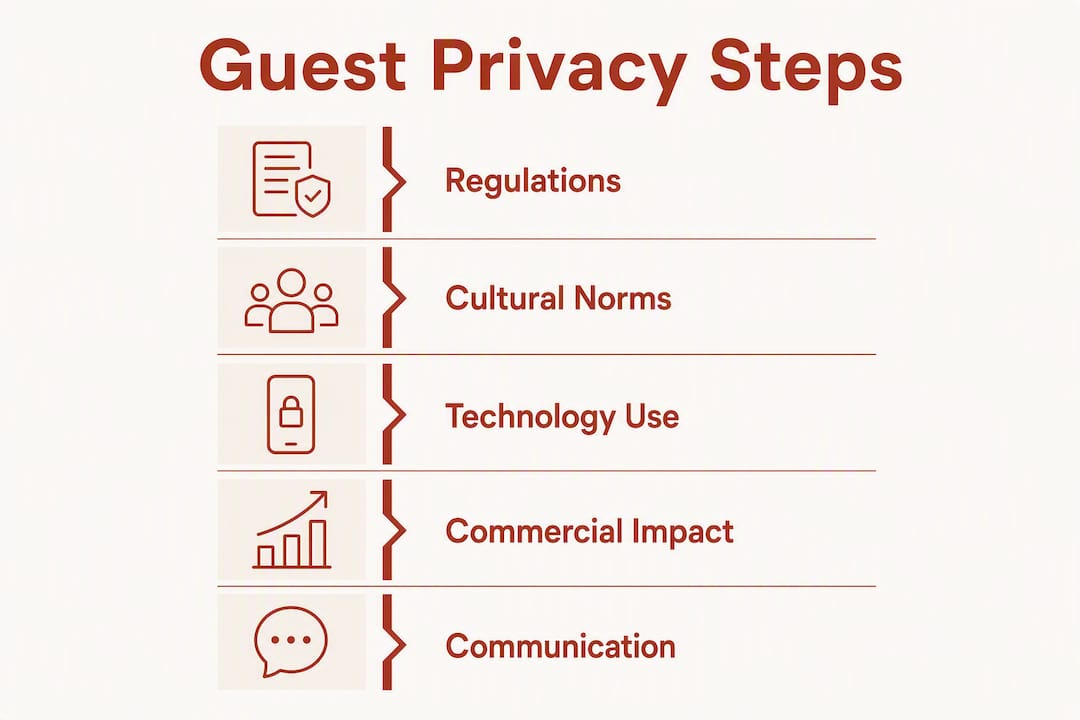
The expectation has three distinct roots: regulatory, cultural, and commercial.
Regulatory drivers are the most concrete. The EU General Data Protection Regulation (GDPR) came into force in May 2018 and reshaped how hundreds of millions of Europeans think about personal data. When those Europeans travel, they carry those expectations with them. UK GDPR and the Data Protection Act 2018 mirror the EU framework closely, meaning hotels operating in the UK are already obligated to meet a standard that European guests recognise. Guests from Germany, France, or the Netherlands do not need to read your privacy policy to know what their rights are; they assume them.
Cultural familiarity compounds the regulatory baseline. European travellers have lived with GDPR for nearly a decade. They have received breach notifications, exercised subject access rights, and opted out of profiling. That experience creates a calibrated sensitivity: they notice vague consent language, pre-ticked boxes, and loyalty schemes that bundle data sharing into a single sign-up click. Hotels that meet or exceed GDPR standards consistently win loyalty across international markets precisely because they speak the same privacy language their guests already use.
Commercial and technology drivers have accelerated the shift. Ubiquitous hotel Wi-Fi, mobile room keys, in-room smart devices, and app-based concierge services all collect personal data continuously. Guests understand this. Data privacy empowers people to control how personal information is shared, and in an environment where a single hotel stay generates data across a PMS, a loyalty platform, a payment processor, and a Wi-Fi provider, the perceived exposure is substantial. High-net-worth guests, in particular, weigh digital privacy alongside physical amenities when selecting a property.
Pro Tip: Assign a named privacy lead, even at small properties. A general manager who owns the privacy workstream will prioritise it; one who assumes IT handles it will not.
What happens when hotels ignore guest privacy expectations?
The consequences fall into three categories, each with a distinct timeline and cost profile.
Financial impacts are the most quantifiable. Under UK GDPR, the ICO can issue fines of up to £17.5 million or 4% of annual global turnover, whichever is higher, for the most serious infringements. Remediation costs, including forensic investigation, legal advice, notification letters, and credit monitoring for affected guests, routinely exceed the fine itself. Contractual penalties from OTA and corporate travel partners who require GDPR compliance as a condition of listing add a further commercial dimension.

Reputational impacts follow a faster and less predictable timeline. Careful handling of guest data is central to maintaining the trust that drives direct bookings and repeat stays; a breach reverses that trust publicly and permanently. Review scores on platforms such as TripAdvisor and Google drop measurably after a publicised incident, and privacy-conscious guests, who tend to be higher-spending, switch to competitors without warning.
Operational impacts are often underestimated during planning. An incident response to a notifiable breach under UK GDPR must be reported to the ICO within 72 hours of discovery. That clock runs regardless of whether your IT team is fully staffed, whether your PMS vendor is cooperating, or whether senior leadership is available. Hotels without a documented incident response plan typically spend the first 24 hours establishing basic facts rather than containing the breach.
A useful reference point is the broader pattern of hospitality-sector breaches documented by Hospitalitynet: the recurring lesson is that third-party vendor access, not direct hotel systems, is the most common point of failure. PMS integrations, booking engines, and loyalty platforms each represent an attack surface that hotels are legally responsible for under the data controller obligations of UK GDPR.
What specific privacy practices do international guests expect?
Expectations are concrete and touchpoint-specific. Mapping them to the guest journey makes compliance visible and manageable.
Guest-facing expectations by touchpoint:
- Check-in: Clear, plain-English explanation of what data is collected and why; no pre-ticked consent boxes; a simple opt-out from marketing at the point of registration.
- Wi-Fi: Separate, specific consent for network usage data; no bundling of Wi-Fi access with loyalty programme enrolment.
- Mobile keys and apps: Explicit disclosure of location data collection; granular permissions rather than all-or-nothing access.
- Loyalty programmes: Transparent statement of third-party sharing; clear explanation of profiling and how to limit it.
- Payment processing: Confirmation that card data is not stored on hotel systems beyond the transaction.
Guest rights in plain language:
- Access: Guests can request a copy of all personal data held about them, typically within one calendar month.
- Rectification: Incorrect data must be corrected promptly upon request.
- Erasure: Guests can request deletion of data where there is no lawful basis for continued retention.
- Portability: Data provided by the guest can be requested in a machine-readable format.
International guests commonly ask where their data is stored and who can access it; data residency is increasingly a trust signal in its own right. A guest who asks whether their booking data is processed in the US, the EU, or the UK is exercising informed consumer behaviour, not being difficult.
Multilingual communications are a practical necessity for properties with significant international footfall. A privacy notice that is legally compliant but written in dense legal English does not serve a German, Japanese, or Brazilian guest. Short, translated summaries at check-in and in-app, covering the five key points above, build trust more effectively than a full privacy policy link.

Which UK laws set the baseline for guest data protection?
Three instruments define the legal framework for hotels operating in the UK.
| Instrument | Scope | Key obligation for hotels |
|---|---|---|
| UK GDPR | All personal data processing in the UK | Lawful basis, transparency, data subject rights, breach notification |
| Data Protection Act 2018 | Supplements UK GDPR; sets national derogations | Defines the ICO's enforcement powers; sets criminal offences |
| EU GDPR | EU citizens' data, regardless of processing location | Hotels serving EU guests must comply even when operating outside the EU |
The UK GDPR and Data Protection Act 2018 together require hotels to identify a lawful basis for every category of processing. Consent is appropriate for marketing; legitimate interest may apply to security logging, but it requires a documented balancing test. Relying on consent for operational processing, such as storing a guest's passport number, is legally incorrect and creates unnecessary friction.
EU GDPR applies extraterritorially: any hotel that processes the personal data of EU citizens, regardless of where the hotel is located, must comply. For a UK property with significant European guests, this means running parallel compliance obligations across both frameworks, which in practice are closely aligned but not identical.
"The ICO can investigate any organisation processing personal data in the UK, issue enforcement notices, and impose fines. Compliance is not optional, and 'we did not know' is not a defence." — ICO, ico.org.uk
International transfers require specific attention. Sending guest data to a US-based cloud provider, a global loyalty platform, or an overseas analytics vendor constitutes a restricted transfer under UK GDPR unless an adequacy decision, standard contractual clauses, or another approved transfer mechanism is in place. Hotels frequently overlook this when selecting PMS or CRM vendors.
For a detailed view of how data compliance functions as a business asset, the relationship between legal obligation and commercial positioning is worth examining alongside the legal framework itself.
What concrete steps should hotels take to protect guest data?
Implementation divides cleanly into technical, contractual, and operational workstreams.
Technical controls (IT lead ownership):
- Encrypt guest data at rest and in transit across all systems, including PMS, Wi-Fi infrastructure, and payment terminals.
- Apply role-based access controls: front-desk staff should not have access to historical booking data beyond their operational need.
- Maintain audit logs for all access to personal data, with retention periods aligned to your documented schedule.
- Patch PMS, booking engine, and Wi-Fi management software on a defined cycle, not reactively.
Contractual controls (legal/compliance ownership):
- Require a signed DPA from every vendor that processes guest data, including cloud providers, loyalty platforms, and analytics tools.
- Review vendor contracts for clauses permitting secondary use of guest data for the vendor's own marketing or product development; negotiate these out.
- Tight contractual clauses limiting vendor reuse of guest data are a standard expectation under UK GDPR's data controller obligations.
- Confirm that any international transfers are covered by an approved transfer mechanism.
Operational controls (GM and operations lead ownership):
- Train all guest-facing staff on the five core guest rights and how to handle a subject access request.
- Document a consent flow for each touchpoint: check-in, Wi-Fi, loyalty, and app.
- Establish a retention schedule: how long is each data category kept, and who authorises deletion?
- Write and test a 72-hour breach notification procedure before you need it.
Pro Tip: Smaller properties with limited IT budgets should prioritise vendor DPA compliance and staff training above all else. Both are free to implement and address the two most common failure points.
Understanding how ISO 27001 controls align with GDPR obligations is useful when scoping technical controls, particularly for properties seeking a structured framework that satisfies both security and data protection requirements simultaneously.
How should you explain privacy to international guests?
Plain language and progressive disclosure are the two principles that make guest-facing privacy communications work.
Template language for common touchpoints:
- Check-in: "We collect your name, contact details, and identification to process your booking and comply with UK law. We do not share your data with third parties for marketing without your separate consent. You can request a copy of your data or ask us to delete it at any time."
- Wi-Fi sign-on: "Connecting to our network means we log your device identifier and session duration for network security. This data is not shared with advertisers."
- Loyalty enrolment: "Joining our programme means we store your stay history and preferences to personalise your experience. We will tell you clearly before sharing any data with partners, and you can opt out at any time."
UX best practices:
- Use progressive disclosure: show a two-sentence summary first, with a link to the full policy for guests who want more detail.
- Offer one-click preference management so guests can update marketing consent without contacting the front desk.
- Display a visible trust signal where applicable, such as "Your data is stored in the UK" or "We do not sell your personal data," at the point of collection.
Transparency about why and how data is collected is the most effective way to reduce guest switching intention and to encourage informed consent. A guest who understands the purpose of collection is significantly more likely to consent and to return.
Multilingual notices need not be full translations of a legal document. A short, accurate summary in the guest's language, covering collection purpose, third-party sharing, and how to exercise rights, satisfies both the spirit of UK GDPR's transparency requirement and the practical expectation of an international visitor.
How does data residency shape guest trust and commercial positioning?
High-net-worth and repeat international guests increasingly treat data residency as a luxury amenity in its own right. They ask, during loyalty enrolment and at check-in, where their data is stored and who can compel access to it. That question is not paranoia; it reflects a sophisticated understanding of jurisdictional risk, particularly for guests from markets where government access to cloud data is a documented concern.
Documenting and communicating your residency position reduces switching intention among this segment. A property that can state clearly, "Your data is processed and stored in the UK under UK GDPR, with no transfers to US-jurisdiction cloud providers," is offering a verifiable assurance that most competitors cannot match without examining their own vendor stack.
For properties seeking to move beyond policy statements to technical guarantees, sovereign infrastructure solutions that keep data on local ground eliminate the jurisdictional ambiguity that arises from reliance on foreign cloud providers. Islandedgetech's EdgePod, for example, provides on-premises compute and storage with encrypted local data residency, removing the exposure to foreign government access that the US CLOUD Act creates for US-hosted services. The data sovereignty advantages for resorts operating in similar markets illustrate how residency commitments translate into measurable guest confidence.
Key takeaways
International guests expect data privacy because law, commercial experience, and cultural norms make it a baseline of trust, and hotels that fail to meet that baseline face financial, reputational, and operational consequences.
| Point | Details |
|---|---|
| Legal obligation is non-negotiable | UK GDPR and the Data Protection Act 2018 require lawful processing, transparency, and breach notification within 72 hours. |
| Many affluent guests demand stronger security | Privacy is a commercial differentiator, not a compliance checkbox, for premium and repeat international visitors. |
| Vendor DPAs are the most common gap | Sign Data Processing Agreements with every cloud and PMS vendor; third-party access is the most frequent breach vector. |
| Plain-language notices build consent | Short, translated privacy summaries at check-in and on Wi-Fi increase guest confidence and informed consent rates. |
| Data residency is a trust signal | Documenting where data is stored and who can access it reduces switching intention among high-value international guests. |
Privacy is a strategic asset, not a compliance burden
The hospitality sector has spent years treating data protection as a legal obligation to be managed rather than a commercial position to be communicated. That framing is increasingly costly. Guests who arrive with GDPR-calibrated expectations are not looking for a privacy policy buried in a footer; they are looking for evidence, at every touchpoint, that the property understands what it holds and why it matters.
The hotels that will win the loyalty of privacy-conscious international guests are those whose general managers brief senior stakeholders this quarter, whose IT leads have signed DPAs with every vendor in the stack, and whose front-of-house teams can answer a subject access request without escalating to legal. Privacy embedded in brand promises, not bolted on as a compliance afterthought, is what separates a property that guests recommend from one they quietly avoid.
Useful sources and implementation resources
The following resources support implementation and compliance verification for UK hospitality operators:
- ICO guidance for organisations — the primary UK regulator; sector-specific guidance, breach notification timelines, and subject access request templates.
- UK data protection legislation overview — GOV.UK summary of UK GDPR and the Data Protection Act 2018 obligations.
- EU GDPR full text — the authoritative regulation text for understanding EU travellers' rights and extraterritorial scope.
- ISO 27001 and GDPR alignment guide — practical mapping of ISO 27001 controls to GDPR obligations for properties building a structured security framework.
- Data residency explained for UK professionals — Islandedgetech's guide to residency concepts and when to communicate them to guests.
- Islandedgetech sovereign infrastructure — overview of EdgePod, Abeng Work Suite, and Ackee for properties seeking on-premises data sovereignty.
This article provides general information on data protection obligations and is not legal advice. Hotels should confirm current requirements with the ICO or a qualified data protection practitioner.