
For UK medical providers, keeping patient data resident in the United Kingdom reduces legal exposure, strengthens patient trust, and materially simplifies compliance with UK GDPR and the Data Protection Act 2018. Three benefits stand out immediately:
- Compliance and audit readiness. Residency within the UK means your organisation can demonstrate, with documentary evidence, that special category health data is processed under a lawful basis and within a jurisdiction where ICO enforcement applies directly. There is no need to construct complex Standard Contractual Clauses or adequacy arguments for routine processing.
- Patient trust and data privacy. Patients have a reasonable expectation that their records remain under UK legal protection. Documented residency controls support that expectation and reduce the reputational risk that follows a cross-border exposure incident.
- Reduced cross-border complexity. When primary storage, backups, disaster recovery, and AI inference all remain in the UK, the transfer-mechanism burden disappears for those flows, and your Data Protection Impact Assessments become significantly less complex to maintain.
Pro Tip: When evaluating any cloud or SaaS vendor, insist on a signed, tenant-level Data Processing Agreement that explicitly names the UK as the storage and processing region and extends that commitment to backups, disaster recovery sites, and AI inference endpoints. A general marketing claim of "UK compliance" is not a contractual guarantee.
Table of Contents
- What does data residency actually mean for a UK healthcare organisation?
- Why data residency matters for healthcare: UK legal and regulatory obligations
- Which organisations and roles must address residency controls?
- What are the real risks when residency controls are absent?
- What technical and contractual controls actually enforce residency?
- How to implement residency controls: a practical sequence for UK medical providers
- How long does residency implementation take, and what drives the cost?
- Common pitfalls with cloud, SaaS, and AI: secondary flows that defeat residency
- Mapping secondary data flows: a practitioner checklist
- Data residency vs sovereignty vs localisation: which matters most for your organisation?
- Key takeaways
- Why residency should be a procurement decision, not a retrofit
- When absolute residency requires a sovereign infrastructure approach
- Useful sources and further reading
What does data residency actually mean for a UK healthcare organisation?
Data residency in healthcare refers to the geographic locations where patient records are stored, processed, and managed, with the explicit aim of keeping those activities within a defined legal jurisdiction. For a UK medical provider, that jurisdiction is the United Kingdom, and the relevant framework is UK GDPR as retained in domestic law alongside the Data Protection Act 2018.

The definition has evolved. In 2026, residency is no longer satisfied by confirming that a database sits in a UK data centre. Residency now extends to data in motion and data in use: ETL pipelines that replicate records into analytics warehouses, AI inference endpoints that receive clinical prompts, logging systems that write audit trails, and backup jobs that replicate to geographically separate sites. Each of these constitutes processing, and each must be mapped and controlled.
Residency and legal jurisdiction are related but distinct. A UK data centre does not, by itself, prevent exposure to extraterritorial laws such as the US CLOUD Act if the vendor operating that centre is a US-incorporated entity subject to those laws. Vendor legal structure matters as much as physical location. A provider that stores data in London but is wholly owned by a US parent company may still be compelled to disclose that data under US law, regardless of where the servers sit.
A practical example illustrates where residency breaks down: a clinical documentation system stores records in a UK region, but the organisation enables an AI summarisation feature that sends free-text clinical notes to an external large language model hosted in the United States. That single API call constitutes an international transfer of special category data and defeats the residency position for those records. The same failure mode applies to analytics pipelines that copy pseudonymised patient cohorts to a US-based data warehouse for reporting.
Why data residency matters for healthcare: UK legal and regulatory obligations
Residency controls reduce legal exposure and provide the documentary evidence needed to demonstrate lawful processing during ICO investigations or NHS audits. The legal case rests on several interlocking obligations.

Health data is special category data. Under Article 9 of UK GDPR, processing health information requires both a lawful basis under Article 6 and an additional condition under Article 9. This heightened status means that any transfer of patient data outside the UK without an appropriate safeguard is not merely a procedural lapse; it is a breach of a specific statutory prohibition.
International transfers require a mechanism. The ICO's guidance on international data transfers is clear: where personal data leaves the UK, the organisation must rely on an adequacy regulation, Standard Contractual Clauses, Binding Corporate Rules, or another approved transfer mechanism. Maintaining residency eliminates the need for these mechanisms for in-scope flows, which reduces both legal complexity and the risk of a mechanism failing or being invalidated.
Audit and documentation requirements are specific. The following controls are expected by the ICO and NHS data governance frameworks:
- A Data Protection Impact Assessment that identifies every processing location, including secondary flows such as backups and AI inference.
- A Record of Processing Activities that names the data controller, processor, and sub-processors, with their jurisdictions.
- A Transfer Impact Assessment for any flow that does leave the UK, documenting the legal basis and the risks assessed.
- Data Processing Agreements with every processor that explicitly restrict storage and processing to the agreed region at tenant level.
- Audit log retention sufficient to evidence that data remained within the UK throughout its lifecycle.
The ICO has the power to issue fines of up to £17.5 million or 4% of global annual turnover for serious breaches of UK GDPR. For NHS trusts and large private providers, the reputational and operational consequences of an enforcement notice frequently exceed the financial penalty. Documented data protection practices are the primary defence.
Which organisations and roles must address residency controls?
Any organisation that determines the purposes and means of processing patient data is a data controller and bears primary responsibility for residency compliance. Any organisation that processes that data on the controller's behalf is a data processor and must operate within the contractual constraints the controller sets. Both categories apply across the health sector.
In practice, this covers NHS trusts, integrated care boards, GP practices, private hospitals and clinics, diagnostic laboratories, telehealth platforms, and any third-party vendor that handles patient records, including electronic patient record suppliers, cloud infrastructure providers, and analytics firms.
Internal responsibility maps as follows:
- Data Protection Officers own the DPIA, the Record of Processing Activities, and the transfer impact assessment. They must verify that residency commitments are reflected in every relevant contract.
- Clinical leads and medical directors must understand which systems process patient data and flag new clinical tools (including AI-assisted diagnostics) to the DPO before procurement.
- IT and infrastructure teams are responsible for configuring region locks, verifying backup and DR locations, and providing technical evidence of residency to auditors.
- Procurement leads must include residency requirements in every Request for Proposal and refuse to accept generic compliance statements in lieu of signed, tenant-level contractual commitments.
- Third-party vendors and sub-processors must provide documented evidence of their processing locations and notify the controller of any change that could affect residency.
The DPIA owner is typically the DPO, but the clinical lead or IT director must sign off on technical evidence. Vendor evidence verification sits with IT and procurement jointly.
What are the real risks when residency controls are absent?
Non-compliance with residency obligations can result in regulatory fines, enforcement action, clinical disruption, and lasting reputational damage. The risks are not theoretical; they arise from specific, identifiable failure modes in cloud and SaaS deployments.
- Regulatory penalties. The ICO can impose fines, issue enforcement notices, and require organisations to cease processing. For special category data, the threshold for serious breach is lower than for general personal data.
- Forced data transfers. If a vendor is subject to a foreign legal order, patient data may be disclosed to a foreign authority without the UK controller's knowledge or consent, and potentially without any mechanism to challenge the disclosure.
- Interrupted clinical access. Residency failures that trigger enforcement action or vendor contract termination can result in loss of access to electronic patient records, with direct consequences for patient safety and clinical continuity.
- Reputational harm. A publicised data breach or ICO investigation damages patient confidence and can affect referral volumes, CQC ratings, and NHS contract renewals.
- Research and collaboration delays. Organisations that cannot demonstrate residency compliance may be excluded from NHS data-sharing agreements and research consortia that require documented governance.
The secondary-flow risk is the most commonly overlooked. A healthcare organisation may correctly configure its primary EHR to store data in a UK region, yet inadvertently route clinical notes through an AI summarisation API hosted in the United States, or allow a third-party analytics vendor to replicate pseudonymised cohort data to a non-UK warehouse. Each of these flows constitutes an international transfer of special category data. The lesson is that residency must be verified at every processing point, not just at the primary storage layer. Discovering a secondary flow during an ICO investigation, rather than during a proactive audit, is the scenario that carries the greatest legal and operational risk.
What technical and contractual controls actually enforce residency?
The most important controls are enforceable contractual commitments combined with technical region enforcement that covers primary storage, secondary processing, backups, disaster recovery, and support access. Neither element alone is sufficient.
| Technical control | What it does | Contractual clause required |
|---|---|---|
| Cloud region lock (tenant-level) | Prevents data from being written to or processed in regions outside the UK | Signed DPA naming UK as the exclusive storage and processing region for the tenant |
| Virtual Private Cloud / private link | Keeps network traffic within the UK boundary and prevents routing through foreign nodes | Network topology clause specifying UK-only routing for data in transit |
| On-premises or private AI inference | Runs model inference locally, preventing clinical prompts from reaching external LLM endpoints | AI processing addendum restricting inference to named UK or on-premises endpoints |
| Backup and DR region restriction | Ensures replicated copies remain in UK data centres | Backup and DR locality clause naming specific UK regions for all replicas |
| Role-based access control with geo-restriction | Prevents support personnel in other jurisdictions from accessing patient data | Support access clause restricting remote access to UK-based personnel or adequacy-region personnel under documented controls |
| Encryption with UK-held keys | Ensures that even if data is physically accessible outside the UK, it cannot be read without keys under UK legal control | Key management clause specifying that encryption keys are held by the controller or a UK-based key management service |
Beyond the table above, procurement teams should require the following documentation before contract signature:
- A signed, tenant-level DPA that explicitly names the UK as the storage and processing region.
- A current sub-processor list with jurisdictions for each sub-processor.
- SOC 2 Type II or ISO 27001 certification scoped to the UK region in question.
- Evidence of tenant region assignment (for example, a cloud console screenshot or a vendor-issued region attestation letter).
- Audit rights allowing the controller to verify residency controls annually or following any material change.
Pro Tip: The NCSC cloud security guidance recommends treating residency as a governance requirement rather than a configuration switch. Request a vendor's shared responsibility matrix at procurement stage and confirm in writing which residency controls are the vendor's responsibility and which remain with your organisation.
How to implement residency controls: a practical sequence for UK medical providers
A staged approach covering discovery, design, procurement, implementation, testing, and ongoing monitoring is the most reliable path to verified residency. Each stage has a defined output and an owner.
Numbered implementation checklist:
- Data mapping and asset inventory. Identify every system that stores or processes patient data, including primary EHRs, diagnostic imaging systems, analytics platforms, AI tools, and communication platforms. Document the data flows between them. Owner: IT lead. Output: data flow diagram.
- DPIA update or initiation. Update existing DPIAs or initiate new ones to reflect the residency requirement. The DPIA must identify every processing location, including secondary flows. Owner: DPO. Output: updated DPIA with residency section.
- Vendor residency requirements in RFPs. Include explicit residency requirements in all Requests for Proposal and Invitation to Tender documents. Require vendors to confirm, in writing, the specific UK regions used for storage, processing, backups, DR, and support access. Owner: procurement lead. Output: residency clause template for RFPs.
- Vendor evidence review. Collect and review signed DPAs, sub-processor lists, SOC/ISO certifications, and region attestation letters from all current and prospective vendors. Owner: IT and DPO jointly. Output: vendor evidence register.
- Contract remediation. Where existing contracts lack tenant-level residency commitments, negotiate amendments or addenda. Where vendors cannot provide compliant terms, initiate a procurement process for a compliant alternative. Owner: procurement and legal. Output: amended contracts or replacement procurement plan.
- Technical configuration and verification. Configure region locks, private networking, backup region restrictions, and access controls. Verify configuration against vendor documentation. Owner: IT lead. Output: configuration evidence pack.
- Test plan and go-live verification. Run staged queries and test data flows to verify that no data leaves the UK boundary during normal operations. Use network monitoring tools to confirm. Owner: IT lead with DPO sign-off. Output: test report.
- Continuous monitoring and annual audit. Implement ongoing monitoring of data flows, sub-processor changes, and vendor notifications. Schedule an annual residency audit against the evidence register. Owner: DPO with IT support. Output: annual audit report.
Templates to prepare or request include: a DPIA residency section template, a DPA clause checklist, a vendor evidence request letter, and an audit test script. The audit guide for healthcare data storage provides a practical starting point for the test script and evidence list.
How long does residency implementation take, and what drives the cost?
Time and cost vary significantly by organisational scope. A small private practice reconfiguring a single cloud-hosted system and updating one vendor contract may complete the process in four to eight weeks. A large NHS trust with multiple EHR systems, dozens of third-party processors, and complex analytics infrastructure may require six to twelve months for full implementation and audit.
| Activity | Typical duration | Relative effort |
|---|---|---|
| Data mapping and flow discovery | 2–4 weeks | High |
| DPIA update | 1–3 weeks | Medium |
| Vendor evidence collection and review | 2–6 weeks | Medium |
| Contract negotiation and remediation | 2–8 weeks | High |
| Technical configuration and testing | 2–6 weeks | Medium |
| Go-live verification | 1–2 weeks | Low |
| Ongoing monitoring (recurring) | Continuous | Low–Medium |
Common cost drivers include:
- Vendor premium for UK-region hosting. Some cloud providers charge a premium for UK-region storage relative to US or EU regions. This is a recurring cost that should be modelled over the contract term.
- Bespoke integration work. Where existing systems require architectural changes to enforce region locks or private networking, development and testing costs can be substantial.
- Staff time for DPIAs and audits. DPO and IT staff time for documentation, evidence review, and annual audits represents a significant recurring cost, particularly for large trusts.
- Monitoring tooling. Automated compliance monitoring tools that track data flows and alert on residency violations add to the recurring cost base but reduce manual audit burden.
- Vendor replacement. Where a current vendor cannot provide compliant terms, the cost of procurement, migration, and parallel running during transition can be the largest single cost item.
Cloud storage in healthcare improves accessibility and disaster recovery, but consumer-grade or non-healthcare-specific cloud services typically lack the BAAs, audit trails, and region controls required for compliant patient data processing. The cost of using a compliant vendor is almost always lower than the cost of remediating a breach.
Common pitfalls with cloud, SaaS, and AI: secondary flows that defeat residency
The biggest blind spot in healthcare residency programmes is secondary processing. An organisation may correctly configure its primary system to store data in a UK region while inadvertently routing patient data through external services that process it outside the UK. Secondary flows including ETL pipelines, AI inference, and logging systems must be mapped and controlled, or residency is effectively defeated.
Specific pitfalls to address:
- AI prompts to external large language models. Clinical documentation assistants, coding tools, and diagnostic support systems that send free-text clinical notes to a US-hosted LLM constitute an international transfer of special category data, regardless of where the primary EHR is hosted.
- Analytics pipelines replicating PHI. ETL jobs that copy patient cohort data into a cloud data warehouse hosted outside the UK create a secondary residency breach. Analytics platforms that use push-down queries or in-place querying avoid this by keeping data in the source system.
- Support staff access from other jurisdictions. Vendor support personnel accessing patient data remotely from outside the UK or an adequacy region constitutes a transfer. This is frequently overlooked in SaaS contracts.
- Cross-region backup replication. Backup jobs configured to replicate to a geographically diverse region may silently route copies to a non-UK data centre, particularly in multi-region cloud configurations.
- Third-party API integrations. Pharmacy systems, referral platforms, and patient communication tools that call external APIs may transmit patient identifiers or clinical data to non-UK endpoints.
Mitigation steps:
- Require vendors to provide a complete list of AI model endpoints and confirm that inference is performed within the UK or on-premises.
- Review ETL and analytics pipeline configurations and prefer architectures that query data in place rather than replicating it.
- Require contractual confirmation that vendor support access is restricted to UK-based or adequacy-region personnel, with documented controls for any exception.
- Audit backup configurations explicitly and request region attestation for all backup and DR sites.
- Review all third-party API integrations as part of the data mapping exercise and include API endpoints in the sub-processor list.
The complexity of international data flows in health tracking and clinical systems is frequently underestimated at procurement stage, which is precisely why a governance-first approach, rather than a configuration-first one, produces more durable compliance.
Mapping secondary data flows: a practitioner checklist
Residency now includes data in motion and data in use. Mapping every processing point, not just primary storage, is the defining challenge of a credible residency programme in 2026.
Actionable discovery checklist:
- Inventory all APIs. List every external API called by clinical systems, including authentication services, AI tools, analytics platforms, and communication services. For each, confirm the endpoint jurisdiction and whether patient data is transmitted.
- List all sub-processors with jurisdictions. Require each vendor to provide a current sub-processor list. Cross-reference against the data flow diagram to identify any sub-processor receiving patient data from a UK-resident system.
- Trace ETL and analytics pipelines. For each analytics or reporting tool, document whether data is replicated to an external warehouse or queried in place. Flag any replication to a non-UK destination.
- Inspect AI model endpoints. For every AI-assisted feature in clinical systems, confirm the inference endpoint location. Request a vendor statement confirming that no patient data is transmitted to a model hosted outside the UK or an adequacy region.
- Verify backup and DR locations. Request a written statement from each infrastructure vendor confirming the specific UK regions used for all backup and DR replicas.
- Test with staged queries. Use network monitoring tools to observe outbound connections during normal clinical operations. Any connection to a non-UK IP range during a patient record access event warrants investigation.
- Request vendor evidence of region-restricted logging. Confirm that audit logs and system logs are written to UK-resident storage and are not replicated to non-UK log aggregation services.
When requesting evidence from vendors, ask specifically for: a region attestation letter signed by a named technical officer, a network topology diagram showing data paths for the tenant's environment, and confirmation of the jurisdiction of any log aggregation or SIEM service used.
Data residency vs sovereignty vs localisation: which matters most for your organisation?
Residency is the practical control, sovereignty is the legal and political stance, and localisation is a mandatory regulatory requirement in certain jurisdictions. For most UK medical providers, residency controls are the immediate priority, but understanding the distinctions helps in setting the right procurement requirements.
- Data residency means that data is stored and processed within a defined geographic boundary. For UK healthcare, this means UK data centres and UK-based processing. It is a contractual and technical commitment, and it is what most procurement clauses and DPAs address.
- Data sovereignty means that data remains subject to the laws of a specific jurisdiction, regardless of where it is physically stored. A UK-sovereign position requires not only UK-resident storage but also a vendor legal structure that is not subject to extraterritorial laws such as the US CLOUD Act. Sovereignty is a higher bar than residency and is relevant for organisations handling data of national security significance or data subject to specific NHS contractual requirements.
- Data localisation refers to a legal mandate requiring data to be stored within a specific country. The UK does not currently impose a general data localisation mandate, but sector-specific requirements (for example, certain NHS data-sharing frameworks) may effectively require it for specific data categories.
For a UK medical provider, the practical decision is as follows:
- If your primary concern is UK GDPR compliance and ICO audit readiness, residency controls are sufficient for most processing activities.
- If your organisation handles data subject to NHS national security classifications, or if you have zero tolerance for foreign legal exposure, sovereignty controls, including vendor legal structure assessment, are necessary.
- If a specific contract or regulatory instrument mandates UK storage, localisation requirements apply and must be reflected in vendor contracts.
Pro Tip: When evaluating vendors, ask whether the vendor entity that holds your data is incorporated in the UK or an adequacy country, not just whether the data centre is in the UK. A UK data centre operated by a US-incorporated entity may not satisfy a sovereignty requirement, even if it satisfies a residency one. The data residency guide for UK professionals covers this distinction in detail.
Key takeaways
UK medical providers that implement verified residency controls gain compliance defensibility, reduced transfer-mechanism complexity, and stronger patient trust, provided those controls extend beyond primary storage to cover AI inference, ETL pipelines, backups, and support access.
| Point | Details |
|---|---|
| Residency covers more than storage | In 2026, residency must extend to AI inference, ETL pipelines, backups, and support access, not just primary data storage. |
| Signed tenant-level DPAs are mandatory | Generic vendor compliance statements are not sufficient; insist on a signed DPA naming the UK as the exclusive processing region for your tenancy. |
| Secondary flows are the primary risk | AI prompts, analytics replication, and cross-region backups are the most common sources of inadvertent international transfer in clinical deployments. |
| Residency reduces transfer-mechanism burden | Keeping all processing within the UK eliminates the need for SCCs or adequacy arguments for those flows, simplifying DPIAs and audits. |
| Islandedgetech offers a sovereign-infrastructure approach | For organisations that require zero foreign legal exposure, Islandedgetech provides locally resident infrastructure with contractual guarantees covering storage, processing, and support access. |
Immediate actions for clinical, IT, and procurement leads:
- Update your DPIA to include a residency section covering all processing locations, including secondary flows.
- Request tenant-level residency evidence from every current cloud and SaaS vendor within 30 days.
- Run a secondary-flow discovery exercise, using the checklist above, within 60 days.
- Include explicit residency clauses in all new RFPs and contract renewals from this point forward.
- Assign a named owner for the annual residency audit and schedule the first review within 90 days.
Why residency should be a procurement decision, not a retrofit
The organisations that handle residency most effectively are those that treat it as a design-stage requirement rather than a compliance problem to solve after a system is live. When residency is specified in the RFP, evaluated during vendor selection, and contracted before go-live, the cost and complexity are a fraction of what they become when an organisation attempts to retrofit controls onto an existing deployment. Retrofitting typically requires contract renegotiation, architectural changes, data migration, and repeat DPIAs, all of which consume DPO and IT resource that would otherwise be directed at patient care.
The longer-term case is equally clear. Organisations that can demonstrate verified residency controls are better positioned for NHS data-sharing agreements, research partnerships, and CQC inspections. Patient trust, once lost through a publicised data breach, is slow to recover. Residency controls, properly implemented and documented, are one of the most direct investments a medical provider can make in clinical continuity and institutional credibility. The case for healthcare data sovereignty is not abstract; it is grounded in the practical reality that the organisations best prepared for ICO scrutiny are those that built governance into their procurement process from the outset.
When absolute residency requires a sovereign infrastructure approach
For medical providers where residency must be absolute, including those handling data subject to NHS national security classifications, zero-tolerance requirements for foreign legal exposure, or contractual mandates for UK-only processing, a sovereign infrastructure approach provides the strongest available guarantee.
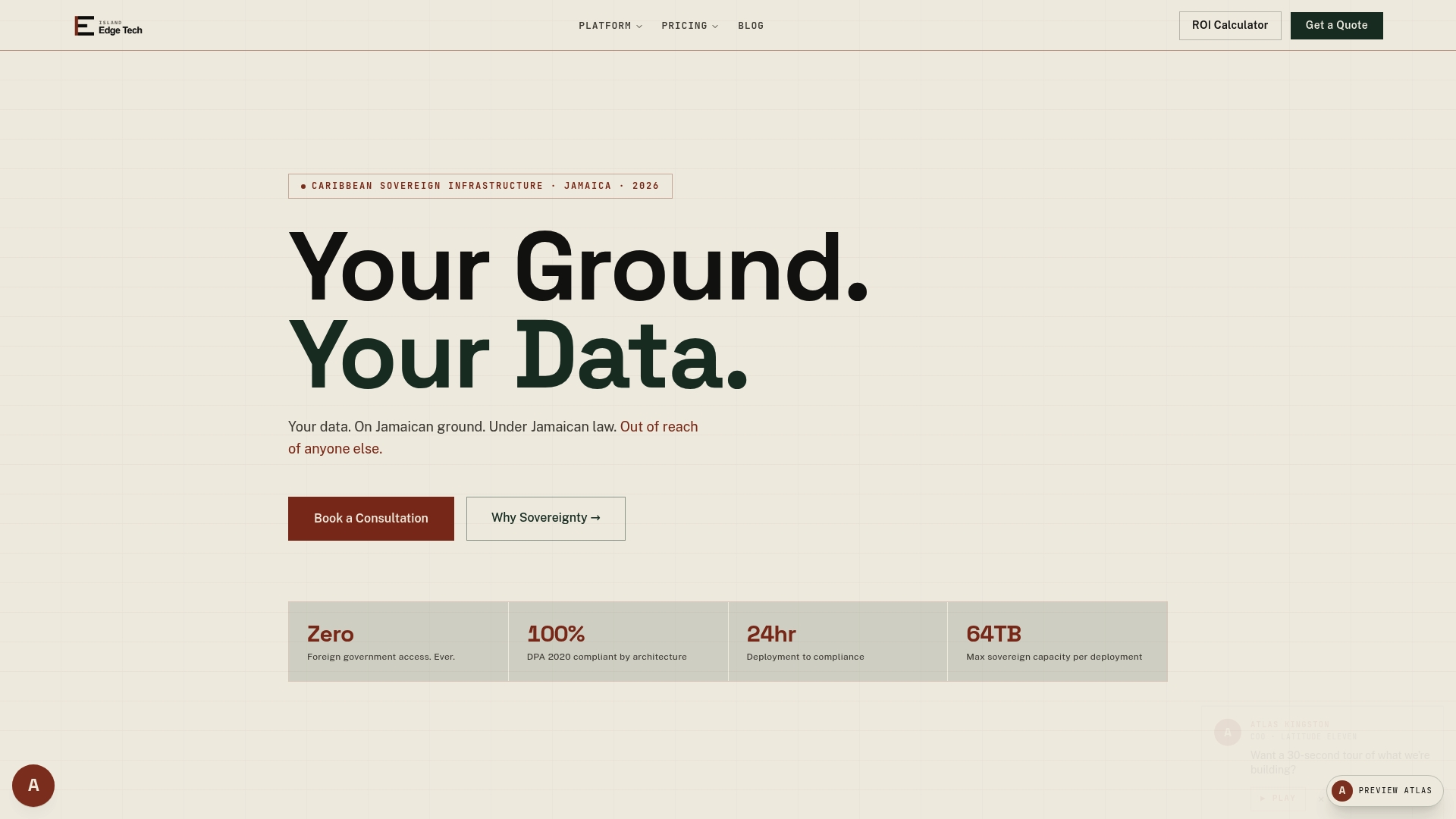
Islandedgetech provides locally resident sovereign infrastructure with contractual commitments covering primary storage, processing, backups, disaster recovery, and support access, all within a defined jurisdiction and under a legal structure designed to eliminate exposure to extraterritorial laws such as the US CLOUD Act. For organisations that cannot accept the residency risk that comes with a US-incorporated cloud vendor operating UK data centres, this represents a materially different risk position.
The sovereign cloud and DPA-ready infrastructure documentation covers the specific contractual guarantees, region commitments, and audit evidence available. Organisations exploring this option can request a signed DPA, sub-processor list, and region attestation letter directly from the Islandedgetech team. Regional availability should be confirmed at enquiry stage, as sovereign infrastructure deployments are scoped to specific jurisdictions.
This article provides general information about data residency obligations and is not legal advice. Medical providers should confirm their specific compliance position with a qualified data protection practitioner and consult current ICO guidance for their circumstances.
Useful sources and further reading
The sources below are the primary references for the legal, technical, and operational claims in this article. They are the appropriate starting point for internal legal and IT conversations about residency compliance.
- UK GDPR international transfers guidance — ICO. Covers adequacy, SCCs, and transfer impact assessments; the primary reference for any cross-border transfer question.
- Data Protection Act 2018 overview — GOV.UK. The statutory basis for special category data processing and the legal framework within which residency obligations sit.
- NCSC cloud security collection — National Cyber Security Centre. Covers shared responsibility, procurement-first advice, and governance requirements for cloud deployments in the UK.
- Healthcare data residency requirements guide — Knowi. Practical coverage of process-level residency including ETL, AI inference, and secondary flows.
- Data residency in healthcare cloud — Censinet. Operational definition and compliance framework for healthcare cloud deployments.
- Cloud computing in health care systems — PMC. Academic analysis of cloud scalability and governance requirements for clinical and research systems.
When requesting evidence from vendors, ask specifically for: a signed DPA naming the UK as the exclusive processing region for your tenancy, a current sub-processor list with jurisdictions, SOC 2 Type II or ISO 27001 certification scoped to the UK region, and a region attestation letter signed by a named technical officer.