
The safest posture for any organisation handling sensitive data is straightforward: keep data under local custody, enforce technical controls that make remote access impractical, and embed contractual terms that limit vendor discretion. Three actions you can commission this week:
- Technical: Enable phishing-resistant multi-factor authentication (MFA) across all administrative accounts and confirm that encryption keys are held outside US jurisdiction.
- Contractual: Require your cloud or SaaS vendors to confirm, in writing, where data is stored, where encryption keys are held, and where backup copies are replicated.
- Governance: Initiate a data mapping exercise to identify which systems touch US-controlled infrastructure, then commission a Data Protection Impact Assessment (DPIA) for your highest-risk data flows.
These steps address the three principal mechanisms of extraterritorial risk: the CLOUD Act, which allows US law enforcement to compel American companies to produce data regardless of where it is physically stored; FTC enforcement under Section 5 of the FTC Act for deceptive or unfair data security practices; and the broader patchwork of US federal and state obligations that can reach non-US organisations processing data about US residents. The UK Information Commissioner's Office (ICO) and the UK Data Protection Act 2018 / UK GDPR set the local regulatory standard against which transfer and residency decisions must be measured. CISA and NIST provide the technical baseline that underpins credible security postures.
Table of Contents
- Which US laws can compel access to your data?
- How does your data reach US jurisdiction in practice?
- Practical mitigations: technical, contractual, and governance controls
- When is sovereign infrastructure the right choice?
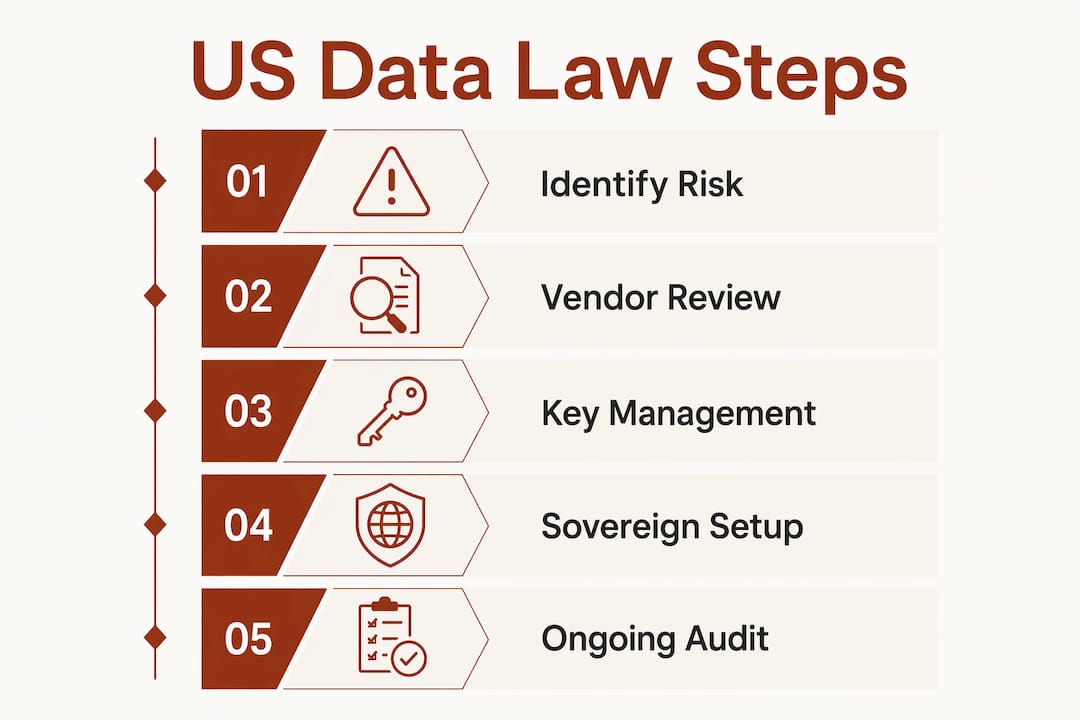
- How to implement sovereign data infrastructure
- Executive checklist: actions to commission this month
- Key takeaways
- Why sovereign-first is often the only defensible posture
- Islandedgetech's sovereign infrastructure: your next step
- Useful sources
Which US laws can compel access to your data?
The CLOUD Act (Clarifying Lawful Overseas Use of Data Act, 2018) is the most direct extraterritorial instrument. It permits US law enforcement to serve a warrant or court order on any US-based provider, compelling production of data stored anywhere in the world. The provider's physical location is irrelevant; what matters is whether the entity is subject to US jurisdiction. A Jamaican organisation whose data sits on a US-headquartered cloud platform is therefore exposed, even if the data centre is located in the Caribbean.
US law enforcement subpoenas and mutual legal assistance treaty (MLAT) requests operate differently. MLAT requests require cooperation between governments and are slower; direct warrants under the CLOUD Act bypass that process entirely. Critically, providers served with a CLOUD Act order may be subject to a gag order, meaning your organisation may never be notified that a disclosure has occurred.
The FTC enforces reasonable security under Section 5 of the FTC Act, targeting organisations that fail to implement adequate security measures or that misrepresent their privacy practices. Sectoral statutes, including HIPAA (health data) and GLBA (financial data), add further obligations, and state-level laws now cover twenty comprehensive privacy regimes, with enforcement pathways that include state attorneys general and, in some states, private rights of action. Non-US organisations processing data about US residents may be subject to these obligations even without a physical US presence.
The practical risk for Jamaican executives: A US-headquartered cloud provider can be compelled to disclose your organisation's data to US authorities without your knowledge or consent, and without any breach of Jamaican law on the provider's part. The legal gap between Jamaica's DPA 2020 and US legal frameworks is not a technicality; it is a structural exposure that contractual assurances alone cannot close.
The UK ICO's guidance on international transfers under UK GDPR reinforces that data controllers must assess the legal environment of the destination country, including the risk of government access, before authorising a transfer. That assessment, for US-hosted infrastructure, will routinely identify CLOUD Act exposure as a material risk.
How does your data reach US jurisdiction in practice?
Most organisations are surprised by how many technical routes pull data into US-controlled infrastructure. Common pathways include:
- Cloud control planes: Even when data is stored in a regional data centre, the management layer (identity, billing, key management) may be operated from the US.
- Cross-region backups: Automated replication to US-based availability zones is a default setting in many enterprise cloud configurations.
- Remote support access: Vendor engineers accessing systems for maintenance or troubleshooting may connect from US-based networks, creating a jurisdictional footprint.
- Third-party SaaS logging and telemetry: Analytics, monitoring, and error-reporting tools frequently export metadata to US-hosted endpoints, even when primary data remains local.
- Subprocessor chains: A primary vendor may engage US-based subprocessors for functions such as identity management, CDN, or security scanning without explicit disclosure.
A practical data-map review should ask vendors four questions: Where is data stored at rest? Where are encryption keys held and managed? Where are backup copies replicated? Who holds remote administrative access, and from which jurisdiction do they operate? The answers to these questions define your actual exposure, not the answers in a vendor's marketing materials.

Practical mitigations: technical, contractual, and governance controls
Immediate actions (commission within 30 days)
- Enable phishing-resistant MFA on all administrative and privileged accounts, leveraging the latest security tooling available from Alectura | AIDR. The FTC identifies MFA as one of the most effective defences against credential compromise, and CISA's guidance on basic cybersecurity practices places it alongside prompt patching as a foundational control.
- Audit encryption key custody. Encryption at rest and in transit is necessary but insufficient if keys are managed by a US-controlled provider. Keys must be held in a jurisdiction outside US reach, either on-premises or with a non-US key management service.
- Isolate backups. Immutable or offline backups are the only reliable defence against ransomware that corrupts live-synced copies. Backups tethered to the same network as primary data offer no meaningful protection.
Near-term actions (30–90 days)
- Implement Zero Trust principles: continuous verification, least-privilege access, and a data asset catalogue that categorises assets by sensitivity. Zero Trust forces explicit access decisions and pairs directly with a sovereignty architecture.
- Establish a documented patching cadence and logging policy. Unpatched vulnerabilities and absent audit logs are the two most common vectors in enforcement actions.
- Conduct a subprocessor audit: require your primary vendors to disclose all subprocessors, their jurisdictions, and the data categories they handle.
Contractual checklist:
- Data Processing Agreement (DPA) with explicit data residency commitments and key custody terms.
- Audit rights and subprocessor transparency clauses, including advance notice of subprocessor changes.
- Choice-of-law and venue clauses specifying a non-US jurisdiction for dispute resolution.
- Support access limits: require that remote administrative access is logged, time-limited, and subject to advance notice where feasible.
- Breach notification obligations aligned to your ICO reporting timeline (72 hours under UK GDPR).
Pro Tip: When negotiating with large cloud providers, do not accept a standard DPA without requesting their data residency addendum and key management options separately. Many providers offer customer-managed encryption keys (CMEK) as an add-on; without it, the provider retains key custody and therefore retains the ability to comply with a CLOUD Act order.
Governance:
- Complete a DPIA for each high-risk data flow involving US-controlled infrastructure.
- Maintain a written data retention and disposal policy. Deleting files does not guarantee removal; secure overwriting or physical destruction is required for decommissioned hardware.
- Prepare a breach response playbook that includes a CLOUD Act disclosure scenario, with legal counsel pre-engaged.
When is sovereign infrastructure the right choice?
| Decision criterion | Contractual/technical mitigations may suffice | Sovereign/local infrastructure warranted |
|---|---|---|
| Data sensitivity | Low to moderate; no special categories | High sensitivity; health, financial, or government records |
| Regulatory obligation | General commercial data | Sector-specific (HIPAA-equivalent, DPA 2020 special categories) |
| Business continuity | Cloud outage tolerable | Operational continuity is mission-critical |
| CLOUD Act exposure | Acceptable residual risk | Zero tolerance for compelled disclosure |
| Vendor negotiating leverage | Large enterprise with contractual power | SME or public body with limited leverage |
Sovereign infrastructure is the only practical path to eliminate CLOUD Act exposure entirely, because it removes the US-jurisdictional nexus at the architectural level. For healthcare providers, government agencies, financial services firms, and BPO operators handling regulated data, the sector-specific obligations typically make sovereignty the default, not the exception.
The EU-US Data Privacy Framework and similar voluntary self-certification mechanisms do not remove CLOUD Act exposure; they address cross-border transfer legitimacy under data protection law, not compelled government access. Organisations that rely on these frameworks as their primary CLOUD Act mitigation are accepting a residual risk that sovereign architecture eliminates.
How to implement sovereign data infrastructure
- Discovery and data mapping: Catalogue all data assets, classify by sensitivity, and identify which systems currently touch US-controlled infrastructure. The Federal Zero Trust data security guide recommends a data asset catalogue as the single most effective tool for targeted sovereignty decisions.
- Pilot and procurement: Evaluate sovereign node options against your data map. Islandedgetech's EdgePod is a physical compute and storage node deployed on-premises, with built-in battery backup, encrypted storage, mesh networking, and offline operation capability. The Ackee security layer provides authentication, encryption, access control, and monitoring. The Abeng Work Suite replaces cloud-hosted productivity tools with locally hosted equivalents covering documents, email, calendar, and video conferencing.
- Rollout and configuration: Deploy with a hardened baseline: customer-managed keys, Zero Trust access policies, phishing-resistant MFA, and an immutable backup configuration that is physically or logically isolated from the primary network.
- Operational handover: Define SLAs for patching cadence, incident response, and hardware maintenance. Confirm that supplier engineers' remote access is logged, jurisdiction-scoped, and subject to advance notice.
- Continuous assurance: Schedule quarterly vendor due diligence reviews, annual DPIAs for material data flows, and a tabletop incident response exercise that includes a CLOUD Act disclosure scenario.
Roles and responsibilities:
- Executive/Board: Approve data residency policy; sign off on DPIA outcomes and sovereign infrastructure budget.
- CIO/IT: Own the data asset catalogue, patching cadence, and key custody model.
- Procurement/Legal: Negotiate DPA terms, subprocessor clauses, and choice-of-law provisions; engage external counsel for CLOUD Act scenario planning.
- Suppliers (Islandedgetech): Deliver SLA-backed deployment, maintenance, and security hardening; provide audit evidence on request.
Pro Tip: Never connect your sovereign backup to the same network segment as your primary data. A ransomware actor who gains access to the primary environment will attempt to corrupt or encrypt backup copies within the same reachable network. Physical or logical isolation is the only reliable guarantee of recoverability.
For organisations in the education sector, the data privacy obligations for schools follow the same sovereignty logic: local hosting removes the jurisdictional exposure that cloud-based student information systems create.
Executive checklist: actions to commission this month
| Role | Action | Timeframe |
|---|---|---|
| CIO / IT | Confirm encryption key custody location for all primary systems | Week 1 |
| CIO / IT | Enable phishing-resistant MFA on all admin accounts | Week 1 |
| CIO / IT | Verify backup isolation (offline or immutable) | Week 2 |
| Procurement | Request vendor confirmation of data storage, key, and backup locations | Week 1 |
| Procurement | Obtain and review subprocessor disclosure from all cloud vendors | Week 2 |
| Procurement | Initiate DPA renegotiation or sovereign infrastructure procurement | Week 3–4 |
| Legal / Compliance | Commission DPIA for highest-risk US-hosted data flows | Week 2 |
| Legal / Compliance | Engage counsel on CLOUD Act scenario and breach playbook | Week 3 |
Quick wins to prioritise:
- Require written vendor confirmation of key storage jurisdiction before renewing any cloud contract.
- Enable phishing-resistant MFA (FIDO2 or hardware token) across all privileged accounts immediately; this single control stops the majority of credential-based attacks.
- Add a data residency clause to every new vendor contract, specifying that data and keys must remain outside US jurisdiction.
For a practical primer on data jurisdiction questions relevant to Jamaican procurement decisions, the linked guide covers the key concepts your legal and IT teams will need.
Key takeaways
Organisations that keep sensitive data under local custody, enforce key management outside US jurisdiction, and embed explicit residency and audit terms in vendor contracts materially reduce their exposure to CLOUD Act compelled disclosure and FTC enforcement risk.
| Point | Details |
|---|---|
| CLOUD Act is the primary risk | US law compels American providers to disclose data globally; only removing the US jurisdictional nexus eliminates this exposure. |
| Key custody determines real control | Encryption at rest is insufficient if keys are US-managed; customer-managed keys held locally are the minimum technical control. |
| Contracts must be explicit | DPAs must specify data residency, key custody, subprocessor jurisdiction, and audit rights; standard terms rarely provide this. |
| Sovereign infrastructure removes residual risk | For healthcare, government, and financial services, sovereign on-premises deployment is the only architecture that eliminates CLOUD Act exposure by design. |
| Islandedgetech EdgePod, Ackee, and Abeng | Islandedgetech's sovereign stack delivers on-premises compute, security, and productivity under Jamaican law with SLA-backed maintenance. |
Why sovereign-first is often the only defensible posture
The conventional advice on US data law compliance tends to focus on contractual mitigations: negotiate a better DPA, add a data residency addendum, rely on the EU-US Data Privacy Framework. That advice is not wrong, but it is incomplete for organisations in sensitive sectors.
The structural problem is that a US-headquartered provider, however well-intentioned, cannot refuse a valid CLOUD Act order. No contractual clause overrides a court-issued warrant. Organisations that treat DPA terms as their primary CLOUD Act defence are, in effect, accepting a residual risk that they may never be notified about. For a healthcare provider, a government agency, or a financial institution, that residual risk is not commercially acceptable.
The sovereign-first approach, implemented through products such as Islandedgetech's EdgePod, Ackee, and Abeng, removes the US jurisdictional nexus at the architectural level. There is no US-controlled provider to serve a warrant on. The trade-off is real: sovereign infrastructure requires upfront deployment, ongoing maintenance discipline, and a willingness to manage hardware. For organisations where data sensitivity and regulatory obligation are high, that trade-off is straightforward. For lower-sensitivity commercial data, layered contractual and technical mitigations may be adequate, provided key custody is genuinely local and subprocessor chains are audited.
The role of data compliance in business governance is not static. US state privacy law is expanding rapidly, with twenty states now operating comprehensive privacy regimes and more enacting legislation each year. Organisations that build a sovereign-first architecture now are better positioned to absorb future legal changes without emergency remediation.
Islandedgetech's sovereign infrastructure: your next step
Jamaican organisations that need to eliminate CLOUD Act exposure by design, rather than manage it contractually, have a direct path forward with Islandedgetech's sovereign stack.
The EdgePod sovereign node deploys on your premises with encrypted storage, mesh networking, built-in battery backup, and offline operation, placing compute and data entirely under Jamaican law. The Ackee security layer provides authentication, access control, encryption, and continuous monitoring. The Abeng Work Suite replaces US-hosted productivity tools with locally hosted equivalents, removing the final SaaS-layer exposure. All three are delivered under SLA-backed subscription terms with managed maintenance, so your IT team is not carrying the operational burden alone.
The engagement follows three steps: an initial risk scan to map your current US jurisdictional exposure, a pilot deployment scoped to your highest-risk data environment, and a production rollout with full SLA and maintenance commitments. To begin your risk scan and commission a sovereign infrastructure pilot, visit islandedgetech.com/groundwork.
This article provides general information on data law and security practices. It does not constitute legal advice. Organisations should confirm their specific obligations and risk exposure with qualified legal counsel and their relevant supervisory authority.
Useful sources
The following authoritative sources underpin the legal and technical guidance in this article. Use them when commissioning legal or security due diligence.
- FTC: Protecting personal information — a guide for business: The primary FTC guidance on Section 5 enforcement, covering MFA, encryption, patching, and secure disposal obligations.
- FTC: Cybersecurity for small businesses: Practical baseline controls including MFA, immutable backups, and patching cadence; directly applicable to SME governance.
- FTC: Privacy and security: Covers the EU-US Data Privacy Framework self-certification process and FTC enforcement of voluntary commitments.
- CISA: Secure your business: No-cost tools and operational guidance on logging, backup planning, phishing training, and SaaS configuration assessment (SCuBA).
- Federal Zero Trust data security guide (revised May 2025): The authoritative federal reference for data asset cataloguing, sensitivity labelling, and least-privilege architecture.
- DLA Piper: Data protection laws in the United States: Comprehensive overview of the US state and federal privacy patchwork, including CPRA and emerging state regimes.
- ICLG: Data protection laws and regulations 2026 — USA: Sector-specific obligations (HIPAA, GLBA, FCRA) and state breach notification requirements relevant to non-US organisations.
- US Department of Commerce: Privacy laws, policies and guidance: Primary reference for federal privacy statutes, OMB memoranda, and agency-level privacy impact assessment requirements.
- NCSL: Data security laws — private sector: State-by-state summary of private sector data security obligations; useful for assessing exposure when processing US resident data.
- White & Case: US data privacy guide: Detailed tracking of comprehensive state privacy law enactments and enforcement developments; essential for ongoing compliance monitoring.