
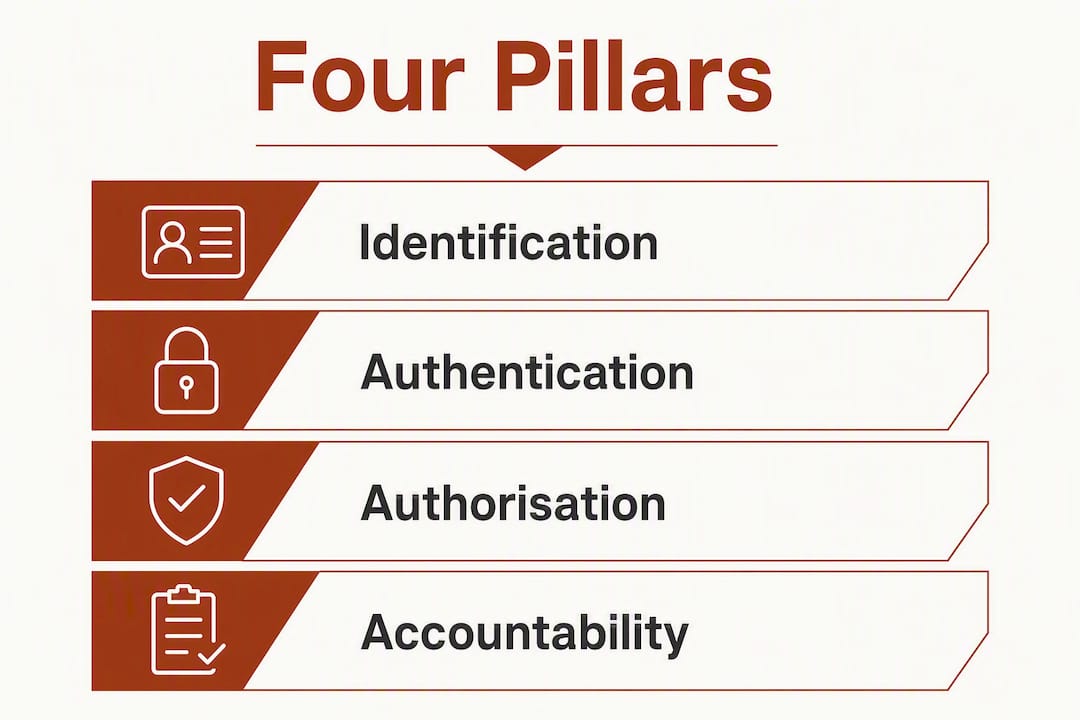
Access control for health data is the set of policies, technical mechanisms, and governance processes that determine who can access patient records and clinical systems, under what conditions, and with what level of permission — protecting the confidentiality, integrity, and availability of special-category personal data as defined under the Data Protection Act 2018 and UK GDPR. The discipline rests on four technical pillars: Identification (establishing who a user is), Authentication (verifying that claim), Authorisation (defining what they may do), and Accountability (creating an auditable record of every action). Systematic reviews of EHR access control consistently structure solutions around this IAAA framework.
For healthcare leaders and IT security teams, the immediate compliance obligations are clear. The NHS Data Security and Protection (DSP) Toolkit requires documented evidence of access policies, role matrices, and audit logs. The ICO expects data controllers to demonstrate purpose limitation and data minimisation in access design. Caldicott Guardians and Data Protection Officers (DPOs) carry specific governance responsibilities that must be reflected in access-control architecture.
Immediate actions for the first few months:
- Validate all role definitions against actual clinical functions and remove orphaned or over-privileged accounts.
- Enforce multi-factor authentication (MFA) on all systems holding special-category health data.
- Audit existing access logs: confirm they capture who, what, when, and from where, and that retention meets NHS guidance.
- Conduct a DSP Toolkit gap assessment focused on access-control evidence requirements.
- Appoint or confirm the Caldicott Guardian and DPO as named owners of the access-control governance process.
Table of Contents
- What are the four pillars of health-data access control?
- Which access control model fits your healthcare environment?
- What technical controls protect health data access?
- How do physical and digital access controls converge in clinical settings?
- How does UK law shape access control for health data?
- How do you implement access control in a healthcare organisation?
- What should you log, monitor, and do when access goes wrong?
- What operational challenges will you face, and how do you address them?
- Why are ReBAC, risk-based controls, and Zero Trust gaining ground in healthcare?
- Key takeaways
- The pitfall most access-control programmes miss
- Useful sources and further reading
What are the four pillars of health-data access control?
Peer-reviewed literature on EHR security frames access control around the IAAA model, and each pillar has a distinct clinical expression.
Identification
Identification establishes a unique, persistent identity for every user before any access is attempted. In a hospital setting, this is typically a staff ID number or NHS smartcard number tied to a single individual. Shared accounts — a persistent problem in clinical environments — break identification entirely, because the system cannot distinguish which person performed an action. Without a unique identifier, the accountability pillar collapses.
Authentication
Authentication verifies the claimed identity using one or more factors: something you know (PIN or password), something you have (NHS smartcard, hardware token), or something you are (fingerprint, iris scan). NHS smartcards combined with a PIN represent the most common authentication mechanism in NHS trusts, providing two-factor assurance without significant workflow friction. The trade-off is real: higher assurance methods slow access in time-critical clinical moments, which is why emergency override ("break-glass") procedures must be designed in parallel.

Pro Tip: When evaluating MFA options for clinical environments, prioritise smartcard-plus-PIN over mobile authenticator apps for ward-based staff. Mobile apps introduce device management complexity and fail in areas with poor signal, whereas smartcards work offline and integrate directly with NHS identity infrastructure.
Authorisation
Authorisation defines what an authenticated user may do: read, write, modify, or delete specific data sets. A ward nurse may have read access to medication records for patients on her ward but no access to psychiatric notes. A consultant may have read/write access across multiple wards but cannot access records outside her specialty without a documented clinical reason. A systematic review of EHR access controls identifies Attribute-Based Access Control (ABAC) as the most widely adopted mechanism for fine-grained authorisation, though gaps in emergency access and audit coverage remain common in deployed systems.
Accountability
Accountability means that every access event — whether successful or denied — generates a tamper-resistant log entry. The log must capture the user identity, the resource accessed, the timestamp, the action performed, the session identifier, and the clinical context (such as the patient identifier). Break-glass events require particular rigour: emergency overrides must trigger mandatory retrospective review workflows and auditable justification fields, not simply an unrestricted access grant.
The four pillars are interdependent. A unique identifier makes accountability meaningful. Strong authentication makes authorisation trustworthy. Without all four operating together, the access-control system has structural gaps that regulators and attackers will both find.
Which access control model fits your healthcare environment?
No single model suits every clinical workflow. Practitioners consistently find that organisations must combine models and adapt controls to local regulatory requirements and care-team structures.
| Model | One-sentence definition | Healthcare strengths | Limitations | Typical use case |
|---|---|---|---|---|
| RBAC (Role-Based) | Access granted by assigned organisational role | Simple to administer; maps to job titles | Struggles with temporary staff, emergency scenarios, fine-grained context | Core access layer for stable clinical roles |
| ABAC (Attribute-Based) | Access determined by user, resource, and environment attributes | Fine-grained; context-aware | Complex policy management; performance overhead | Specialty-specific record access, time-of-day controls |
| ReBAC (Relationship-Based) | Access gated on the relationship between clinician and patient | Mirrors care-team assignment; reduces false negatives | Requires relationship data to be maintained accurately | Care-team access, GP referral workflows |
| RiBAC (Risk-Based) | Permissions adjusted dynamically using real-time risk signals | Adaptive; reduces exposure in high-risk situations | Requires risk-scoring engine; higher complexity | High-assurance systems, remote access, third-party connections |
| Zero Trust | No implicit trust; every request verified regardless of network location | Reduces attack surface; strong for distributed environments | Higher operational overhead and cost | Telehealth, multi-site trusts, third-party integrations |
RBAC as the foundation
RBAC is the natural starting point for most NHS trusts because it maps directly to existing job-title and department structures. Its weakness is well-documented: it struggles with temporary staff, emergency scenarios, and any access decision that depends on context rather than role. Practitioners routinely layer ABAC or relationship checks on top of RBAC to achieve the required granularity.
ReBAC for care-team workflows
HL7 notes that ReBAC enables access gating based on relationships such as "is this clinician assigned to this patient's care team?" This mirrors how clinical assignment actually works and reduces the administrative overhead of manually granting and revoking access as patients move between wards or care pathways.

Hybrid models for complex environments
Research on integrated RBAC+ABAC+RiBAC architectures shows that combining these models improves both the precision of access grants and the system's ability to deny unauthorised requests in dynamic clinical environments. A practical hybrid approach assigns a base role (RBAC), applies attribute checks for specialty or location context (ABAC), and then applies a risk score to flag or block access when signals such as off-hours access or unusual data volumes are detected (RiBAC).
Break-glass scenario: In an emergency, a clinician who lacks a standing role for a patient's record invokes a break-glass override. RBAC alone cannot handle this gracefully without either over-provisioning roles or blocking lifesaving access. A hybrid model with a dedicated emergency-access policy, mandatory justification capture, and automatic retrospective review satisfies both clinical need and regulatory obligation.
Pro Tip: Design break-glass as a named policy, not an exception. Define the trigger conditions, the justification fields the system must capture, the review workflow that fires within 24 hours, and the escalation path to the Caldicott Guardian. Treat every break-glass event as a near-miss until the review confirms otherwise.
What technical controls protect health data access?
The technologies that enforce access control in healthcare span identity management, authentication, session handling, and audit infrastructure. Each solves a distinct problem.
- Identity and Access Management (IAM): Centralises user provisioning, role assignment, and deprovisioning. Prevents orphaned accounts and enforces least-privilege by default.
- Single Sign-On (SSO): Allows clinicians to authenticate once and access multiple clinical systems without re-entering credentials, reducing password fatigue and shared-account workarounds.
- Multi-Factor Authentication (MFA): Adds a second verification factor, significantly reducing the risk of credential-based attacks on systems holding special-category data.
- Privileged Access Management (PAM): Controls, monitors, and records access by administrators and privileged accounts, which carry the highest risk if compromised.
- Device posture checking: Verifies that the device requesting access meets security standards (patch level, encryption status, managed configuration) before granting a session.
- Session management: Enforces automatic logout after inactivity, limits on session duration, and re-authentication for high-risk actions within a session.
- Encryption: Protects data at rest and in transit, ensuring that even if access controls fail, intercepted data is unreadable.
Integration with EHR systems
FHIR's Security and Privacy module provides the standards-based integration points for authorisation (OAuth 2.0 scopes), consent representation (Consent resource), and audit logging (AuditEvent resource). FHIR does not mandate a single technical stack; it leaves enforcement to implementers. In practice, this means the policy engine, the identity provider (IdP), and the EHR must be configured to exchange tokens, enforce scopes, and write AuditEvent records consistently.
| Control layer | Where it sits | What it enforces |
|---|---|---|
| Directory (e.g. Active Directory, LDAP) | Identity store | User identities, group memberships, role assignments |
| Identity Provider (IdP) | Authentication layer | MFA, SSO tokens, session lifetime |
| EHR application | Authorisation enforcement | Role/attribute checks, record-level permissions |
| API gateway | API access control | OAuth scopes, rate limiting, consent enforcement |
| Audit store / SIEM | Accountability layer | Tamper-resistant logs, alerting, forensic retention |
Common pitfalls: Credential sprawl occurs when users accumulate accounts across systems without a central IAM. Shared accounts persist because SSO is not deployed or is bypassed for legacy systems. Weak default configurations — particularly on third-party clinical applications — leave administrative interfaces exposed. The immediate mitigation for each is the same: centralise identity, enforce MFA, and audit privileged accounts weekly until the IAM is fully operational.
Pro Tip: When integrating a new clinical application with your EHR, require the vendor to document their OAuth scope design and AuditEvent output before sign-off. A system that cannot produce structured audit logs to a defined schema is a compliance liability from day one.
How do physical and digital access controls converge in clinical settings?
Physical access control and digital access control are not separate disciplines in healthcare. A clinician who badges into a medication room and then accesses the corresponding prescription record in the EHR has generated two events that, when correlated, provide a complete forensic picture. When those events are stored in separate, unlinked systems, incident investigation becomes significantly harder.
Core physical controls and their digital counterparts:
- Badge access to clinical areas: Door-entry events should be timestamped and stored in a format that can be correlated with EHR access logs by user identity and time window.
- Biometric doors to high-security areas (server rooms, pharmacy stores): Biometric events provide stronger identity assurance than badge swipes and should feed the same audit infrastructure.
- Locked medication cabinets: Cabinet-open events tied to staff identity should correlate with medication administration records in the EHR.
- Shared clinical terminals and thin clients: These require mandatory session locking on inactivity (typically 2–5 minutes in clinical areas), automatic logout, and device-level identity so that the terminal's location is captured in every access log.
A converged workflow example
A nurse badges into a ward medication room at 02:14. The cabinet system logs her staff ID and the timestamp. At 02:16, the EHR records her accessing a patient's medication record. An incident investigation can now confirm that physical presence and record access are consistent. If the EHR access occurs at 02:16 but the badge record shows she was in a different building, that discrepancy is an immediate indicator of a compromised credential or a shared account.
IHE's access control white paper describes the need to enforce policies at the middleware layer for federated sharing scenarios, which applies equally to the correlation of physical and digital events across multi-site trusts.
Numbered steps for implementing converged access logging:
- Map all physical access points that are adjacent to clinical data (medication rooms, server rooms, clinical terminals) and confirm each generates a timestamped, identity-linked event.
- Establish a common identity anchor (staff ID or smartcard number) used by both physical access systems and the IAM/EHR.
- Configure log forwarding from physical access systems to the central audit store or SIEM, using the common identity anchor as the correlation key.
- Define correlation queries in the SIEM that flag discrepancies between physical location events and EHR access events within a defined time window.
- Test the correlation workflow with a tabletop exercise before relying on it for incident response.
Pro Tip: Physical access logs are frequently excluded from information governance reviews. Include them explicitly in your DSP Toolkit evidence pack and your annual audit scope. Regulators increasingly expect converged logging as evidence of a mature access-control programme.
How does UK law shape access control for health data?
UK GDPR and the Data Protection Act 2018 classify health data as a special category of personal data, requiring a higher standard of protection and a specific lawful basis for processing. For NHS organisations and private healthcare providers operating in the United Kingdom, access control is not a technical preference — it is a legal obligation with direct consequences for data controllers and processors.
Legal duties that drive access-control design
- Lawful basis and purpose limitation: Access must be restricted to the purpose for which data was collected. A clinician treating a patient has a lawful basis to access that patient's record; the same clinician accessing a colleague's record out of curiosity does not.
- Data minimisation: Role definitions must grant access only to the data fields necessary for the user's function. Granting all clinical staff access to all fields in all records violates data minimisation.
- Pseudonymisation: Where clinical workflows permit, pseudonymisation reduces the risk of unauthorised disclosure by removing direct identifiers from data sets accessible to non-treating staff.
- Accountability (Article 5(2) UK GDPR): Data controllers must be able to demonstrate compliance. Access logs, role matrices, and audit evidence are the primary instruments of that demonstration.
NHS-specific obligations
The DSP Toolkit requires NHS organisations to evidence access-control policies, role-based access matrices, MFA deployment, and log retention. Caldicott Guardians are responsible for protecting the confidentiality of patient information and must approve any new information flows, including those enabled by access-control changes. DPOs are responsible for monitoring compliance with data protection law, advising on Data Protection Impact Assessments (DPIAs), and acting as the point of contact for the ICO.
The seven Caldicott Principles — including "access to patient-identifiable information should be on a strict need-to-know basis" — translate directly into access-control policy requirements. Every role definition should be defensible against Principle 3 (use the minimum necessary patient-identifiable information) and Principle 4 (access on a strict need-to-know basis).
Compliance checklist
| Requirement | Control | Evidence auditors expect |
|---|---|---|
| Lawful basis for access | Role-based authorisation policies | Role matrix signed by Caldicott Guardian |
| Data minimisation | Field-level access controls in EHR | Access policy documentation, EHR config records |
| Accountability (Art. 5(2)) | Tamper-resistant audit logs | Log samples, retention policy, SIEM reports |
| Special-category data protection | MFA, encryption, PAM | MFA deployment records, encryption certificates |
| Consent management | FHIR Consent resource or equivalent | Consent records, patient-facing privacy notice |
| DSP Toolkit evidence | Annual self-assessment with supporting docs | Completed DSP Toolkit submission with evidence links |
| DPIA for new systems | Pre-deployment risk assessment | Completed DPIA signed by DPO |
For patient data privacy in the UK, the ICO's guidance on special-category data and the NHS Digital information governance pages are the primary reference points. Both are updated periodically, and organisations should subscribe to change notifications rather than relying on static documentation.
How do you implement access control in a healthcare organisation?
A phased implementation reduces risk and allows clinical operations to continue without disruption. The sequence below reflects the typical approach for an NHS trust or medium-sized private hospital, though timelines will vary with organisational complexity.
Phased timeline:
- Assess (weeks 1–6): Inventory all systems holding health data, map current role definitions, identify orphaned accounts, and conduct a DSP Toolkit gap assessment. Deliverable: gap report with prioritised remediation list.
- Design (weeks 7–12): Define the target role model (RBAC as base, ABAC attributes for context), specify authentication requirements per system, and design the audit log schema. Deliverable: access-control policy and technical architecture document, signed by DPO and Caldicott Guardian.
- Pilot (weeks 13–20): Deploy the new controls in one ward or department. Measure against defined success criteria (see below). Deliverable: pilot evaluation report.
- Iterate (weeks 21–24): Address issues identified in the pilot. Refine role definitions, adjust MFA workflows, and update training materials. Deliverable: revised configuration and updated training pack.
- Roll-out (weeks 25–40): Phased deployment across remaining departments, with change management support and a helpdesk escalation path for access issues. Deliverable: full deployment sign-off.
- Sustain (ongoing): Quarterly role reviews, automated deprovisioning, annual DSP Toolkit submission, and continuous SIEM monitoring. Deliverable: governance calendar and audit evidence pack.
Pilot success criteria checklist:
- All pilot users authenticated via MFA with no clinical workflow stoppage reported.
- Zero shared accounts active at end of pilot period.
- Audit logs capturing all required fields for 100% of access events during the pilot.
- Break-glass events logged with justification fields completed and retrospective review completed within 24 hours.
- Caldicott Guardian and DPO sign-off on pilot evidence pack.
- No DSP Toolkit gaps introduced by the new configuration.
Typical cost drivers:
- IAM platform licensing and integration effort (often the largest single cost).
- Smartcard or hardware token procurement and distribution.
- SIEM licensing and log storage infrastructure.
- Clinical staff training and change management.
- Third-party application integration (legacy systems frequently require custom connectors).
- Ongoing audit log retention storage, particularly for the extended periods NHS guidance recommends.
For teams building the business case, the data residency benefits for medical providers resource covers the operational and legal arguments for keeping health data under local control, which directly supports the access-control investment case.
Pro Tip: Keep the pilot scope small enough to complete in eight weeks. A pilot that spans an entire hospital takes so long that the findings are stale before roll-out begins. One ward, one department, or one clinical application is sufficient to validate the technical design and surface workflow issues.
What should you log, monitor, and do when access goes wrong?
Effective audit logging is the operational backbone of access-control accountability. Without it, neither forensic investigation nor regulatory compliance is possible.
Log schema for forensic reconstruction
| Field | Description | Example value |
|---|---|---|
event_id | Unique identifier for the log entry | example-event-id |
timestamp | standard date/time format with timezone | 2026-03-14T02:16:00Z |
user_id | Unique staff identifier | NHS-SC-xxxxxx |
session_id | Session or token identifier | sess-xxxxxx |
resource_id | Record or system accessed | patient-rec-xxxxx |
action | Read, write, modify, delete, override | read |
outcome | Success, denied, break-glass | break-glass |
justification | Free-text or coded reason (break-glass only) | Emergency: cardiac arrest |
source_ip | IP address of the requesting device | 10.4.x.x |
device_id | Managed device identifier | WRD4-TERM-xx |
physical_event_ref | Correlated physical access event ID | door-evt-YYYYMMDD-xxxxx |
FHIR AuditEvent and Consent resources provide a standards-based format for capturing security and privacy-relevant events in machine-readable form, which simplifies audit evidence production and cross-system correlation.
SIEM detection use cases to configure from day one:
- Excessive record downloads within a single session (threshold to be set based on clinical role norms).
- Access to records outside the user's assigned ward or specialty without a documented clinical relationship.
- Off-hours access by accounts that have no documented on-call or night-shift assignment.
- Privilege escalation: a standard user account attempting administrative functions.
- Multiple failed authentication attempts followed by a successful login (potential credential stuffing).
- Break-glass events not followed by a completed retrospective review within 24 hours.
Retention: NHS guidance and the DSP Toolkit expect access logs to be retained for a minimum period consistent with the records they relate to. For adult patient records, this is typically a minimum of eight years from the last entry under NHS Records Management Code of Practice guidance. Logs must be stored in a tamper-resistant format; write-once storage or cryptographic chaining are the standard technical approaches.
Incident response playbook for an access-control breach:
- Contain: Immediately revoke or suspend the compromised account or session. If a shared account is involved, suspend all users of that account pending investigation.
- Preserve: Lock the relevant log files to prevent modification. Export a forensic copy to secure, isolated storage before any remediation changes are made.
- Notify: Assess whether the breach meets the threshold for ICO notification (within 72 hours of becoming aware, if the breach is likely to result in a risk to individuals' rights and freedoms). Notify the Caldicott Guardian and DPO immediately regardless of ICO threshold.
- Remediate: Review and correct the access rules that permitted the breach. Conduct a root-cause analysis before re-enabling access.
- Communicate: Inform affected clinical leads and, where required by law, affected patients. Document all communications as part of the incident record.
For audit and logging best practices in healthcare storage environments, the retention and tamper-resistance requirements are consistent across NHS and private sector obligations.
What operational challenges will you face, and how do you address them?
Healthcare access control faces a set of recurring operational problems that generic IT security frameworks do not fully anticipate. Each has a pragmatic mitigation.
Dynamic roles and temporary staff: Clinicians rotate between wards, locums join at short notice, and student placements create time-limited access needs. The mitigation is automated account expiry: every temporary account must have a defined end date set at provisioning, with an automated deprovisioning workflow that fires without manual intervention. Just-in-time (JIT) access provisioning — where access is granted for a defined session rather than a standing role — reduces the window of exposure for short-term staff.
Third-party access: Suppliers, maintenance contractors, and external clinical systems all require access to health data or clinical infrastructure. Third-party accounts must be provisioned under the same IAM framework as internal staff, with stronger controls: time-limited access, PAM-monitored sessions, and contractual obligations to comply with the organisation's access-control policy. Never grant third parties standing administrative access.
Legacy systems: Many clinical environments include systems that cannot support modern authentication standards, MFA, or structured audit logging. The mitigation is compensating controls: network segmentation to isolate legacy systems, monitoring of all traffic to and from those systems, and manual logging procedures where automated logging is impossible. Legacy systems should appear explicitly in the DSP Toolkit gap assessment with a documented remediation timeline.
Role complexity and over-provisioning: Role proliferation — where hundreds of slightly different roles accumulate over years — makes access management unmanageable. Role mining tools can analyse actual access patterns and identify a smaller set of roles that cover real clinical functions. Least-privilege by default, combined with a formal role-template library for common clinical functions (ward nurse, specialist registrar, pharmacy technician), prevents role creep from recurring.
Pro Tip: Run an automated deprovisioning report monthly and share it with the Caldicott Guardian. Accounts that have not been used in 30 days should be suspended automatically; accounts unused for 90 days should be deleted. This single governance cadence eliminates the majority of orphaned-account risk without requiring a manual audit.
Why are ReBAC, risk-based controls, and Zero Trust gaining ground in healthcare?
The shift toward hybrid and risk-aware access models is driven by evidence, not trend. Research on integrated RBAC+ABAC+RiBAC architectures demonstrates that combining these models improves the precision of access decisions in dynamic clinical environments, reducing both over-permissive grants and unnecessary denials that disrupt care.
ReBAC's clinical advantage is its alignment with how care actually works. HL7's ReBAC guidance describes access gating based on care-team relationships, which means a clinician gains access to a patient's record when assigned to that patient's care team and loses it when the assignment ends. This mirrors clinical reality far more closely than a static role, and it reduces the administrative overhead of manual access grants and revocations as patients move through the system.
Risk-based access control (RiBAC) introduces real-time contextual signals — time of day, device posture, location, recent behaviour — into the access decision. A clinician accessing records from a managed device on the hospital network at 10:00 presents a low risk profile; the same clinician accessing from an unmanaged device via a public network at 03:00 presents a materially different profile. RiBAC can step up authentication requirements or restrict access scope in the second scenario without blocking care entirely.
Zero Trust reduces implicit trust by verifying every access request regardless of network location, which is particularly relevant for telehealth and multi-site trusts where the network perimeter is no longer a meaningful security boundary. The trade-off is operational: Zero Trust architectures require more infrastructure, more policy management, and more user-facing friction than perimeter-based models. For Zero Trust implementation guidance in resource-constrained environments, the evaluation must weigh incident rates, regulatory exposure, and third-party sharing complexity against the operational cost.
Decision criteria: when to invest in ReBAC, RiBAC, or Zero Trust:
- Workflows involve frequent care-team reassignments or cross-organisational referrals (ReBAC).
- Third-party clinical systems or remote access are significant parts of the access surface (RiBAC, Zero Trust).
- The organisation has experienced access-related incidents or near-misses in the past 12 months (RiBAC, Zero Trust).
- Regulatory pressure from the ICO or DSP Toolkit assessors has identified access-control gaps (all three).
- The existing RBAC model requires many distinct roles to cover actual clinical functions (ReBAC, hybrid ABAC).
- Telehealth or remote consultation services are expanding (Zero Trust, RiBAC).
No single universal model exists for healthcare; the decision must reflect local regulatory requirements, clinical workflow complexity, and the organisation's current security maturity.
Key takeaways
Effective access control for health data requires combining the right technical models, enforcing UK legal obligations, and maintaining continuous governance — not a one-time deployment.
| Point | Details |
|---|---|
| IAAA is the structural foundation | Every access-control system must address Identification, Authentication, Authorisation, and Accountability as interdependent pillars. |
| Hybrid models outperform single models | RBAC alone is insufficient; layering ABAC, ReBAC, or RiBAC improves precision and adaptability in clinical environments. |
| UK law mandates demonstrable compliance | UK GDPR, the Data Protection Act 2018, and the DSP Toolkit require documented role matrices, audit logs, and DPO/Caldicott Guardian governance. |
| Break-glass must be designed, not improvised | Emergency overrides require mandatory justification capture, tamper-resistant logging, and retrospective review within 24 hours. |
| Governance cadence prevents drift | Monthly deprovisioning reports, quarterly role reviews, and annual DSP Toolkit submissions are the minimum governance rhythm. |
The pitfall most access-control programmes miss
The most persistent failure in healthcare access-control programmes is not technical. Organisations invest heavily in IAM platforms, MFA, and SIEM tooling, then neglect the governance processes that keep those controls effective over time. Role definitions that were accurate at go-live become inaccurate within months as staff move, services change, and new clinical applications are added outside the formal procurement process. The system remains technically functional while the access policies it enforces drift further from clinical reality.
The practical corrective is not a larger technology budget. It is a governance cadence: a named owner (the Caldicott Guardian or DPO), a monthly automated deprovisioning report reviewed by that owner, a quarterly role-review meeting with clinical leads, and a rule that no new clinical application goes live without a completed access-control design reviewed against the existing role model. Small, fast pilots — eight weeks, one department — surface these governance gaps before they scale. Organisations that skip the pilot in favour of a trust-wide rollout typically discover the governance failures at the worst possible moment: during an ICO investigation or a DSP Toolkit assessment.
The role of data protection in healthcare extends well beyond technology. The organisations that manage it well treat access control as a clinical governance matter, not an IT project.
Useful sources and further reading
The following sources underpin the analysis in this article and provide authoritative further reading for practitioners seeking technical or regulatory detail.
- Health Information System Role-Based Access Control Current Security Trends and Challenges (PMC) — Peer-reviewed systematic review; best for understanding the IAAA framework and RBAC limitations in EHR contexts.
- Access control solutions in electronic health record systems: A systematic review (ScienceDirect) — Comprehensive literature review; best for ABAC adoption evidence and implementation gap analysis.
- Enhancing Healthcare Security: A Unified RBAC and ABAC Risk-Aware Access Control Approach (MDPI) — Experimental evidence for hybrid RBAC+ABAC+RiBAC models; best for architects evaluating risk-aware architectures.
- Break the Glass protocol in healthcare access control (MDPI) — Practitioner-focused analysis of emergency override design; best for compliance teams designing break-glass policies.
- HL7 FHIR Security and Privacy Module (HL7) — Standards reference for OAuth integration, AuditEvent, and Consent resources; best for EHR integration architects.
- HL7 ReBAC Product Brief (HL7) — Standards guidance on relationship-based access control; best for care-team workflow design.
- IHE IT Infrastructure Access Control White Paper (IHE) — Implementation guidance for federated and cross-enterprise access control; best for multi-site and shared-care environments.
- TJT Medical: Practitioner perspective on flexible access control — Practitioner commentary on local adaptation of access-control designs; best for implementation teams navigating regulatory variation.
- ICO guidance on special-category data and UK GDPR — Primary UK regulatory authority; best for confirming lawful basis and data minimisation obligations.
- Islandedgetech: Healthcare data compliance explained for Jamaican providers — Practical compliance guidance for healthcare providers operating under local data protection law; useful for organisations evaluating sovereign infrastructure options.
This article provides general information on access control for health data and does not constitute legal or professional advice. Organisations should confirm current regulatory requirements with the ICO, NHS Digital, or a qualified data protection professional.