
Digital sovereignty is the capacity of an organisation to maintain enforceable control over its data, infrastructure, software and governance so that all of these operate in line with local law and strategic requirements, free from undue external dependence. For Jamaican organisations, the immediate operational implication is straightforward: check where your data physically resides, confirm who holds administrative control, and verify that your contracts provide legally enforceable guarantees under Jamaican law, including the Data Protection Act 2020.
Three questions to ask before anything else:
- Data residency: Is sensitive data stored on Jamaican soil, or in a foreign jurisdiction subject to laws such as the US CLOUD Act?
- Administrative control: Are the personnel who can access, modify or shut down your systems subject to local jurisdiction?
- Contractual guarantees: Do your supplier agreements explicitly state data location, audit rights and breach notification obligations aligned with the DPA 2020?
Table of Contents
- What are the four pillars of digital sovereignty?
- How the UK frames digital sovereignty, and what it means for your organisation
- How to assess your organisation's digital sovereignty right now
- What implementation options are available to UK-aligned organisations?
- What vendor red flags should procurement teams watch for?
- What does a realistic implementation timeline look like?
- How does a sovereign infrastructure provider support organisations like yours?
- How has Brexit affected digital sovereignty in the UK?
- How do cybersecurity frameworks interact with digital sovereignty in the UK?
- What regulatory changes should organisations anticipate?
- Key takeaways
- Sovereignty as a governance discipline, not a technology project
- Islandedgetech: sovereign infrastructure, on Jamaican ground
- Useful sources and references
What are the four pillars of digital sovereignty?
Digital sovereignty is typically understood across four interdependent pillars. Each maps to specific, auditable controls.
| Pillar | Practical controls | Evidence to collect |
|---|---|---|
| Data sovereignty | Data residency clauses, data classification policy, transfer restrictions | Contract schedules, data flow maps, DPA 2020 compliance records |
| Operational sovereignty | Vetted local admins, access logs, change management procedures | Admin access registers, audit logs, incident response records |
| Legal sovereignty | Jurisdiction clauses, governing law, cross-border access restrictions | Legal opinions, contract reviews, regulatory correspondence |
| Technical sovereignty | Open standards, portable architectures, encryption key control | Architecture diagrams, key management policies, exit plans |
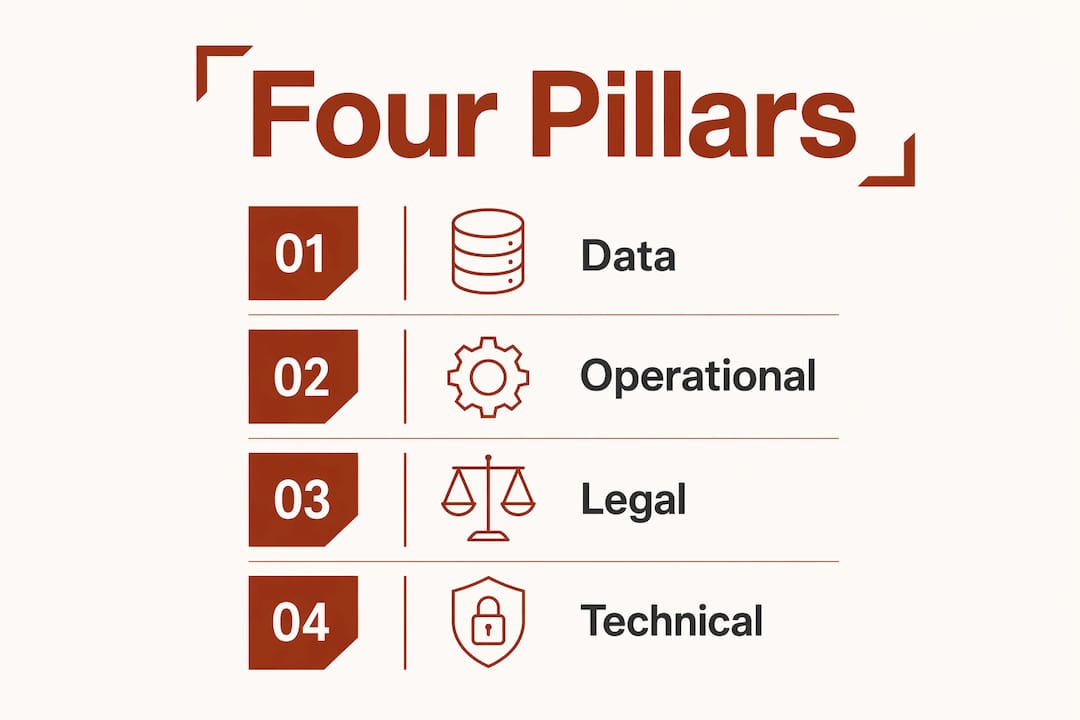
Operational sovereignty requires that administrative access and maintenance are performed by vetted personnel under local jurisdiction. Keeping data on local soil is insufficient if remote or foreign administrators can exercise control over the systems that process it.
Pro Tip: Define the 'object of sovereignty' before scoping any programme. Identify the specific datasets, models or services that carry the highest legal or operational risk, and apply controls there first. Attempting to achieve sovereignty across every system simultaneously leads to scope creep and stalled programmes.
How the UK frames digital sovereignty, and what it means for your organisation
The UK government's position, articulated through the UK Compute Roadmap and the June 2025 Modern Industrial Strategy, is to build sovereign capability in critical technologies rather than to demand strict self-sufficiency. The emphasis is on capability, strategic partnerships and the ability to influence international standards, not on severing ties with global providers.
This framing has a direct practical implication: sovereignty does not mean isolation. Analysts describe the operational objective as informed dependency: understand precisely what your organisation relies on, measure the associated risks, and preserve decision rights even when using global cloud or software services. The risk is not dependency itself; it is unmanaged dependency where the organisation cannot exit, audit or override a supplier's decisions.
For UK-aligned compliance, organisations must also account for cross-border access risk. A contract governed by US law, or a cloud provider subject to US jurisdiction, may be compelled to disclose data under the CLOUD Act regardless of where that data is physically stored.
How to assess your organisation's digital sovereignty right now
A structured assessment can be completed in four to six weeks with the right stakeholders: legal counsel, IT architecture leads, procurement, and an executive sponsor.
Step 1: Define the object and the actor (Days 1–5) Identify which datasets, services or systems require sovereign control and who currently controls them. This scoping decision determines everything that follows.
Step 2: Data mapping (Days 6–14) Map all data flows: where data originates, where it is stored, where it is processed, and where it crosses jurisdictional boundaries. Dependency mapping extends this to cloud services, software licences and AI inference endpoints.
Step 3: Access and administrative controls review (Days 15–21) Audit who holds administrative credentials to critical systems. Confirm whether those individuals are subject to local jurisdiction or to a foreign legal regime.
Step 4: Legal exposure check (Days 22–28) Review contracts for governing law clauses, subcontractor disclosure obligations and cross-border warrant exposure. Flag any agreement where a foreign government could compel disclosure without your organisation's consent.
Step 5: Risk register creation (Days 29–42) Document each identified dependency, its risk rating, the control gap and the remediation owner. This register becomes the audit trail for governance and compliance reporting.
Minimum evidence to gather: data flow diagrams, admin access registers, contract schedules with jurisdiction clauses, and a completed risk register.
What implementation options are available to UK-aligned organisations?
Organisations have four primary implementation patterns, each suited to different risk profiles and budget constraints.
Onshore private cloud places all compute and storage within the target jurisdiction under locally vetted administration. This delivers the highest degree of sovereignty but carries the highest capital cost.

Hybrid architecture partitions workloads: sensitive data and regulated processing remain on local infrastructure, while non-sensitive workloads use public cloud services. This is the most common starting point for organisations with existing cloud contracts.
Sovereign partner-hosted solutions use a third-party provider that contractually guarantees data residency, local administration and audit rights within the jurisdiction. The contractual and operational burden shifts to the provider, but due diligence on that provider's own supply chain remains the organisation's responsibility.
Fully private on-premises deployment offers maximum control but requires internal skills and capital that most organisations cannot sustain alone.
Open source is advocated as foundational for technical sovereignty because it enables public audit, reduces vendor lock-in and supports collaborative security responses. Procurement teams should demand open standards, containerised deployments and infrastructure-as-code configurations that allow workload portability across providers.
What vendor red flags should procurement teams watch for?
Common pitfalls that undermine sovereignty after contracts are signed:
- Invisible remote admin rights: Contracts that permit the vendor's overseas staff to access systems without prior notification or consent.
- Ambiguous jurisdictional clauses: Governing law set to a foreign jurisdiction, or clauses that defer to the vendor's home country in disputes.
- Closed-source critical components: Proprietary software with no audit path and no contractual right to inspect source code or security configurations.
- No clear exit or migration path: Contracts with no data portability obligation, no migration assistance clause and no defined off-boarding timeline.
Vendor questions to ask during RFP and contract negotiation:
- Who holds administrative credentials to our environment, and under which jurisdiction are they employed?
- Can you provide full audit logs of all access events, on demand and in a machine-readable format?
- Which subcontractors process or store our data, and are they disclosed in the contract?
- Who controls the encryption keys, and can we hold them independently of your infrastructure?
- What is the contractual process for migrating our data out if we terminate the agreement?
Request written answers and supporting evidence: access registers, subcontractor schedules and sample audit log exports.
What does a realistic implementation timeline look like?
| Stage | Duration | Primary cost drivers |
|---|---|---|
| Discovery and scoping | 2–4 weeks | Legal review, staff time, data mapping tools |
| Pilot deployment | 4–6 weeks | Infrastructure capacity, integration effort |
| Phased roll-out | 3–6 months | Migration effort, staff training, licences |
| Steady-state operations | Ongoing | Audit costs, certification maintenance, support |
Major cost drivers are infrastructure capacity (compute and storage), staff skills and training, certification and audit costs (ISO 27001, DPA 2020 compliance reviews), and migration effort for existing workloads. A hybrid approach reduces up-front capital by limiting the sovereign perimeter to the highest-risk data and services, while non-sensitive workloads remain on existing public cloud contracts.
How does a sovereign infrastructure provider support organisations like yours?
Islandedgetech provides on-island sovereign infrastructure with data residency on Jamaican soil, DPA 2020-aligned contractual guarantees, and products including EdgePod (a localised deployment unit suitable for pilots and medium workloads) and Abeng (a productivity and collaboration suite with sovereignty controls built in).
| Provider feature | Sovereignty pillar strengthened |
|---|---|
| Data residency on Jamaican soil | Data sovereignty |
| Locally vetted administration | Operational sovereignty |
| DPA 2020-aligned contracts and audit rights | Legal sovereignty |
| Open standards, portable architecture | Technical sovereignty |
Jurisdictional disclaimer: Local infrastructure is a necessary but not sufficient condition for full sovereignty. Organisations must still conduct procurement due diligence, maintain their own governance controls, and confirm that all contractual guarantees are legally enforceable under Jamaican law for their specific circumstances.
How has Brexit affected digital sovereignty in the UK?
Brexit materially altered the UK's data sovereignty position. The UK is no longer subject to the EU's General Data Protection Regulation directly; it operates under the UK GDPR and the Data Protection Act 2018, administered by the Information Commissioner's Office. The UK government has pursued its own adequacy decisions with third countries, and the EU granted the UK an adequacy decision in 2021, though this is subject to periodic review.
For organisations, the practical consequence is that data transfers between the UK and the EU remain lawful under current adequacy arrangements, but this status is not permanent. Organisations that assumed EU-UK data flows were settled indefinitely should maintain transfer impact assessments and monitor ICO guidance, as any change in adequacy status would require immediate contractual remediation.
Brexit also accelerated the UK's divergence from EU digital regulation, meaning that organisations operating across both jurisdictions now face two distinct compliance regimes rather than one unified framework.
How do cybersecurity frameworks interact with digital sovereignty in the UK?
The National Cyber Security Centre's guidance treats sovereignty and cybersecurity as complementary disciplines rather than separate programmes. The NCSC's Cyber Essentials scheme and its cloud security principles both address administrative access controls, data residency and supply chain risk, which are the same control domains that sovereignty programmes target.
Organisations implementing a sovereignty programme should align their risk register with the NCSC's 14 Cloud Security Principles, particularly those covering data-in-transit protection, asset protection and resilience, and supply chain security. ISO 27001 certification provides an internationally recognised audit framework that supports both cybersecurity and sovereignty assurance, and many sovereign cloud providers offer it as a contractual commitment.
The interaction is practical: a sovereignty programme that does not address cybersecurity controls leaves the organisation legally compliant but operationally exposed, while a cybersecurity programme that ignores jurisdictional risk may pass technical audits while remaining legally vulnerable to foreign access demands.
What regulatory changes should organisations anticipate?
The UK's Data (Use and Access) Act, which received Royal Assent in June 2025, introduces new provisions on data sharing, digital verification services and smart data schemes. Organisations should assess how these provisions affect their data governance frameworks and whether any new data-sharing obligations create cross-border transfer risks.
At the international level, the EU's AI Act and Data Act are reshaping expectations around data portability, algorithmic transparency and supply chain disclosure. Although these instruments do not directly bind UK organisations, they affect any UK organisation that processes data relating to EU residents or that operates within EU supply chains.
The trajectory of UK digital regulation points towards greater specificity around AI governance, critical infrastructure protection and supply chain transparency. Organisations that build sovereignty controls now, particularly around administrative access, encryption key management and exit strategies, will be better positioned to absorb these regulatory changes without disruptive remediation programmes.
Key takeaways
Digital sovereignty requires organisations to control not just where data is stored, but who administers it, under which law, and with what technical architecture to ensure a credible exit if circumstances change.
| Point | Details |
|---|---|
| Define the object first | Identify the specific datasets and services that carry the highest risk before scoping any sovereignty programme. |
| Informed dependency, not isolation | Map all cloud, software and AI dependencies; measure risk and preserve decision rights rather than cutting off global services. |
| Operational control is non-negotiable | Confirm that administrators of critical systems are subject to local jurisdiction, not a foreign legal regime. |
| Demand an exit strategy | Require open standards, portable architectures and a contractual migration path from every sovereign provider. |
| Islandedgetech for Jamaican organisations | Islandedgetech provides on-island data residency, DPA 2020-aligned contracts and locally vetted administration through products including EdgePod and Abeng. |
Sovereignty as a governance discipline, not a technology project
The organisations that struggle most with digital sovereignty are those that treat it as a one-time infrastructure purchase rather than an ongoing governance discipline. The assessment workflow outlined here, scoping, data mapping, dependency mapping, legal exposure review, and risk register, is not a project with an end date. It is a repeating cycle that should sit within your organisation's existing governance calendar, reviewed at least annually and triggered by any material change in supplier arrangements or regulatory requirements.
The practical priority for Jamaican organisations is clear: identify the data and services that carry the highest legal and operational risk, confirm who controls them and under which jurisdiction, and build the contractual and technical conditions to change that arrangement if necessary. Sovereignty is not about self-sufficiency; it is about preserving the right to choose.
Islandedgetech: sovereign infrastructure, on Jamaican ground
Jamaican organisations that have completed a dependency mapping exercise frequently discover that their most sensitive data, patient records, financial transactions, agricultural supply chain data, sit in infrastructure governed by foreign law and administered by personnel outside local jurisdiction. Islandedgetech addresses that gap directly.
Through its sovereign cloud services, Islandedgetech provides assessment and dependency mapping support, pilot EdgePod deployments for organisations testing a local-first architecture, and contractual guarantees covering data residency on Jamaican soil, locally vetted administration, and DPA 2020 compliance. The Abeng Work Suite extends sovereignty controls to productivity and collaboration workloads, so the entire operational stack, not just storage, remains under local governance. Organisations in healthcare, tourism and agriculture can review sector-specific deployment options at islandedgetech.com/industries.
To begin an assessment or discuss a pilot deployment, contact Islandedgetech through the Groundwork page and request a dependency mapping consultation.
Useful sources and references
The following primary sources underpin the analysis in this article and are recommended for inclusion in any sovereignty programme's audit trail.
- What is digital sovereignty and why does it matter? — IE University: Foundational definition and organisational framing; useful as a reference in governance documentation.
- UK Compute Roadmap — UK Government: Primary source for the UK policy position on sovereign capability; cite in procurement strategies and board-level risk papers.
- Digital and technology policy and national sovereignty — Lords Library: Parliamentary analysis of operational sovereignty and CLOUD Act exposure; useful for legal exposure assessments.
- Open but Not Powerless: Towards a Common Understanding of EU Digital Sovereignty — JRC: Multi-layered framework for sovereignty; relevant for organisations operating across EU and UK jurisdictions.
- Digital sovereignty — Microsoft Learn: Practical operational controls reference; useful when drafting technical requirements for procurement.
- What Is Digital Sovereignty? A Practical Guide — SAP: Dependency mapping methodology and switching power framework; use as a template reference in assessment documentation.
- Informed dependency and supply chain concentration risk — Escode: Articulates the informed dependency concept; cite when justifying a risk-based rather than isolation-based approach to governance committees.
- OSS EU 2025 — Sovereignty Spotlight: Open source as a technical sovereignty lever; reference in technical architecture decisions and vendor evaluation criteria.
- Exit strategy: a key to digital sovereignty — Korte: Practical guidance on portability and exit planning; include in contract negotiation checklists.
This article provides general information on digital sovereignty and does not constitute legal, regulatory or professional advice. Organisations should confirm the current requirements of the Data Protection Act 2020 and any applicable UK or Jamaican regulatory obligations with qualified legal counsel for their specific circumstances.