
For UK private hospitals evaluating data sovereignty tools, the leading deployable option is a sovereign, on-premises edge stack: EdgePod (physical compute and storage node) combined with the Abeng Work Suite (locally hosted productivity and collaboration) and the Ackee security layer (authentication, encryption, access control, and continuous monitoring). This combination keeps cryptographic control with the hospital, satisfies the data residency requirements of UK GDPR and the Data Protection Act 2018, and supports FHIR interoperability with existing EHR systems.
The immediate next step is a scoped multi-week pilot:
- Deploy an on-site EdgePod node and configure a scoped Abeng tenancy against your existing EHR environment.
- Activate Ackee baseline controls: role-based access, encryption at rest and in transit, and immutable audit logging.
- Validate FHIR connector behaviour and run a DPIA gap assessment against your current data flows.
- Request the vendor's SLA draft and evidence of UK GDPR/DPA 2018 alignment before the pilot closes.
Pre-built, interoperable healthcare data models have demonstrated a median time-to-first-insight of 30 days, making a structured pilot the fastest path to a defensible compliance position.
Table of Contents
- What legal obligations do UK private hospitals actually face?
- What should you look for in a data sovereignty tool for hospitals?
- What does a realistic deployment timeline and cost look like?
- How do you connect a sovereign platform to EHRs, labs, and devices?
- How do security controls and monitoring create defensible compliance?
- How does EdgePod, Ackee, and Abeng fit a private hospital's needs?
- What questions should you ask vendors, and what are the red flags?
- Key takeaways
- Why sovereign infrastructure is the only defensible position
- How Islandedgetech supports your pilot and procurement
- Authoritative UK sources and further reading
What legal obligations do UK private hospitals actually face?
UK private hospitals are data controllers under UK GDPR and the Data Protection Act 2018. Health data is special category data under Article 9 UK GDPR, meaning the lawful basis for processing must be explicit and documented. Consent management, data subject access rights, and retention schedules must all be operationally enforced, not merely stated in a policy document.
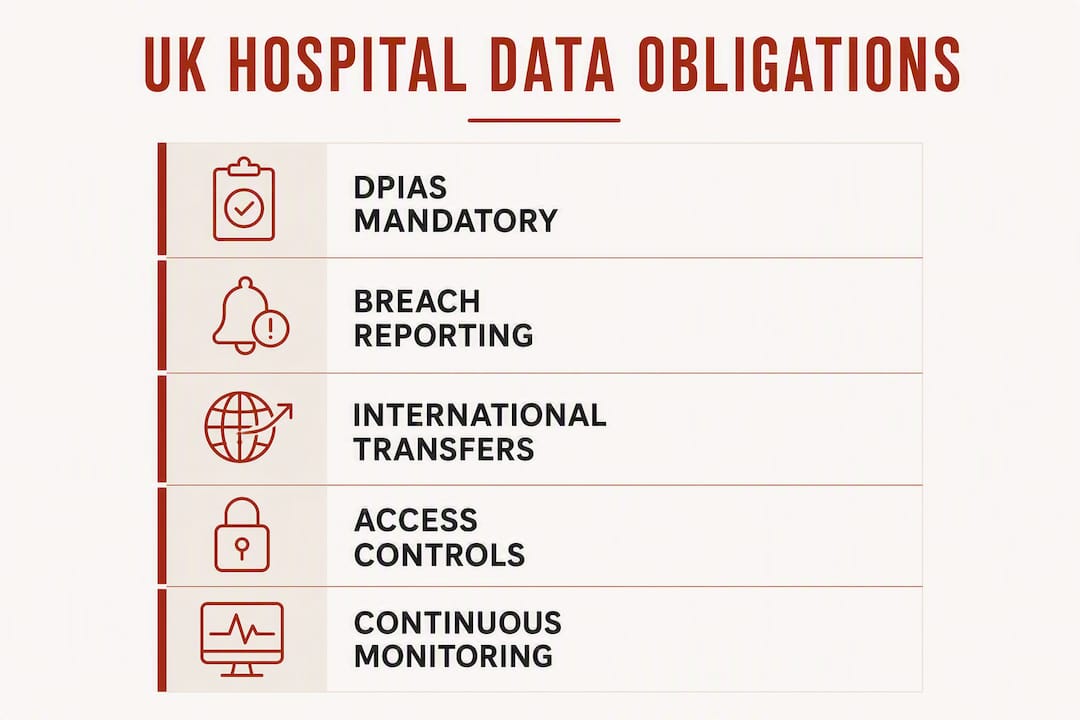
International transfers require either an adequacy decision, standard contractual clauses (SCCs), or a recognised transfer mechanism. Critically, contractual residency assurances alone are insufficient: infrastructure-layer sovereignty — where the hospital controls encryption keys and the vendor cannot access plaintext — provides a technically stronger mitigation than contract language alone.
DPIAs are mandatory for large-scale processing of health data. Mandatory breach reporting to the ICO must occur within 72 hours of becoming aware of a qualifying breach. Regulators expect hospitals to produce audit evidence, DPIA records, and vendor data-sharing agreements on request, not retrospectively.
What should you look for in a data sovereignty tool for hospitals?
Procurement teams should evaluate candidates against four categories: infrastructure, interoperability, operational signals, and commercial terms.
Infrastructure requirements
- True data residency: physical confirmation that data does not leave a defined geographic boundary.
- HYOK (Hold Your Own Key): the hospital, not the vendor, controls encryption keys. Sovereignty enforced at the infrastructure layer is materially stronger than contractual residency claims.
- Physical access controls and audited tenancy isolation to prevent cross-tenant exposure.
- Immutable audit logs with hospital-controlled access to raw log data.
Interoperability requirements
- FHIR-native connectors and HL7 support for clinical system integration.
- EMPI (Enterprise Master Patient Index) options to maintain patient identity consistency across systems.
- Low-latency interfaces that do not degrade clinical workflow performance.
Operational and trust signals
- SLA wording that specifies uptime, recovery time objectives, and maintenance windows.
- Evidence of health sector deployments and third-party audit or penetration test reports.
- AI-powered data classification that maps sensitive data in real time and enforces policies continuously.
Commercial terms
- Transparent pricing: subscription or lease-to-own hardware, per-user SaaS fees, and clear exit and data replication terms.
- Support windows and local support availability, particularly for out-of-hours clinical environments.
Pro Tip: Ask every vendor to show you their HYOK architecture diagram and their most recent third-party penetration test summary before shortlisting. Vendors who cannot produce either within five working days should be removed from consideration.

What does a realistic deployment timeline and cost look like?
| Phase | Duration | Key Activities |
|---|---|---|
| Discovery and scoping | 2–4 weeks | Data flow mapping, DPIA gap analysis, EHR integration audit |
| Pilot (edge node + integration) | 4 weeks | EdgePod on-site deployment, Abeng tenancy, Ackee baseline, FHIR connector testing |
| Phased roll-out | — | Department-by-department expansion, staff training, parallel UAT |
| Validation and audit | 2–4 weeks | Compliance evidence review, DPIA update, SLA sign-off |
| Handover and training | 2–4 weeks | Clinical informatics handover, change management completion |
Cost shape divides into two categories. Capital and one-off costs include deployment and configuration fees and, where applicable, a lease-to-own hardware arrangement for the EdgePod node. Recurring operational costs include per-user monthly or annual Abeng Work Suite subscriptions and ongoing managed maintenance. Staff change management and training should be budgeted as OPEX, not absorbed into IT project costs, since clinical adoption is the primary risk to timeline.
The 30-day median time-to-first-insight for pre-built, interoperable healthcare models means a well-scoped pilot can produce a compliance evidence baseline and initial clinical reporting capability within 30 days, which is a credible ROI anchor for a business case submission.
How do you connect a sovereign platform to EHRs, labs, and devices?
FHIR-native architectures reduce vendor lock-in and lower long-term technical debt, making FHIR the correct starting point for any integration design. EMPI reconciliation should run in parallel to prevent duplicate patient records from degrading data quality across connected systems.
Integration priorities
- Map FHIR R4 connectors to your primary EHR first; HL7 v2 and MLLP gateways handle legacy lab and device interfaces where FHIR is not yet supported.
- DICOM gateways for imaging systems should route through the EdgePod's secure API gateway with tokenised payloads, so PHI never traverses an uncontrolled network segment.
- Self-hosted AI models for clinical analytics can be deployed on the EdgePod so PHI never leaves the organisation's controlled environment, while de-identified telemetry can move to cloud services for batch analytics where appropriate.
Assign named integration owners: a clinical informatics lead for EHR and device interfaces, and a lab lead for pathology and diagnostics. Schedule parallel user acceptance testing before each phase goes live to catch mapping errors before they affect clinical records.
Pro Tip: FHIR alignment and embedded governance speed clinical analytics and reduce mapping time between systems. Prioritise FHIR R4 over HL7 v2 wherever your EHR vendor supports it — the long-term maintenance saving is substantial.
How do security controls and monitoring create defensible compliance?
Core controls begin with encryption at rest and in transit, HYOK key custody, role-based and attribute-based access control, and immutable audit logs. These are not optional enhancements; they are the minimum evidence set a UK regulator expects to see during an investigation.
AI-driven governance platforms harmonise metadata, enforce policies, and produce audit-ready metadata for regulatory reporting. Runtime classification prevents PHI from leaving controlled zones and automates consent linkage, reducing the manual compliance burden on clinical and information governance teams.
SIEM integration enables real-time alerting on anomalous access patterns. Quarterly internal audits, combined with continuous monitoring output, provide the evidence base for DPIA updates and regulator requests. Regulators expect continuous auditing of vendor data-sharing permissions, not periodic reviews; the monitoring architecture must reflect that expectation.
Third-party vendor oversight requires contractual audit rights, a minimum data exposure principle applied to all data-sharing agreements, and an active vendor audit cadence documented in the hospital's information governance framework.
How does EdgePod, Ackee, and Abeng fit a private hospital's needs?
Islandedgetech's product set maps directly to the hospital checklist above.
EdgePod is a physical on-premises compute and storage node that keeps data on local soil. It supports mesh networking, built-in battery backup for operational continuity during power interruptions, encrypted storage, and offline operation. Managed maintenance is included, removing the operational burden from hospital IT teams.
Abeng Work Suite is a locally hosted productivity and collaboration suite covering documents, spreadsheets, file storage, email, calendar, and video conferencing. Deploying Abeng replaces third-party cloud productivity tools and eliminates the associated cross-border data transfer risk for administrative and clinical workflows.
Ackee is the security layer: authentication, encryption, access control, and continuous monitoring designed to support HYOK and maintain the audit trails required for UK GDPR compliance. Cryptographic key custody and auditable attestation make the compliance evidence traceable and regulator-ready.
The recommended procurement route is a scoped pilot: EdgePod node, Abeng tenancy, and Ackee baseline. Request evidence of UK GDPR/DPA 2018 alignment in the SLA before the pilot closes.
What questions should you ask vendors, and what are the red flags?
Essential RFP questions
- Who holds encryption keys, and where are they stored? Can the hospital hold its own keys (HYOK)?
- What is the maturity of your FHIR R4 connector set, and which EHR systems have you integrated in a UK private hospital context?
- What is your EMPI approach, and how do you handle patient identity conflicts across connected systems?
- How long are audit logs retained, and does the hospital have direct access to raw log exports?
- What are your RTO and RPO commitments, and how are they tested?
Operational questions
- What is your downtime SLA, and what are the remedies for breach?
- What local support is available, and what are your incident response time commitments?
- How is hardware maintenance managed, and what is the process for on-site intervention?
Red flags that should stop an engagement
- Vendor refuses to grant cryptographic control to the hospital or cannot explain their key custody model clearly.
- Data residency claims are contractual only, with no technical enforcement at the infrastructure layer.
- No healthcare sector references, or references are from jurisdictions with materially different regulatory requirements.
- Absence of third-party audit reports or penetration test summaries. Weak vendor governance is a documented failure mode in healthcare data breaches; a vendor who cannot evidence their own security posture cannot support yours.
Key takeaways
Sovereign, on-premises infrastructure combining HYOK key custody, FHIR-native interoperability, and continuous monitoring is the most defensible approach to data sovereignty compliance for UK private hospitals under UK GDPR and the Data Protection Act 2018.
| Point | Details |
|---|---|
| UK legal baseline | UK GDPR and DPA 2018 require documented DPIAs, timely breach reporting, and demonstrable vendor oversight. |
| HYOK is non-negotiable | Contractual residency alone is insufficient; the hospital must control encryption keys at the infrastructure layer. |
| 30-day pilot benchmark | Pre-built healthcare models deliver a median time-to-first-insight of 30 days, making a scoped pilot the fastest path to compliance evidence. |
| FHIR first | FHIR-native connectors reduce mapping time, lower technical debt, and preserve clinical workflow continuity during integration. |
| Islandedgetech recommendation | Pilot EdgePod + Abeng + Ackee to validate integration, HYOK controls, and UK GDPR/DPA 2018 compliance evidence in 4 weeks. |
Why sovereign infrastructure is the only defensible position
The procurement conversation in most private hospitals still centres on cost and feature parity. That framing misses the actual risk. Under UK GDPR, a hospital that cannot produce a DPIA, an audit log, or evidence of vendor oversight on demand is already non-compliant, regardless of what its contracts say. The question is not whether to invest in data sovereignty controls, but whether the investment is made before or after a regulator investigation.
The hospitals that recover fastest from incidents are those with immutable audit logs, tested incident runbooks, and a clear chain of cryptographic custody. Those are architectural decisions, not policy decisions. A sovereign stack built on physical on-premises infrastructure with HYOK controls gives a hospital the technical foundation to answer a regulator's questions with evidence rather than assurances.
Procurement teams that treat data sovereignty as a compliance checkbox will select the cheapest contractual residency claim. Those that treat it as an operational and legal risk will select infrastructure that gives them genuine control. The difference between those two positions is the difference between a defensible compliance record and a 72-hour breach notification that could have been prevented.
How Islandedgetech supports your pilot and procurement
Islandedgetech's standard pilot package gives a private hospital a concrete starting point: an on-site EdgePod node, a scoped Abeng tenancy, Ackee baseline security controls, a four-week integration window, and a compliance report aligned to UK GDPR and the Data Protection Act 2018. The commercial model is structured to reduce upfront commitment: hardware is available on a lease-to-own basis, Abeng subscriptions are priced per user on a monthly or annual basis, and roll-out pricing is staged by capacity and department scope.
For procurement and finance teams building a business case, the sovereign cloud groundwork page sets out the pilot scope, SLA structure, and next steps in detail. To request a pilot scope document and SLA draft, contact the Islandedgetech team directly through the site.
Authoritative UK sources and further reading
- UK Information Commissioner's Office (ICO): ico.org.uk — primary regulator for UK GDPR and DPA 2018; download the ICO's DPIA guidance and breach reporting templates before contacting vendors.
- UK GDPR full text: available via the ICO's website; Articles 9, 35, and 83 are the most directly relevant for health data processing.
- Data Protection Act 2018: legislation.gov.uk — the domestic statute that supplements UK GDPR.
- HL7 FHIR R4 specification: hl7.org/fhir — the authoritative reference for FHIR connector requirements in vendor RFPs.
- Islandedgetech healthcare data residency guidance: data residency for medical providers — practical operational considerations for sovereign infrastructure in healthcare.
- Islandedgetech healthcare compliance overview: healthcare data compliance explained — compliance mapping and DPIA preparation guidance for procurement teams.
- Audit readiness checklist: audit healthcare data storage practices — step-by-step log retention and audit readiness guide.
This article provides general information about data sovereignty tools and UK regulatory obligations. It does not constitute legal or professional advice. Procurement and legal teams should verify current ICO guidance and consult a qualified data protection officer for their specific circumstances.