
For Jamaican organisations subject to the Data Protection Act 2020, the verdict on data storage is clear: onshore sovereign hosting in Jamaica is the practical default, and offshore hosting is acceptable only where explicit, documented safeguards are in place and actively maintained.
Three reference points anchor every decision in this comparison:
- Jamaica's Data Protection Act 2020 sets the legal standard for how personal data is collected, stored, transferred and protected; cross-border transfers require demonstrated adequacy or approved safeguards.
- The Office of the Information Commissioner (OIC) is the supervisory authority that assesses whether a foreign jurisdiction offers adequate protection and enforces breach notification obligations.
- Islandedgetech (EdgePod, Abeng Work Suite, Ackee) provides a sovereign infrastructure stack deployed on Jamaican soil, purpose-built to satisfy DPA 2020 obligations without cross-border transfer documentation.
Offshore hosting is not automatically prohibited. Where a data controller can produce Commissioner-approved standard contractual clauses (SCCs) or binding corporate rules (BCRs), and where annual adequacy monitoring is contractually obligated, offshore transfers may be defensible. The administrative burden of sustaining that position, however, frequently exceeds the cost of local sovereign infrastructure for regulated workloads.
Table of Contents
- How does onshore storage compare to offshore hosting for DPA 2020?
- What does onshore sovereign infrastructure actually look like?
- What does DPA 2020 require, and how do you verify it?
- What are the operational risks and benefits of each approach?
- What does onshore deployment cost, and how long does it take?
- What questions should you ask a vendor before signing?
- How does sovereign storage apply across different sectors?
- What are your next steps in the next 30–90 days?
- What challenges arise when migrating data from offshore to local storage?
- Which frameworks and certifications verify vendor compliance beyond DPA 2020?
- What does data sovereignty mean when your cloud provider operates across borders?
- Key takeaways
- Why sovereign hosting is the only defensible default
- Islandedgetech's sovereign infrastructure pilot for Jamaican organisations
How does onshore storage compare to offshore hosting for DPA 2020?
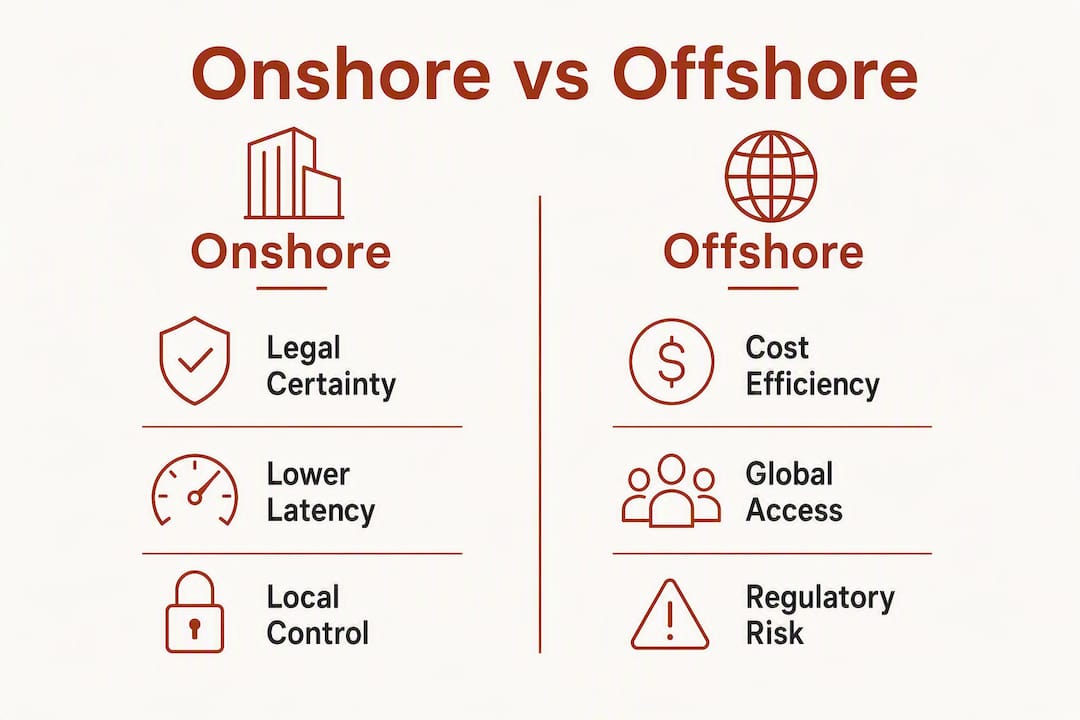
| Dimension | Onshore sovereign (EdgePod + Abeng) | Offshore hosting with safeguards |
|---|---|---|
| Compliance certainty with DPA 2020 | Direct — no cross-border transfer documentation required | Conditional — requires SCCs, BCRs, or OIC adequacy finding |
| Foreign legal orders (e.g. CLOUD Act) | None — data sits under Jamaican law only | Exposure if provider is subject to US or other foreign jurisdiction |
| Operational resilience / DR | Local support, on-island failover, offline capability | Dependent on provider's remote DR; latency in recovery |
| Data control and portability | Full — contractual residency warranty, on-demand export | Variable — subject to provider terms and exit clauses |
| Cost / TCO | Hardware lease + subscription; predictable; no ongoing legal compliance overhead | Lower headline cost; higher ongoing legal and administrative cost |
| Deployment timeline | 30–90 days from procurement to cutover | Faster initial setup; longer compliance validation |
| Vendor transparency, SLAs, audits | On-island audits, third-party penetration tests, OIC-aligned SLAs | Audit rights must be negotiated; may be limited by provider policy |
Pro Tip: When offshore hosting is unavoidable for a specific workload, require an annual adequacy review clause in the contract, with explicit audit rights and a documented breach-notification procedure mapped to the OIC's 72-hour reporting expectation.
What does onshore sovereign infrastructure actually look like?

Sovereign data storage is not simply a server in a local data centre. For Jamaican organisations, it means a documented, auditable stack where every component sits under Jamaican legal jurisdiction.
The Islandedgetech architecture centres on the GECCO EdgePod, a physical compute and storage node deployed on the client's premises or at a certified on-island facility. The EdgePod provides encrypted storage, mesh networking, built-in battery backup, and the ability to operate offline during connectivity disruptions. Layered above the hardware is the Abeng Work Suite, a locally hosted productivity environment covering documents, spreadsheets, email, calendar, and video conferencing — replacing offshore SaaS tools that would otherwise create cross-border transfer obligations. The Ackee security layer handles authentication, role-based access control, encryption key management, and continuous monitoring.
Managed maintenance, on-island backups, and a secure chain of custody for storage media are operational requirements that accompany the hardware. Without them, a physical node does not constitute sovereign infrastructure in any meaningful compliance sense.
For a detailed breakdown of the sovereign infrastructure architecture, including network segregation and documented data flows, Islandedgetech publishes technical guidance aligned to OIC expectations.
What does DPA 2020 require, and how do you verify it?
The OIC requires appropriate technical and organisational measures, restricts cross-border transfers unless adequacy or safeguards are in place, and sets specific timelines for breach notification and data subject rights. The DPA 2020 uses an adequacy and safeguards regime rather than a blanket localisation mandate, but controllers must demonstrate adequate protections for any transfer — a burden that onshore hosting eliminates entirely.
For onshore providers, verify:
- Certified on-island hosting address and contractual residency clause
- OIC registration alignment (data controller registration is mandatory before processing personal data)
- SLA metrics covering uptime, RTO and RPO
- Third-party security audit reports and penetration test results
- Encryption standards (at rest and in transit) and access control documentation
- Breach notification procedure with a 72-hour OIC reporting commitment
- Data subject rights procedures with documented 30-day access response windows
For offshore providers, additionally require:
- Commissioner-approved SCCs or BCRs, current and signed
- Documented annual adequacy monitoring, with evidence that the destination jurisdiction's legal position has been reviewed
- Explicit breach-notification procedures mapped to OIC timeframes
- Contractual audit rights, not merely a right to request audit summaries
- Evidence of how the provider responds to foreign government data demands (e.g. CLOUD Act orders)
The CLOUD Act compels US-based providers to disclose stored data in response to lawful US government demands, regardless of where the data physically resides. That exposure does not disappear with contractual safeguards alone. For a direct comparison of how Jamaican and US law interact on this point, Islandedgetech's analysis of the legal gap between Jamaica's DPA and US law is a useful reference.
What are the operational risks and benefits of each approach?
Onshore sovereign infrastructure offers a materially different operational profile from offshore hosting, particularly for sectors where access continuity is non-negotiable.
Uptime and disaster recovery: An EdgePod node with battery backup and mesh networking can sustain operations during power or connectivity outages — a genuine advantage in Jamaica's hurricane-season environment. Offshore providers offer high aggregate uptime figures, but recovery from a major incident depends on transatlantic or inter-regional connectivity that may itself be disrupted.
Latency: Locally hosted services reduce round-trip latency for end users, which matters for real-time clinical systems, government service portals, and BPO contact centre platforms where response time affects service quality.
Local support: On-island managed maintenance means a technician can respond physically. Offshore support is typically remote, with hardware replacement dependent on international logistics.
Sector-specific obligations:
- Healthcare: Patient records require immediate access during emergencies; a 72-hour breach notification obligation to the OIC demands a local incident response capability.
- Government: Citizen data and continuity of public services require infrastructure that cannot be suspended by a foreign court order or provider insolvency.
- BPO: Client contractual obligations frequently specify data residency; offshore hosting may breach those terms directly.
Pro Tip: Test your failover runbook at least once before go-live. A documented RTO means nothing if the recovery procedure has never been executed under realistic conditions. Schedule a controlled failover drill within the first 60 days of deployment.
What does onshore deployment cost, and how long does it take?
Cost transparency is a prerequisite for budget sign-off. The table below sets out the principal cost components and a representative procurement timeline.
| Milestone | Typical duration | Cost component |
|---|---|---|
| Procurement and contract execution | Weeks 1–2 | One-time deployment and configuration fee |
| Site preparation | Weeks 2–3 | Client-side (power, network, physical space) |
| EdgePod delivery and installation | Weeks 3–5 | Hardware lease or lease-to-own |
| Data migration and integrity validation | Weeks 5–7 | Migration services; parallel run period |
| Cutover and post-deployment audit | Weeks 8–11 | Included in managed maintenance subscription |
| Ongoing operations | Monthly / annual | Abeng per-user subscription + managed maintenance |
Migration services include data export from the incumbent provider, integrity validation, a parallel run period where both environments operate simultaneously, and defined rollback criteria if validation fails. The economic case for sovereign hosting becomes clearest at this stage: the administrative cost of maintaining offshore adequacy arrangements over a two-to-three-year horizon frequently exceeds the total cost of local deployment.
What questions should you ask a vendor before signing?
A vendor's marketing materials rarely reveal the compliance gaps that matter. The following checklist is designed for procurement teams conducting due diligence.
Technical and contractual items to verify:
- Proof of on-island physical residency (certified address, not just a local entity registration)
- SLA metrics: uptime percentage, RTO, RPO, and escalation procedures
- Independent audit reports (ISO 27001, SOC 2, or equivalent) dated within the last 12 months
- Encryption standards: AES-256 at rest, TLS 1.2 or higher in transit
- Personnel background check policy for staff with data access
- Data export controls: format, timeline, and cost on contract termination
Interview questions for vendor demos and RFPs:
- Where, precisely, is data stored? Provide a certified address.
- What happens to our data if you receive a foreign government order?
- How do you notify us of a breach, and within what timeframe?
- Can we conduct or commission an independent audit? At what cost and notice?
- What are the data-return procedures on termination, and what is the deletion timeline?
Red flags: vague residency claims ("data stored in the region"), refusal to grant contractual audit rights, absence of independent security certifications, and SLAs that exclude force majeure events without a defined recovery commitment.
Pro Tip: Structure payments in stages linked to delivery milestones: a portion on contract execution, a portion on successful installation and connectivity test, and the remainder on completion of the post-deployment audit. This protects budget and creates a contractual incentive for the vendor to deliver on residency and SLA commitments.
How does sovereign storage apply across different sectors?
Each sector carries distinct regulatory drivers and data sensitivity profiles that shape the configuration requirements.
- Healthcare: Patient records are among the most sensitive categories under DPA 2020. Emergency access requirements mean that offline operation capability is not optional — it is a clinical safety requirement. Healthcare providers should specify RTO under four hours and require that the breach notification procedure names a designated on-island data protection officer. For detailed guidance, Islandedgetech's resource on health data residency requirements covers the specific obligations.
- Government: Citizen data, revenue records, and social protection databases cannot be subject to foreign legal orders. The Jamaican government's active exploration of data embassy models and the launch of the Jamaica Data Exchange Platform signal a clear policy direction towards sovereign, on-island control.
- Tourism: Guest data, payment card information, and booking records create both DPA 2020 obligations and PCI DSS considerations. Offshore processors introduce cross-border transfer obligations that require active management. Islandedgetech's sector analysis on data sovereignty for Jamaican resorts addresses the specific configuration requirements.
- Agriculture: GIS data, research datasets, and supply chain records are increasingly subject to data governance frameworks as the sector digitises. Sovereign hosting protects proprietary research from foreign jurisdiction access.
- BPO: Client contracts routinely specify data residency. Offshore hosting may constitute a direct breach of those terms. On-island infrastructure provides the contractual certainty that BPO clients in regulated industries demand.
- NGOs: Donor and beneficiary data carries both DPA 2020 obligations and reputational risk. Sovereign hosting provides a defensible position for grant reporting and donor due diligence.
What are your next steps in the next 30–90 days?
The verdict holds: onshore sovereign hosting is the lower-risk, lower-administrative-burden path for Jamaican organisations processing personal data under DPA 2020. The following steps translate that verdict into a procurement action plan.
- Register with the OIC (if not already completed). Registration is mandatory for data controllers before processing personal data.
- Audit your current data flows. Identify which systems hold personal data and whether any are currently hosted offshore.
- Request a technical pilot from Islandedgetech. A 30–60 day pilot scoped to one department or data category provides residency proof, SLA demonstration, and a migration plan before full commitment.
- Require contractual residency warranties from any vendor under evaluation, alongside audit rights and a documented breach-notification procedure.
- Schedule stakeholder approvals and budget sign-off in parallel with the pilot, so procurement can proceed immediately on successful validation.
For a practical DPA 2020 compliance roadmap, Islandedgetech's published guidance covers the specific registration, documentation, and technical control requirements.
This article provides general information about data protection obligations in Jamaica and does not constitute legal advice. Organisations should confirm current regulatory requirements with the Office of the Information Commissioner or a qualified legal adviser.
What challenges arise when migrating data from offshore to local storage?
Data migration from an offshore provider to a local sovereign environment introduces several practical risks that project managers must plan for explicitly.
Data export delays are the most common obstacle. Offshore providers are not always contractually obligated to export data in a usable format within a defined timeframe, and some impose exit fees or provide data in proprietary formats that require conversion. Requiring a data portability clause at contract inception — specifying format, timeline, and cost — prevents this at the procurement stage.
Integrity validation during migration requires a documented checksum or hash-verification process for every dataset transferred. Without it, silent data corruption during transit may not be detected until a data subject access request or audit surfaces the discrepancy.
Parallel operation reduces risk but increases cost. Running both environments simultaneously for four to six weeks allows staff to validate that locally hosted systems produce identical outputs before the offshore environment is decommissioned. Define rollback criteria before the parallel run begins, not during it.
Chain of custody for physical media, where data is transferred via encrypted drives rather than network transfer, must be documented from the offshore facility to the on-island deployment site. This documentation forms part of the compliance record.
Which frameworks and certifications verify vendor compliance beyond DPA 2020?
DPA 2020 compliance is the legal floor, not the ceiling. Organisations evaluating sovereign infrastructure vendors should require evidence of alignment with recognised international frameworks.
ISO/IEC 27001 is the most widely recognised information security management standard and provides an independently audited baseline for security controls. A current ISO 27001 certification from an accredited body is the minimum expectation for any vendor handling sensitive personal data.
SOC 2 Type II reports provide a third-party assessment of security, availability, processing integrity, confidentiality, and privacy controls over a defined audit period. A Type II report (covering a minimum six-month period) is more meaningful than a Type I point-in-time assessment.
NIST Cybersecurity Framework (CSF) alignment, while a US-origin standard, is widely adopted in the Caribbean as a structured approach to identifying, protecting, detecting, responding to, and recovering from cyber incidents. Vendors who can demonstrate CSF alignment provide a structured evidence base for operational resilience.
PCI DSS is relevant for any organisation processing payment card data, including tourism operators and BPO providers. Sovereign hosting does not automatically satisfy PCI DSS requirements, but it simplifies the scoping of the cardholder data environment.
For AI and cloud workloads where cross-border processing is unavoidable, a GDPR-aligned compliance framework provides a useful reference model for structuring written safeguards and vendor commitments, even where GDPR does not directly apply.
What does data sovereignty mean when your cloud provider operates across borders?
Cross-border cloud providers present a structural sovereignty problem that contractual safeguards alone cannot fully resolve. When a provider's infrastructure spans multiple jurisdictions, data may be replicated, cached, or processed in a foreign territory even when the primary storage location is nominally local.
The CLOUD Act is the most direct illustration. US-based providers are legally required to comply with lawful US government demands for stored data, regardless of where that data physically resides. A Jamaican organisation whose data sits on a US-headquartered cloud platform has no reliable mechanism to prevent that disclosure, even with a contractual residency clause in place.
The OIC's assessment of cross-border transfers considers the destination jurisdiction's laws, the nature of the data, and the security measures in place. A jurisdiction whose laws permit government access to data without judicial oversight is unlikely to meet the adequacy standard — and that assessment can change as foreign laws evolve. Legal advisers note that adequacy is an ongoing monitoring obligation, not a one-time determination. A jurisdiction that was adequate at contract inception may not remain so, creating sudden compliance exposure for organisations that have not built annual review obligations into their vendor agreements.
Sovereign on-island hosting eliminates this structural risk. Data held on an EdgePod node, under a contractual residency warranty, processed exclusively through Abeng's locally hosted services, and monitored through the Ackee security layer, does not leave Jamaican jurisdiction. There is no foreign replication, no cross-border caching, and no exposure to foreign legal orders.
Key takeaways
Onshore sovereign hosting in Jamaica is the most legally certain and operationally defensible data storage option for organisations subject to DPA 2020, eliminating cross-border transfer obligations and foreign legal exposure in a single architectural decision.
| Point | Details |
|---|---|
| Onshore hosting removes cross-border risk | Sovereign on-island storage eliminates the need for SCCs, BCRs, or adequacy monitoring entirely. |
| Offshore adequacy is an ongoing obligation | A jurisdiction's legal position can change, creating sudden compliance exposure if annual reviews are not contractually required. |
| DPA 2020 breach notification is time-critical | Controllers must report breaches to the OIC within 72 hours; vendor SLAs must reflect this obligation explicitly. |
| Vendor evaluation requires specific evidence | Require a certified residency address, ISO 27001 or SOC 2 certification, and contractual audit rights before signing. |
| Islandedgetech provides a ready sovereign stack | EdgePod, Abeng Work Suite, and Ackee deliver on-island residency, DPA 2020 alignment, and managed maintenance under a single subscription. |
Why sovereign hosting is the only defensible default
The conventional framing of this decision treats offshore cloud hosting as the cost-efficient default and local hosting as the premium exception. That framing is wrong for Jamaican organisations, and it is worth saying plainly.
The administrative and legal cost of sustaining an offshore adequacy position is not a one-time exercise. It requires annual monitoring of the destination jurisdiction's legal framework, active management of SCC or BCR documentation, and a breach-notification procedure that must account for a provider who may be operating under a foreign legal obligation to withhold information. For a healthcare provider, a government ministry, or a BPO operator with client contractual obligations, that ongoing burden is both a compliance risk and a resource cost that compounds annually.
Sovereign hosting does not merely simplify compliance. It removes an entire category of legal exposure. The Jamaican government's own trajectory, from the Jamaica Data Exchange Platform to active exploration of data embassy models, signals that on-island data control is the direction of national policy. Organisations that align with that trajectory now reduce regulatory friction and position themselves to participate in national digital infrastructure initiatives.
Islandedgetech's ability to provide a contractual residency warranty, backed by on-island audits and a managed maintenance commitment, is the practical expression of that position. The evidence base for sovereign hosting is not theoretical. It is architectural, contractual, and increasingly a matter of national policy.
Islandedgetech's sovereign infrastructure pilot for Jamaican organisations
Islandedgetech offers Jamaican organisations a structured 30–60 day pilot that delivers three concrete outputs: documented proof of on-island data residency, a live SLA demonstration covering uptime and RTO, and a migration plan scoped to your specific data environment. The pilot is designed for procurement teams that need evidence before full budget commitment, and for legal teams that need residency documentation before OIC registration or a regulatory review.
The EdgePod sovereign infrastructure node provides encrypted on-island storage with offline operation capability. The Abeng Work Suite replaces offshore productivity tools with locally hosted equivalents, eliminating the cross-border transfer obligations those tools create. The Ackee security layer provides authentication, access control, and continuous monitoring aligned to OIC standards.
Pricing is structured as a monthly or annual subscription covering hardware lease, managed maintenance, and per-user Abeng access, with a one-time deployment fee. To request a pilot scoped to your sector and data volume, visit islandedgetech.com/groundwork or contact the Islandedgetech team directly for a technical review.