
Store and process your most sensitive data on local, sovereign infrastructure provisioned and audited to Jamaica's Data Protection Act 2020 standards. That is the single most defensible position for any Jamaican organisation handling personal, financial, or health-related information. The immediate next steps are concrete: conduct a full data inventory, enforce multi-factor authentication on all administrative accounts, isolate your most sensitive systems from internet-facing networks, and commission a baseline cyber-risk assessment promptly.
Data residency rules require decision makers to confirm that processing adheres to local data protection law and that cross-border transfers are minimised or eliminated. Foreign cloud providers operating under the U.S. CLOUD Act remain subject to compelled disclosure regardless of where data physically sits. Sovereign local infrastructure removes that exposure entirely.
- Conduct a full data inventory across all digital and physical storage locations.
- Enforce MFA on every privileged and administrative account immediately.
- Segment your most sensitive systems from general internet-facing infrastructure.
- Commission a baseline cyber-risk assessment and schedule it as a recurring annual event.
- Engage a sovereign infrastructure provider with documented data residency guarantees and contractual clauses before any new system procurement.
Table of Contents
- Controls you must have before any local deployment
- Why sovereign local storage matters legally and operationally
- Start here: cyber-risk assessment, data mapping, and classification
- Technical design: core engineering controls for locally stored sensitive data
- Policies, people, and processes to keep local systems secure
- Deployment choices and how a purpose-built sovereign stack helps
- Typical cost drivers and a realistic deployment timeline
- A vendor evaluation checklist and contract questions to ask
- A practical 30/90/180-day implementation roadmap
- Sector notes: additional requirements for healthcare, finance, public sector, and tourism
- Key takeaways
- The case for sovereign infrastructure: a perspective
- Islandedgetech's sovereign infrastructure: request a pilot
- Useful sources and further reading
Controls you must have before any local deployment
CISA and FTC guidance recommend a multi-layered approach combining physical security, electronic controls, staff training, and third-party access management. Before deploying any local infrastructure, the following controls must be in place or explicitly scheduled:
- Multi-factor authentication on all accounts with access to sensitive data, not just administrators.
- Encryption at rest and in transit: AES-256 for stored data; TLS 1.3 for all data in motion.
- Role-based access control (RBAC): every user receives only the permissions their role requires, with no standing administrative rights.
- Automated patch management: operating systems, firmware, and application layers patched on a defined cycle with documented exceptions.
- Hardened, locally retained backups: encrypted physical or isolated-network backups that never traverse a public internet link.
- Physical security: server rooms with access logs, CCTV, and locked racks; visitor records for all entry.
- Third-party access rules: time-bound, supervised remote sessions only; contractual residency clauses in every vendor agreement.
Pro Tip: Before adding any new tooling, apply the FTC's data minimisation principle: collect and retain only what is operationally necessary. Reducing your data footprint is often the fastest single risk-reduction step available, and it lowers storage, compliance, and remediation costs simultaneously.
Why sovereign local storage matters legally and operationally
Storing sensitive data locally is not merely a technical preference; it is increasingly a legal obligation. Jamaica's Data Protection Act 2020 establishes obligations on data controllers that mirror UK GDPR principles: lawful basis for processing, data minimisation, security of personal data, and breach notification. Cross-border transfers introduce jurisdictional complexity that local storage eliminates by design.
Privacy law specialists view sovereign infrastructure as strategically necessary where the convergence of residency laws and rising threat levels makes local storage the only way to maintain verifiable compliance. Foreign cloud subprocessors may themselves be subject to foreign government access orders, creating a compliance gap that contractual clauses alone cannot close.
- Local storage provides a clear, auditable chain of custody for all personal data.
- It eliminates exposure to foreign subpoena risk and compelled disclosure under laws such as the U.S. CLOUD Act.
- It supports breach notification obligations: when data never leaves local infrastructure, the scope of any incident is bounded and easier to evidence.
CISA's guidance confirms that a local security plan is only as effective as the employees who implement it, making technical controls and staff training equally indispensable.
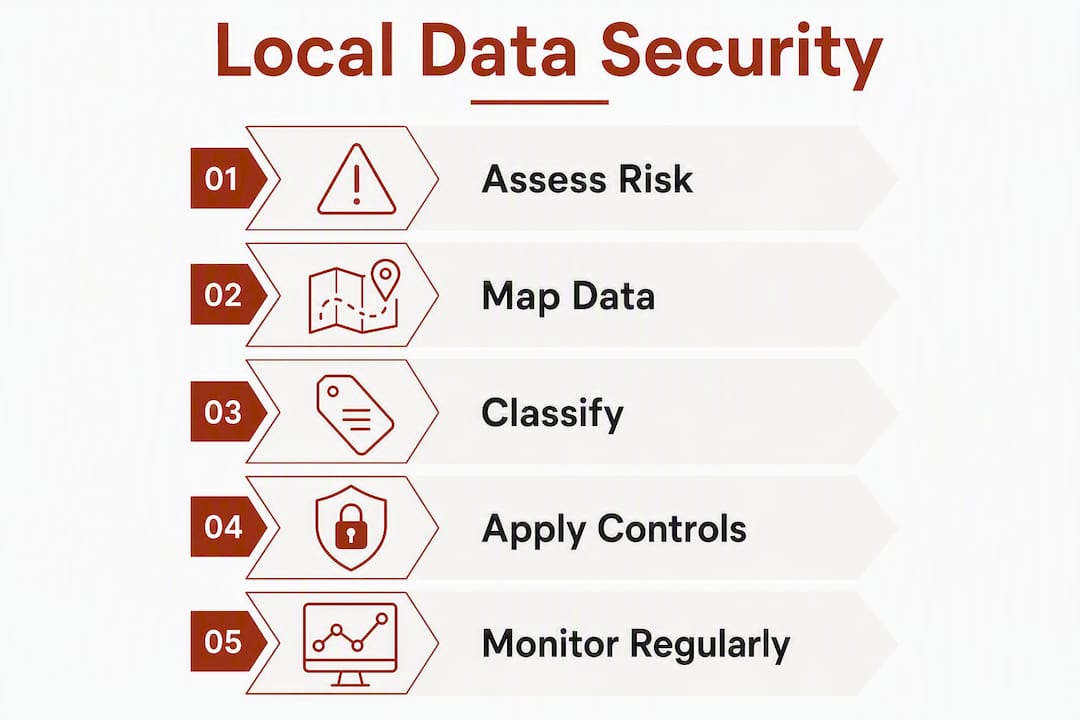
Start here: cyber-risk assessment, data mapping, and classification
A structured baseline assessment is the prerequisite for any sovereign deployment. Without it, organisations cannot determine which data must stay local, where it currently resides, or what controls are proportionate.
Running the baseline assessment:
- Define scope: include all business units, IT systems, physical storage, and third-party processors.
- Identify stakeholders: executive sponsor, IT lead, legal counsel, and department heads.
- Catalogue assets: servers, endpoints, cloud tenancies, paper records, and removable media.
- Score criticality: likelihood of breach multiplied by impact severity for each asset category.
- Map data flows: trace every data movement, including third-party API calls and backup destinations.
The FTC recommends inventorying all locations where sensitive data is stored, both digital and physical, and minimising retention wherever possible.
| Sensitivity tier | Data types | Retention rule | Required controls |
|---|---|---|---|
| Critical | PHI, financial records, authentication credentials | Minimum necessary; defined deletion schedule | AES-256 encryption, MFA, RBAC, air-gap or restricted network |
| Confidential | Employee PII, contracts, IP | Retention per legal obligation | Encryption at rest and in transit, RBAC, audit logging |
| Internal | Operational data, internal communications | Business need | Access controls, standard patching |
| Public | Marketing materials, published reports | Indefinite | Integrity checks |
Technical design: core engineering controls for locally stored sensitive data
The architecture choice determines how much sovereignty an organisation actually achieves. On-premises deployment with restricted network access offers the highest control level; air-gapped environments are appropriate for the most sensitive inference and document-processing workloads. Sovereign cloud hosted by a local provider offers a managed middle ground. Hybrid topologies retain critical data locally while allowing less sensitive workloads to use managed services.
Core technical controls:
- Encryption at rest: AES-256 across all storage volumes, with keys held in a separate hardware security module (HSM) or local vault, never co-located with the encrypted data.
- Encryption in transit: TLS 1.3 enforced on all internal and external connections; legacy protocol versions disabled.
- Key management: key custody on local HSMs prevents a cloud provider or foreign authority from accessing encrypted data even if storage media is seized.
- Phishing-resistant MFA: hardware tokens or FIDO2 passkeys for all privileged accounts.
- Network segmentation: sensitive systems on isolated VLANs with deny-by-default firewall rules.
- Host hardening: disable unused services, enforce configuration baselines, and apply Centre for Internet Security (CIS) benchmarks.
- Immutable audit logs: write-once logging infrastructure that cannot be altered or deleted by any standard user account.
- Patch management: automated scanning and deployment with a defined remediation SLA by severity.
Key custody is the decisive control in sovereign infrastructure. Encrypting data is necessary but insufficient if the keys are held by a foreign cloud provider. Keeping keys on a local HSM means that even a compelled disclosure order served on a foreign vendor cannot yield readable data. Organisations should require written confirmation of key custody arrangements in every vendor contract, and verify this through independent penetration testing and audit.
Backups must be treated as part of the hardened perimeter. Encrypted physical media or isolated-network backup destinations that never cross a public internet link are the only configurations that avoid reintroducing cross-border jurisdictional risk. Project Knox's air-gapped enterprise model demonstrates that fully local, no-external-API inference is technically feasible for organisations with the highest sensitivity requirements.
Pro Tip: Schedule regular automated integrity checks on backup sets. A backup that has never been tested for restoration is not a backup; it is an untested assumption.

Policies, people, and processes to keep local systems secure
Technical controls fail without the organisational layer. Human error, including phishing susceptibility, weak passwords, and excessive privilege, is the leading breach vector for organisations of all sizes.
- Access control policy: document least-privilege provisioning rules, privileged access management procedures, and a formal joiner-mover-leaver process.
- Secure disposal and retention policy: define retention periods by data class and mandate certified destruction for hardware and media.
- Staff security programme: mandatory onboarding security training; quarterly phishing simulations with documented results; role-specific training for IT, finance, and clinical staff.
- Third-party access management: vet all subprocessors against residency requirements; require contractual residency clauses; limit remote access to time-bound, supervised sessions.
- Incident response plan: documented, tested, and version-controlled; includes breach notification timelines aligned with DPA 2020 obligations.
- Maintain training records and phishing simulation results as audit evidence.
- Review third-party subprocessor lists at least annually and after any vendor change.
- Conduct tabletop incident response exercises at least once per year.
Pro Tip: The FTC's guidance on the 'human perimeter' is direct: remove unnecessary admin rights and apply technical controls that prevent staff from bypassing security policies. Privilege creep, where users accumulate rights over time without review, is one of the most common audit findings.
Deployment choices and how a purpose-built sovereign stack helps
| Deployment model | Control level | Operational overhead | Typical sectors |
|---|---|---|---|
| On-premises (owned hardware) | Highest | High | Finance, healthcare, public sector |
| On-premises (leased hardware) | Highest | Medium | SMEs, NGOs, education |
| Colocation (local data centre) | High | Medium | BPO, tourism, mid-market |
| Sovereign cloud (local provider) | High | Low | All sectors |
| Hybrid (local critical + managed non-critical) | Medium-high | Medium | Tourism, agriculture |
Islandedgetech's sovereign stack addresses each deployment tier through three integrated products:
- EdgePod: a GECCO EdgePod physical compute and storage node deployed on the client's premises. It includes built-in battery backup, encrypted storage, mesh networking, and offline operation capability, making it appropriate for organisations that require the highest control level with managed maintenance.
- Ackee: the security layer providing authentication, encryption, access control, and continuous monitoring across the sovereign environment. Ackee enforces the RBAC and audit-logging requirements described in the technical controls section.
- Abeng Work Suite: a locally hosted productivity suite covering documents, spreadsheets, storage, email, calendar, and video conferencing. It replaces foreign cloud productivity tools and eliminates the cross-border data flows they introduce.
Pro Tip: When evaluating colocation versus managed sovereign cloud, the deciding factor is usually operational capacity, not cost. If the organisation cannot staff a 24/7 on-call rota for infrastructure incidents, a managed sovereign cloud with a documented SLA is the lower-risk choice.
Typical cost drivers and a realistic deployment timeline
Cost factors to budget for:
- Hardware procurement or lease payments (EdgePod or equivalent)
- Physical installation, cabling, and rack provisioning
- Connectivity: dedicated or redundant local links
- Licensing: per-user SaaS subscriptions (Abeng) and security layer (Ackee)
- Staff training and phishing simulation programmes
- External penetration testing and compliance audits
- Skilled labour: security engineer and IT lead time during deployment and ongoing operations
| Phase | Duration | Key milestones | Gating criteria |
|---|---|---|---|
| Pilot | 30 days | Data mapping complete; EdgePod set up; Ackee configured; pilot users onboarded | Penetration test passed; audit log verified; MFA enforced |
| Expanded pilot | a few months | Full department migrated; backup restoration tested; staff training complete | Compliance checklist signed off; incident response plan tested |
| Production | several months | All sensitive data migrated; foreign backups decommissioned; external audit complete | Independent audit report; DPA 2020 compliance sign-off |
Lease-to-own and subscription financing models reduce upfront capital expenditure. Common hidden costs include skilled labour during migration, compliance audit fees, and the time required to renegotiate third-party contracts to include residency clauses. Organisations that achieve data sovereignty through local infrastructure consistently report that audit and legal costs are lower than anticipated when the deployment is planned systematically from the outset.
A vendor evaluation checklist and contract questions to ask
Questions to put to any sovereign infrastructure provider:
- Where, precisely, is data stored and processed? Provide a written data residency guarantee.
- Who holds encryption keys, and under what legal jurisdiction?
- What independent penetration testing has been conducted, and can you share the report?
- What certifications does the infrastructure hold, and are they current?
- What is the incident response SLA, and how is breach notification handled?
- Where are backup copies stored, and do they ever traverse a public internet link?
- Who are your subprocessors, and are they all subject to Jamaican law?
Contract clauses to require:
- Explicit data residency clause naming Jamaica as the sole processing jurisdiction.
- No-export assurance: prohibition on transferring data to foreign jurisdictions without written consent.
- Key custody confirmation: keys held on local HSMs under client or local-provider control.
- Breach notification timeline: notification to the data controller within 72 hours of discovery.
- Audit rights: client's right to commission independent audits with reasonable notice.
- Termination and data return: clear process for data retrieval and certified deletion on contract end.
Red flags:
- Opaque or evasive answers on key custody arrangements.
- No independent penetration test report available.
- Backup locations described as "cloud" without specifying jurisdiction.
- Subprocessor list unavailable or includes foreign entities without residency controls.
- No documented incident response plan or untested air-gap claims.
Pro Tip: Require the vendor to name their subprocessors in the contract, not merely confirm they exist. A data jurisdiction guide for Jamaican organisations explains why subprocessor transparency is a legal obligation, not a commercial courtesy.
A practical 30/90/180-day implementation roadmap
- Days 1–30 (Discovery and pilot): Complete data inventory and classification; identify pilot scope (one department or data class); procure and deploy EdgePod; configure Ackee authentication and RBAC; onboard pilot users to Abeng; conduct penetration test; verify audit logging.
- Days 31–90 (Expanded pilot): Migrate full department; test backup restoration; complete staff security training for all pilot users; conduct tabletop incident response exercise; obtain compliance checklist sign-off from legal and IT leads.
- Days 91–180 (Production): Migrate all sensitive data to local infrastructure; decommission foreign cloud backups; complete external compliance audit; obtain DPA 2020 sign-off; establish recurring audit and training schedule.
| Responsibility | Executive sponsor | IT lead | Security engineer | Procurement | Legal | Vendor |
|---|---|---|---|---|---|---|
| Data inventory | Approve | Lead | Support | — | Review | — |
| Pilot deployment | Approve | Lead | Lead | Procure | — | Deliver |
| Penetration test | Approve | Coordinate | Review | — | — | Support |
| Compliance audit | Approve | Support | Support | — | Lead | Support |
| Production sign-off | Sign | Confirm | Confirm | — | Confirm | — |
Gating criteria between phases: penetration test passed; MFA enforced on all accounts; audit log integrity verified; incident response plan documented and tested; legal sign-off on residency clauses.
Sector notes: additional requirements for healthcare, finance, public sector, and tourism
Healthcare: PHI must be handled under strict access controls with role separation between clinical and administrative staff. Audit logs must be retained for the period specified under applicable health regulations. Healthcare data sovereignty requires particular attention to third-party medical device integrations, which can introduce uncontrolled data flows if not explicitly scoped in vendor contracts.
Finance: Transaction logs must be immutable and retained for regulatory reporting periods. Key custody requirements are stricter: hardware security modules are the minimum standard. Regulatory reporting expectations mean that audit trails must be exportable in a format acceptable to the relevant authority without compromising the integrity of the local environment.
Public sector: Business continuity and disaster recovery planning must account for extended outages. Data subject access requests must be fulfilled within statutory timeframes, requiring a documented and tested process. Provenance records for all personal data must be maintained.
Tourism: Data sovereignty for Jamaican resorts addresses the specific challenge of guest data collected across multiple touchpoints. Continuity planning is critical given the sector's dependence on booking and payment systems. Customer data provenance must be documented to support data subject rights requests from international visitors whose home jurisdictions may impose additional obligations.
This article provides general information on data protection and sovereign infrastructure practices. It does not constitute legal or professional advice. Decision makers should confirm current obligations under Jamaica's Data Protection Act 2020 and any applicable sector regulations with qualified legal counsel.
Key takeaways
Organisations that store and process sensitive data on sovereign local infrastructure, paired with defence-in-depth technical and operational controls, achieve the strongest defensible position under Jamaica's Data Protection Act 2020.
| Point | Details |
|---|---|
| Sovereign infrastructure is a legal position | Local storage eliminates cross-border transfer risk and supports verifiable DPA 2020 compliance. |
| Data minimisation reduces risk fastest | Collecting and retaining only what is necessary lowers storage, compliance, and remediation costs before any new tooling is deployed. |
| Key custody is the decisive control | Encryption is insufficient if keys are held by a foreign provider; local HSM custody is the minimum standard for sensitive data. |
| The 30/90/180 roadmap structures procurement | Pilot at 30 days, expanded deployment at 90, full production with external audit at 180 days. |
| Islandedgetech provides a complete sovereign stack | EdgePod, Ackee, and Abeng together address infrastructure, security, and productivity within a single locally governed deployment. |
The case for sovereign infrastructure: a perspective
The organisations that delay sovereign infrastructure deployments typically do so for one of two reasons: they believe the risk is theoretical, or they assume the cost is prohibitive. Both assumptions are wrong, and the consequences of acting on them are increasingly visible.
The legal exposure created by foreign cloud dependency is not theoretical. It is structural. A data controller that stores personal data with a foreign provider has, by definition, created a cross-border transfer, regardless of where the physical servers are located. The contractual protections available to remedy that exposure are limited and, in some jurisdictions, unenforceable against a government access order. Sovereign local infrastructure does not merely reduce that risk; it eliminates the structural condition that creates it.
The cost argument is similarly misplaced. Subscription and lease-to-own models have made local infrastructure accessible at a per-user cost that is directly comparable to foreign cloud alternatives, without the compliance liability those alternatives carry. The hidden cost of a breach, including notification, remediation, regulatory scrutiny, and reputational damage, consistently exceeds the cost of prevention by a substantial margin.
The organisations that move first on sovereign infrastructure also tend to find that it becomes a competitive differentiator, particularly in healthcare, finance, and public sector procurement, where data residency is increasingly a qualification criterion rather than a preference.
Islandedgetech's sovereign infrastructure: request a pilot
Islandedgetech delivers sovereign data infrastructure that keeps Jamaican organisations' most sensitive data on local soil, under Jamaican law, with no exposure to foreign jurisdictional access. The EdgePod provides on-premises compute and encrypted storage with built-in battery backup and offline operation. Ackee enforces authentication, access control, and continuous monitoring across the environment. The Abeng Work Suite replaces foreign cloud productivity tools with locally hosted documents, email, calendar, and video conferencing, eliminating the cross-border data flows those tools introduce.
Pricing operates on a subscription or lease-to-own basis, with tiered packages by capacity and sector. A one-time deployment and configuration fee covers installation and onboarding. To request a pilot, obtain pricing, or commission a baseline assessment, visit Islandedgetech's sovereign cloud page and submit a pilot request directly.
Useful sources and further reading
Primary regulatory and technical references:
- CISA: Secure your business: multi-layered defence-in-depth guidance and staff training requirements.
- FTC: Protecting personal information: data inventory, minimisation, and retention best practice.
- DLA Piper: Data protection laws of the world: cross-border transfer obligations and residency requirements by jurisdiction.
- FCC: Cybersecurity for small businesses: practical controls including MFA, encryption, and network security.
- World Bank ID4D: Data protection and privacy laws: international standards on security, breach notification, and data controller accountability.
Islandedgetech sector and technical guides:
| Resource | Relevant sections |
|---|---|
| Data residency explained | Legal alignment, procurement |
| Healthcare data sovereignty | Sector controls, PHI handling |
| Data residency risks for Jamaica | Jurisdictional risk, vendor evaluation |
| Data sovereignty for Jamaican resorts | Tourism sector, continuity planning |
| Role of data compliance in business | Governance, audit programmes |